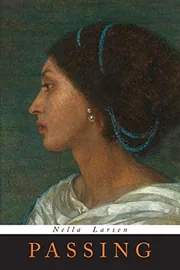
Passing
by Nella Larsen, Matthew Hodgson · 1929
Best suited to mature teens and adults, and it is a common choice for school and college study.
179 pages, about 3 to 4 hours.
A short, sharp novel about friendship, identity, and a secret in Harlem. 65% taste match
The story
Passing is a novel by Nella Larsen, first published in 1929. It belongs to the Harlem Renaissance and is set mainly in Harlem, in New York City, during the 1920s. The book looks at racial passing, the practice of living as a white person while being Black, and at questions of identity, skin color, and race relations in America.
The story follows Irene Redfield, a married woman living in a comfortable Harlem town house with her husband Brian, a physician, and their sons. Her days are filled with charity work and a settled sense of respectability. Her life is unsettled when she meets Clare Kendry, a childhood friend she has not seen in years. Clare has been passing as white, and her husband, John Bellew, does not know the truth. As the two women reconnect, each becomes increasingly drawn into the other's life, and the friendship between them sets off the events that lead to the novel's tragic course.
It was the last letter in Irene Redfield's little pile of morning mail.
Characters
Nella Larsen
Setting
New York (N.Y.)
Period
20th century
Themes
Passing (Identity)African American womenHuman skin colorFemale friendshipMarried womenRacially mixed peopleIdentity (Psychology)Criticism and interpretation
- Want to read 519
- Reading now 32
- Read 27
Most people shelving it are saving it for later.
Of 578 readers who put it on a shelf, 90% want to read it, 6% are reading it now, 5% have finished it and 0% stopped before the end.
By the numbers
- The median edition runs 179 pages. Counting about 275 words a page and an adult reading pace of 250 words a minute, that is about 3.3 hours of reading.
- Open Library tracks 74 editions from 53 publishers, the earliest dated 1929 and the latest 2025, across 2 languages.
- On reader demand it ranks in the top 4% of the classic books in our catalog (8,749 of them).
- Libraries shelve it under Dewey 813.52 and Library of Congress class PZ-0003.00000000.L33 Pas6.
 BookWard’s take
A short, sharp novel about friendship, identity, and a secret in Harlem
Passing runs only 179 pages, and Nella Larsen uses every one. The setup is spare: Irene Redfield, settled and respectable in Harlem, meets Clare Kendry, a childhood friend who has been living as white. Few novels are this tight, and none of it feels padded, which is a real pleasure. What stands out most is how original it still feels: a 1929 novel that treats identity and race with this much psychological nerve remains unfamiliar. Character depth is the real engine, since the whole book lives inside Irene's perceptions and its tension comes from what she will not say. The emotion stays restrained throughout, and the ending lands firmly, with no fog to wade through. It rewards a second read once you know where it goes.
At 179 pages it is lean and economical, which is exactly the kind of length BookWard favors.
The telling is controlled and unhurried in places, a touch slower than BookWard's taste for speed.
A story built on racial passing and a charged friendship between two women feels distinctive and unfamiliar, even now.
The prose is polished and evocative without being showy, somewhat richer than BookWard's plainer preference.
What happens flows from who Irene and Clare are and how they see each other, so character leads.
The book is shadowed by dread and loss, well below BookWard's more hopeful outlook.
The book follows a mostly conventional arc, told in a straightforward sequence of scenes.
The tone is serious and tense throughout, with little room for comedy.
The tone turns tragic and tense, with its darkness tied to the story's social stakes.
Feeling runs high beneath the surface, but it is expressed with restraint.
See all 50 dialsEvery position, side by side with this book
Where it lines up
- SentimentBookWard 8 · book 8
- Sagging middleBookWard 8 · book 8
- LengthBookWard 1 · book 2
Where it pulls apart
- OpeningBookWard 10 · book 7
- Familiar tropesBookWard 10 · book 8
- Internal logicBookWard 10 · book 8
At 179 pages it is lean and economical, which is exactly the kind of length BookWard favors.
It opens on a single letter in Irene's morning mail, an ordinary start that draws you in without any fanfare.
Its handling of race and identity is pointed and unfamiliar rather than the stock treatment, which BookWard prizes.
Characters act from consistent motives and the social pressures around them hold together, so the story's turns feel earned.
The telling is controlled and unhurried in places, a touch slower than BookWard's taste for speed.
A story built on racial passing and a charged friendship between two women feels distinctive and unfamiliar, even now.
Irene and Clare are drawn with real psychological complexity, and the book is largely a study of what each wants.
It builds toward a decisive close that settles the story, though what it means is still debated.
Larsen holds feeling at arm's length, letting the tension build quietly without leaning on easy emotion.
The darkness grows out of the situation and its stakes, not from effects added for impact.
This is a novel, so rigor as a nonfiction measure does not apply.
Larsen's controlled, watchful narration is her own, and it gives the book a clear and distinct personality.
It is driven by a story of two women, though the questions about identity and race give it real intellectual weight.
Ideas surface through scenes, conversations, and Irene's private doubts rather than being explained outright.
At this length there is little room to drift, and the tension builds steadily from scene to scene.
The prose is polished and evocative without being showy, somewhat richer than BookWard's plainer preference.
What happens flows from who Irene and Clare are and how they see each other, so character leads.
The book is shadowed by dread and loss, well below BookWard's more hopeful outlook.
The book follows a mostly conventional arc, told in a straightforward sequence of scenes.
The tone is serious and tense throughout, with little room for comedy.
It is short and readable, though its layered social and psychological themes ask for attention.
The story is seen through one central consciousness, Irene's, which keeps the focus tight.
Events unfold in a largely linear way across the years of the story.
It is firmly grounded in the real world of 1920s New York.
A small circle of characters carries the story, centered on two women and their husbands.
It stays intimate, working through a friendship, a marriage, and a household.
Much of the action is in Irene's perceptions, suspicions, and anxieties rather than external events.
Conversations carry a good share of the tension, often saying more through what is held back.
Marriage and desire matter, but the book's core is the friendship and the stakes of identity.
The Harlem of the 1920s will be unfamiliar to many readers, though its social dynamics are recognizable.
It is set in the 1920s, a past era, though its concerns still carry forward.
Its questions about identity, belonging, and self-presentation have kept it relevant for nearly a century.
Irene's view of events is colored by her fears and desires, so the reader is invited to read between the lines.
The book resists neat judgments, leaving ambiguity about motive, loyalty, and blame.
Setting and appearance are drawn with some care, though the book is not heavy on lush detail.
This is a novel, so nonfiction style does not apply.
This is a novel, so nonfiction perspective does not apply.
It stands on its own as a single complete novel.
The plot moves through some turns, but it is built more on mounting tension than on surprises.
It raises uncomfortable questions about race, identity, and belonging that do not resolve comfortably.
The tone turns tragic and tense, with its darkness tied to the story's social stakes.
Feeling runs high beneath the surface, but it is expressed with restraint.
Humor is scarce and, where it appears, tends toward the dry.
Violence is not a feature of the book until its tragic course, and it is not dwelt on.
Desire is implied rather than shown, and there is little explicit content.
Race, class, and identity are central to the story, though it works through character rather than argument.
The language is clear, though some period phrasing and social references take attention.
The narration is mostly measured, leaving judgments to emerge from what the characters do and notice.
The book looks back at a particular moment and at what its characters have left behind.
It is clear-eyed about prejudice and social pressure, with little faith that they can be escaped.
Review written by BookWard, dial version 1, November 2026.
Who is Passing right for?
Best suited to mature teens and adults, and it is a common choice for school and college study. It deals with racism, deception, and a tragic course of events, so readers may want to be ready for a serious tone.
It is short and readable, though its layered social and psychological themes ask for attention.
The tone turns tragic and tense, with its darkness tied to the story's social stakes.
Feeling runs high beneath the surface, but it is expressed with restraint.
Violence is not a feature of the book until its tragic course, and it is not dwelt on.
Book CompanionPassing: ideas, characters, themes
Passing follows two childhood friends in 1920s Harlem whose reunion exposes what each has traded away and what each still wants.
- A reunion that unsettles. Irene Redfield has a secure, respectable life in Harlem until she meets Clare Kendry again, and the meeting shakes her hold on that life.
- The meaning of passing. Clare has been living as a white woman, and her husband does not know the truth, which puts concealment at the center of the story.
- Two women, two choices. Irene and Clare have taken different paths, and the book measures each against the other.
- Fascination and unease. The two women grow increasingly drawn into each other's lives, and that pull carries the story's tension.
- A tragic course. The friendship sets off events that lead the novel toward its tragic course.
Characters
Irene Redfield
Protagonist
A married woman in Harlem whose comfortable life and standing are disturbed by an old friend's return.
Clare Kendry
Childhood friend
A light-skinned, charming woman who has been passing as white and keeps the truth from her husband.
Brian Redfield
Irene's husband
A prominent physician who shares the Harlem town house with Irene and their sons.
John Bellew
Clare's husband
Clare's husband, who does not know the truth about her.
Themes
Living as a member of a different race, and what that costs in secrecy and loss.
The tension between who a person is, who they appear to be, and who they wish to become.
The pull of community and the price of leaving it behind.
A bond that mixes affection, envy, and suspicion.
The pressure to maintain a settled, approved image of one's life.
Discussion questions
- Why might Irene feel so unsettled by Clare's return?
- What does Clare gain and lose by passing?
- How does the story's close Harlem setting shape what the characters can hide?
- Is Irene a reliable guide to what is happening between the two women?
- What does the novel suggest about the cost of respectability?
Personalize your Book Companion
This is the general edition. In BookWard, the Companion is written for you: your reading profile, your notes, and spoiler-safe to the page you are on.
Buy, listen or borrow Passing
Each link opens a search for this book on that store, in a new tab.
Read on a device
Borrow
Reviews and community
If you liked Passing
A kidnapping told twice, by captor and captive
Bartleby, the ScrivenerHerman MelvilleFive words, a lawyer's unease, and a office that cannot cope
The StrangerAlbert CamusA cold, short novella that still unsettles
Presumed InnocentScott TurowA prosecutor investigates a murder, then stands accused of it
Sources: Open Library.
Track Passing and find your next favorite
Add it to your shelf, rate what you have read, and BookWard will recommend what fits you.
Free to start. No credit card needed.