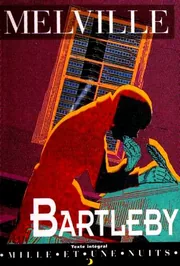
Bartleby, the Scrivener
by Herman Melville · 1853
Suits mature teens and adults, and is a common short classroom text.
70 pages, about 1 to 1.5 hours.
Five words, a lawyer's unease, and a office that cannot cope. 61% taste match
The story
Herman Melville's Bartleby, the Scrivener is a short story set among the law offices of Wall Street in New York. It first appeared anonymously in Putnam's Magazine, split across the November and December 1853 issues, and was gathered into The Piazza Tales in 1856 with minor changes to the text. The period is the decades before 1861, and the setting is the world of copyists, clerks and the securities trade.
The story is told by an elderly lawyer who takes on a new copyist named Bartleby. After an initial stretch of diligent work, Bartleby stops copying and declines every other task, answering each request with the words "I would prefer not to." The office also includes the colleagues Turkey, Nippers and Ginger Nut, and the narrator's reactions to his employee form the core of the tale. Some readers have connected the story to Melville's reading of Emerson and to Emerson's essay "The Transcendentalist." It runs to roughly 70 pages in the median edition, and it has been adapted for the screen twice, in 1970 with Paul Scofield and in 2001 with Crispin Glover.
Characters
BartlebyTurkeyNippersGinger Nut
Setting
New YorkWall Street
Themes
Young menCopyistsclassic literaturePsychologySecurities industryPresidents, united states, messagesWall streetPs2384 .b26 2004
- Want to read 68
- Reading now 4
- Read 50
Readers are split between finishing it and saving it for later.
Of 122 readers who put it on a shelf, 56% want to read it, 3% are reading it now, 41% have finished it and 0% stopped before the end.
By the numbers
- The median edition runs 70 pages. Counting about 275 words a page and an adult reading pace of 250 words a minute, that is about 75 minutes of reading.
- Open Library tracks 79 editions from 52 publishers, the earliest dated 1966 and the latest 2024, across 6 languages.
- On reader demand it ranks in the top 9% of the classic books in our catalog (8,749 of them).
- Libraries shelve it under Dewey 813.3 and Library of Congress class PS-2384.00000000.B26 2004.
 BookWard’s take
Five words, a lawyer's unease, and a office that cannot cope
Bartleby is about as short as a classic gets, and it earns that length. At roughly 70 pages, it is compact in a way I appreciate. The hook is immediate: a new copyist, a brief burst of diligent work, then the refusal that defines him. That single phrase, "I would prefer not to," gives the story its distinctive voice and its engine. It is driven by an idea more than by plot, closer to a parable than a thriller, and the narrator's responses carry the character depth. The ending is more open than I usually like, and the narrator's reliability is part of the puzzle. Still, the logic holds and nothing sags.
At about 70 pages it is compact and complete, exactly the tight shape BookWard favors.
Short scenes keep it moving, but the tone is measured and deliberate rather than brisk.
One repeated phrase turns an ordinary law office into something unsettling, which is the kind of invention BookWard prizes.
Nineteenth-century sentences are formal and measured without being showy, a little richer than BookWard's plain-leaning taste.
The tale turns on how the narrator responds to one man, so character slightly outweighs plot.
The tone leans toward isolation and futility, darker than BookWard's mildly hopeful outlook.
It is told straight through by one voice, conventional in form even though the content is strange.
There is dry comedy in the office oddities and the narrator's fretting, but the whole is serious.
The mood grows bleak and quietly distressing without graphic detail.
Feeling builds gently through the narrator's growing unease rather than through high drama.
See all 50 dialsEvery position, side by side with this book
Where it lines up
- LengthBookWard 1 · book 1
- OriginalityBookWard 9 · book 9
- Authorial voiceBookWard 9 · book 9
Where it pulls apart
- EndingBookWard 8 · book 3
- Story or ideasBookWard 3 · book 8
- Internal logicBookWard 10 · book 7
At about 70 pages it is compact and complete, exactly the tight shape BookWard favors.
The new clerk's turn from diligence to refusal arrives early and sets the story moving, though it builds a little more calmly than BookWard's top end.
A clerk who simply declines to work avoids the usual office-story tropes, which suits BookWard well.
The situation is a deliberate puzzle, so it runs on its own strange rules without ever fully explaining them, slightly looser than BookWard prefers.
Short scenes keep it moving, but the tone is measured and deliberate rather than brisk.
One repeated phrase turns an ordinary law office into something unsettling, which is the kind of invention BookWard prizes.
The lawyer is drawn through his own reactions, while Bartleby stays deliberately opaque, so depth is real but uneven.
The story leaves its central mystery unresolved by design, which sits further toward open than BookWard's taste.
Feeling is present but kept at arm's length by a dry, slightly self-justifying narrator.
Its unease comes from a quiet refusal rather than spectacle, which BookWard counts as earned.
Melville's lawyer-narrator has a precise, fussy, unmistakable manner that BookWard rates very highly.
The story exists to pose a question about work and refusal, so ideas lead more than events do, unlike BookWard's story-first lean.
Most meaning arrives through scenes and exchanges, which matches BookWard's preference for showing.
At this length there is no room to slump, and the tension holds from start to finish.
Nineteenth-century sentences are formal and measured without being showy, a little richer than BookWard's plain-leaning taste.
The tale turns on how the narrator responds to one man, so character slightly outweighs plot.
The tone leans toward isolation and futility, darker than BookWard's mildly hopeful outlook.
It is told straight through by one voice, conventional in form even though the content is strange.
There is dry comedy in the office oddities and the narrator's fretting, but the whole is serious.
The prose is period-formal and the meaning is deliberately slippery, so it asks a bit more than BookWard's average.
Everything is filtered through the lawyer alone, so this is a single-viewpoint story.
Events unfold in order as the narrator recounts them, with no jumps to track.
A Wall Street law office is entirely grounded, with no fantastical element.
Besides the narrator and Bartleby, the office holds only Turkey, Nippers and Ginger Nut, a small, tight cast.
The action stays inside a few rooms and one working relationship, very intimate.
The drama lives in the narrator's reactions and rationalizations more than in outward action.
The refusals are spoken aloud and short exchanges carry much of the tension, so dialogue plays a solid role.
There is no romantic thread to speak of.
A 1850s Wall Street copying office is somewhat unfamiliar to today's reader but easy to grasp.
Set in mid-nineteenth-century New York, firmly in the past.
The question of what a person owes to work has not aged, which BookWard rewards highly.
The lawyer tells it his own way and sometimes flatters himself, so he is not fully to be trusted.
The story refuses to say who is right, leaving the ethics of the situation deeply ambiguous.
Settings and figures are sketched economically rather than lavishly rendered.
A single self-contained story, later collected but not continued.
Its pull comes from a slow, strange escalation rather than from reversals.
It leaves a lingering discomfort and no easy answers, more unsettling than comforting.
The mood grows bleak and quietly distressing without graphic detail.
Feeling builds gently through the narrator's growing unease rather than through high drama.
Comic touches are dry and understated.
Nothing violent happens on the page.
There is no sexual content.
The setting touches on commerce and class, but politics is not the point.
Nineteenth-century diction and long sentences add some density but remain readable.
The narrator offers views freely, yet the story steers clear of pushing a message.
It looks at a fixed moment and mostly into the past.
The tone is more weary and doubtful than idealistic.
Review written by BookWard, dial version 1, November 2026.
Who is Bartleby, the Scrivener right for?
Suits mature teens and adults, and is a common short classroom text. It deals with isolation and despair but contains nothing graphic.
The prose is period-formal and the meaning is deliberately slippery, so it asks a bit more than BookWard's average.
The mood grows bleak and quietly distressing without graphic detail.
Feeling builds gently through the narrator's growing unease rather than through high drama.
Nothing violent happens on the page.
Book CompanionBartleby, the Scrivener: ideas, characters, themes
A lawyer's orderly world is thrown into confusion by a clerk who calmly declines to do what is asked.
- A tale of Wall Street. The story is set among the law offices and copyists of New York's financial district.
- The new copyist. A lawyer hires Bartleby, who works diligently at first before everything changes.
- The refusal. Bartleby answers every request with "I would prefer not to," which becomes all he says.
- The office around him. Turkey, Nippers and Ginger Nut make up the rest of the narrator's working world.
- How it appeared. It ran anonymously in two parts in Putnam's Magazine in 1853 and was reprinted in The Piazza Tales in 1856.
Characters
Bartleby
The new copyist
Works hard at first, then declines every task with a single repeated phrase.
The narrator
A Wall Street lawyer
Tells the story and tries to make sense of his employee's behavior.
Turkey
A fellow copyist
One of the narrator's established clerks in the office.
Nippers
A fellow copyist
Another established clerk working under the same roof.
Ginger Nut
The office boy
The youngest member of the narrator's staff.
Themes
What happens to a workplace when one person simply will not comply.
The distance between people who share a space but not an understanding.
How far an employer owes care to someone who gives nothing back.
Defiance expressed through declining rather than fighting.
Discussion questions
- Why does Bartleby's phrase unsettle the narrator more than an outright argument would?
- How much should we trust the lawyer's account of himself?
- What do the other clerks reveal about the office Bartleby disrupts?
- Is the story about one man or about the system of work around him?
- Why might Melville have chosen to publish it anonymously?
Personalize your Book Companion
This is the general edition. In BookWard, the Companion is written for you: your reading profile, your notes, and spoiler-safe to the page you are on.
Buy, listen or borrow Bartleby, the Scrivener
Each link opens a search for this book on that store, in a new tab.
Read on a device
Borrow
Reviews and community
If you liked Bartleby, the Scrivener
A short, sharp novel about friendship, identity, and a secret in Harlem
The StrangerAlbert CamusA cold, short novella that still unsettles
Uno, nessuno e centomilaLuigi PirandelloOne man unravels his own identity, one nose-tilt at a time
Down and Out in Paris and LondonGeorge OrwellOrwell's first book, and a clear-eyed look at poverty
Sources: Open Library.
Track Bartleby, the Scrivener and find your next favorite
Add it to your shelf, rate what you have read, and BookWard will recommend what fits you.
Free to start. No credit card needed.