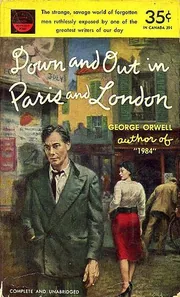
Down and Out in Paris and London
by George Orwell · 1933
Suited to mature teens and adults interested in social history and plain, observant writing.
224 pages, about 3.5 to 5 hours.
Orwell's first book, and a clear-eyed look at poverty. 60% taste match
What it covers
Down and Out in Paris and London, published in 1933, is George Orwell's first full-length work. It is a memoir in two parts about poverty in two cities, set in the 20th century. The writing draws on Orwell's own time among people with very little money, and it was aimed at middle- and upper-class readers who were unlikely to have seen such conditions firsthand.
The first part takes place in Paris, where Orwell lives in near-extreme poverty and takes casual work in restaurant kitchens, including a stint as a dishwasher at a hotel. The second part moves to London and the roads in and around it, following life from a tramp's point of view. It describes the hostels and doss houses where homeless men sleep, along with some of the people living on the margins of society. The book sits within history and politics, looking at social conditions and homelessness in France and Great Britain through the eyes of a writer who lived them. It runs to roughly 224 pages in a typical edition.
THE Rue du Coq d'Or, Paris, seven in the morning.
Characters
George Orwell
Setting
London (England)Paris (France)EnglandParisLondon
Period
20th century
Themes
PoorLiteratureHomelessnessSocial conditionsHistoryOrwell, george, 1903-1950Poor, francePoor, great britain
- Want to read 182
- Reading now 2
- Read 48
Most people shelving it are saving it for later.
Of 232 readers who put it on a shelf, 78% want to read it, 1% are reading it now, 21% have finished it and 0% stopped before the end.
By the numbers
- The median edition runs 224 pages. Counting about 275 words a page and an adult reading pace of 250 words a minute, that is about 4.1 hours of reading.
- Open Library tracks 120 editions from 73 publishers, the earliest dated 1933 and the latest 2025, across 7 languages.
- On reader demand it ranks in the top 5% of the classic books in our catalog (8,749 of them).
- Libraries shelve it under Dewey 362.509421 and Library of Congress class HV-4545.00000000.
 BookWard’s take
Orwell's first book, and a clear-eyed look at poverty
At 224 pages, this is a short, brisk book that never overstays its welcome. Orwell lived the life he describes, and that shows in the voice, which is distinctive, dry and unflinching. His rigor goes well beyond the anecdotal: he catalogues the kitchens, the doss houses and the tramp's routine with a reporter's care. He is also admirably restrained about sentiment, refusing to wring pity from squalor and letting detail do the work. The setting will be unfamiliar to most readers, a Paris restaurant basement and the roads around London, which gives it real freshness. The voice and the restraint are what I admire most, though the book is more personal and narrative than analytical.
At about 224 pages it is compact and focused, close to BookWard's preference for tight books.
Episodes move along steadily, though the tramping section has a more meandering rhythm.
A firsthand account from inside poverty, aimed at readers who had never seen it, was fresh and still reads that way.
The prose is clear and unadorned, a plain style that is far from ornate.
It follows a narrator's experience and the people he meets rather than a driving plot.
The outlook is mostly grim, with dry endurance rather than uplift.
Two parts, one per city, is a simple and conventional memoir arrangement.
Wry observations lighten it, but the subject keeps it mostly serious.
Squalor, hunger and exhaustion are central, though handled without melodrama.
The feeling is held under a cool, observant surface rather than displayed.
See all 50 dialsEvery position, side by side with this book
Where it lines up
- Authorial voiceBookWard 9 · book 9
- LengthBookWard 1 · book 2
- OriginalityBookWard 9 · book 8
Where it pulls apart
- OpeningBookWard 10 · book 7
- ExpositionBookWard 2 · book 6
- Familiar tropesBookWard 10 · book 8
At about 224 pages it is compact and focused, close to BookWard's preference for tight books.
It opens on a vivid Paris scene and holds attention steadily rather than seizing it at once.
It avoids the sentimental poverty narrative of its day, which BookWard values highly.
Its two-part structure and clear account of how casual labour and hostels work hold together well.
Episodes move along steadily, though the tramping section has a more meandering rhythm.
A firsthand account from inside poverty, aimed at readers who had never seen it, was fresh and still reads that way.
The people on the margins are sketched with sharp, memorable strokes rather than deep portraits.
It closes on observations about the life described more than a neat resolution, a little looser than BookWard prefers.
Orwell reports hardship plainly and resists easy pity, which suits BookWard's taste for restraint.
The squalor is documented to make a point, not to titillate, so the darkness is earned.
It is a memoir built on lived detail rather than statistics, rigorous in observation but not in data.
Orwell's plain, wry, direct voice is unmistakable even in his first full-length book.
It balances lived episodes with a larger argument about poverty, leaning slightly toward story.
He often explains how the kitchen or the doss house works outright, which runs against BookWard's lean toward showing.
The Paris and London halves each sustain interest, with only slight dips in the road sections.
The prose is clear and unadorned, a plain style that is far from ornate.
It follows a narrator's experience and the people he meets rather than a driving plot.
The outlook is mostly grim, with dry endurance rather than uplift.
Two parts, one per city, is a simple and conventional memoir arrangement.
Wry observations lighten it, but the subject keeps it mostly serious.
The writing is easy to follow, and the main effort is emotional, not intellectual.
Everything is seen through the author's single perspective.
It moves forward through his experiences without major time shifts.
It is entirely grounded in real conditions and real places.
A modest but varied set of kitchen workers, tramps and lodgers passes through.
It stays close to individual lives and rooms, though it speaks to wider social conditions.
It leans toward what he does and sees, with some reflection woven in.
Conversation appears regularly among the people he meets, balanced against narration.
Romance plays essentially no part in this account.
Restaurant kitchens, lodging houses and tramp routes are unfamiliar territory for most readers.
Set in the early 20th century, it is firmly a book of the past.
Its concerns about poverty and dignity still feel relevant to readers today.
The narrator reports from direct experience and reads as straightforward and reliable.
Orwell's sympathies are clear, though he complicates easy judgments about the poor.
Kitchens, hostels and streets are rendered in concrete, vivid detail.
It reads as lived narrative more than analysis, though it carries an argument.
It is a first-person memoir from someone who lived what he describes.
It stands entirely on its own.
It unfolds as a series of episodes rather than plot surprises.
It asks readers to look squarely at conditions many prefer to ignore.
Squalor, hunger and exhaustion are central, though handled without melodrama.
The feeling is held under a cool, observant surface rather than displayed.
Humor is dry and wry, not broad.
Physical violence is rare, with hardship coming from deprivation rather than brutality.
Sexual content is minimal.
It carries clear social concern, but as observation more than a political program.
The language is plain, with occasional period slang and French terms.
Orwell is willing to state his views directly alongside his reporting.
It documents a world of its time, looking back at lived experience.
It is unsentimental and clear-eyed about people and systems, closer to cynical than idealistic.
Review written by BookWard, dial version 1, November 2026.
Who is Down and Out in Paris and London right for?
Suited to mature teens and adults interested in social history and plain, observant writing. It contains descriptions of squalor, hunger and hardship that may be uncomfortable for some readers.
The writing is easy to follow, and the main effort is emotional, not intellectual.
Squalor, hunger and exhaustion are central, though handled without melodrama.
The feeling is held under a cool, observant surface rather than displayed.
Physical violence is rare, with hardship coming from deprivation rather than brutality.
Book CompanionDown and Out in Paris and London: ideas, characters, themes
Orwell, by living among the destitute in Paris and London, shows what poverty is actually like day to day and urges educated readers to see it.
- Memoir in two parts. The book is split between Paris and London, giving two views of poverty in two cities.
- Paris kitchens. The first part describes near-extreme poverty and casual work in restaurant kitchens, including a stint as a dishwasher.
- The tramp's road. The second part follows life on the road in and around London from a tramp's perspective.
- Hostels and doss houses. It describes the types of hostel accommodation available to homeless men.
- A middle-class audience. It was aimed at middle- and upper-class readers who were unlikely to have seen such conditions firsthand.
Characters
George Orwell
Narrator and author
He tells the story as someone who lived among the poor in both cities.
Themes
The daily reality of having almost nothing, shown through hunger, labour and shelter.
The hostels, doss houses and roads that make up life for people without homes.
How the structure of two prosperous cities leaves some people on the margins.
The value of an author who experienced hardship firsthand reporting it plainly.
Discussion questions
- Why might Orwell have aimed this book at middle- and upper-class readers?
- How does the Paris section differ in feel from the London section?
- What does the book gain from being a memoir rather than a reported study?
- Which details of life on the margins stayed with you most?
- How do the conditions described compare with homelessness and poverty today?
Personalize your Book Companion
This is the general edition. In BookWard, the Companion is written for you: your reading profile, your notes, and spoiler-safe to the page you are on.
Buy, listen or borrow Down and Out in Paris and London
Each link opens a search for this book on that store, in a new tab.
Read on a device
Borrow
Reviews and community
If you liked Down and Out in Paris and London
Jack London's candid, argumentative memoir of drink and his long struggle
Into Thin AirJon KrakauerA first-person Everest disaster account that grips from page one
Kitchen ConfidentialAnthony BourdainBourdain's unfiltered, funny tour through the back of the house
Burmese DaysGeorge OrwellOrwell's first novel: empire, rot, and one man's small cowardice
Sources: Open Library.
Track Down and Out in Paris and London and find your next favorite
Add it to your shelf, rate what you have read, and BookWard will recommend what fits you.
Free to start. No credit card needed.