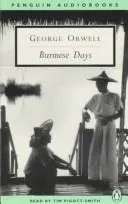
Burmese Days
by George Orwell · 1934
Suited to mature teens and adults, especially readers curious about empire and colonial history.
288 pages, about 4.5 to 6.5 hours.
Orwell's first novel: empire, rot, and one man's small cowardice. 66% taste match
The story
Burmese Days is a historical novel by George Orwell, first published in 1934. It was his first novel. The story takes place in the fictional district of Kyauktada in Upper Burma during the 1920s, in the last years of British imperial rule, when Burma was administered from Delhi as part of British India. The setting is a small colonial town with a mix of Burmese, Indian and British residents, and the social life of its European Club.
The cast includes U Po Kyin, a Burmese magistrate with ambitions of his own, and Dr. Veraswami, an Indian physician whose position depends on his friendship with John Flory, a European timber man. Their dealings are shaped by racism and class, and the book looks at corruption among local officials alongside the prejudice of the colonial community. Flory stands at its centre as an individual caught inside a system larger than himself. Readers interested in British fiction about empire, colonial society and life in the colonies will find it fits that tradition. The median edition runs about 288 pages.
U PO KYIN, Subdivisional Magistrate of Kyauktada, in Upper Burma, was sitting in his veranda.
Setting
AsiaBurmaGreat BritainGran BretañaIndia
Themes
ImperialismoImperialismColoniasSocial conditionsFicciónClassic LiteratureColoniesSuburban life
- Want to read 74
- Reading now 3
- Read 16
Most people shelving it are saving it for later.
Of 93 readers who put it on a shelf, 80% want to read it, 3% are reading it now, 17% have finished it and 0% stopped before the end.
By the numbers
- The median edition runs 288 pages. Counting about 275 words a page and an adult reading pace of 250 words a minute, that is about 5.3 hours of reading.
- Open Library tracks 125 editions from 58 publishers, the earliest dated 1934 and the latest 2024, across 7 languages.
- On reader demand it ranks in the top 13% of the classic books in our catalog (8,749 of them).
- Libraries shelve it under Dewey 823.912 and Library of Congress class PR-6029.00000000.R8 Bu11.
 BookWard’s take
Orwell's first novel: empire, rot, and one man's small cowardice
Burmese Days is short enough to read in a weekend and sharp enough to stay with you. Orwell sets it in a small Upper Burma town in the 1920s, and the book is strongest on character: Flory, U Po Kyin and Dr. Veraswami are drawn with real attention to what pressure does to people. Its moral picture is deliberately muddy, since corruption and prejudice run through every community it shows, and that restraint is to its credit, because the book never turns into a sermon. It is not sentimental, and the darkness is earned rather than decorative. The prose is plainer than ornate, and the setting will still feel unfamiliar to many readers. If you want a fast-hooking thriller, adjust your expectations, but if you want a clear-eyed portrait of empire, this delivers.
At 288 pages it is compact, and that economy matches BookWard's preference for tight books.
The pace is steady and observational rather than brisk, a little slower than BookWard's usual preference.
For its time it was an unflinching look at the dark side of the Raj, which BookWard values as fresh.
The prose is clear and direct with moments of vivid description, close to BookWard's slightly plain preference.
The drama turns on who these people are and what the community does to them, matching BookWard's lean to character.
The book is bleak about both colonial and local corruption, far gloomier than BookWard's mildly hopeful outlook.
It tells its story in a conventional, straightforward way, in step with BookWard's conventional leaning.
There is dry social satire but the book is mainly serious, a little less funny than BookWard's lean.
The cruelty and corruption make this a dark read, somewhat darker than BookWard's middle.
Feelings run strong beneath a controlled surface, close to BookWard's moderate lean.
See all 50 dialsEvery position, side by side with this book
Where it lines up
- Character depthBookWard 8 · book 8
- EndingBookWard 8 · book 8
- SentimentBookWard 8 · book 8
Where it pulls apart
- OpeningBookWard 10 · book 6
- Familiar tropesBookWard 10 · book 7
- Internal logicBookWard 10 · book 8
At 288 pages it is compact, and that economy matches BookWard's preference for tight books.
It opens by establishing its colonial town and cast rather than grabbing you at once, a slower start than BookWard likes.
It treats empire without the usual adventure-story gloss, so it avoids most tropes of colonial fiction, which BookWard rewards.
The schemes and social pressures follow cause and effect cleanly, which suits BookWard's taste for airtight plotting.
The pace is steady and observational rather than brisk, a little slower than BookWard's usual preference.
For its time it was an unflinching look at the dark side of the Raj, which BookWard values as fresh.
Flory, U Po Kyin and Dr. Veraswami are each shaped by the system around them, matching BookWard's love of deep characters.
The outcome for U Po Kyin and the club is settled rather than left hanging, which BookWard likes.
Orwell refuses comfort and sentiment, keeping the tone cool, which fits BookWard's restraint.
The bleakness comes from how people treat each other, not from gratuitous incident, so the darkness is earned.
This is a novel, so the nonfiction rigor dial does not apply.
Orwell's unmistakable, unsparing voice marks the book, a strong match for BookWard's taste for distinctiveness.
It carries a clear argument about empire but delivers it through a story, so it sits near the middle, a bit more idea-led than BookWard prefers.
Orwell mixes scene with plain commentary on colonial society, leaning slightly toward explaining, more than BookWard likes.
The social drama holds attention across its short length without a notable slump, in line with BookWard's taste.
The prose is clear and direct with moments of vivid description, close to BookWard's slightly plain preference.
The drama turns on who these people are and what the community does to them, matching BookWard's lean to character.
The book is bleak about both colonial and local corruption, far gloomier than BookWard's mildly hopeful outlook.
It tells its story in a conventional, straightforward way, in step with BookWard's conventional leaning.
There is dry social satire but the book is mainly serious, a little less funny than BookWard's lean.
The writing is accessible, though the themes ask for attention, which sits close to BookWard's comfort level.
The story moves among Burmese, Indian and British characters, giving a moderate range of viewpoints, close to BookWard's taste.
The story unfolds in a straight line through the district's events, a bit more linear than BookWard's middle position.
This is a grounded, realistic portrait of colonial life, more realist than BookWard's slightly open lean.
A small colonial town supplies a modest cast, close to BookWard's preference.
The focus stays on one district and its club, which is intimate and in line with BookWard.
It balances Flory's inner turmoil with the outward social action, near BookWard's slightly inward lean.
Club scenes and confrontations make for plenty of talk, comfortably matching BookWard's liking for dialogue.
Romance is part of Flory's story but not the whole book, close to BookWard's middle ground.
Colonial Upper Burma will feel unfamiliar to most readers, which BookWard enjoys.
It is set in the 1920s and published in 1934, so it belongs to the past, unlike BookWard's present-leaning taste.
Its portrait of prejudice and power still reads as relevant, which BookWard values.
The narration is a steady, trustworthy guide to the town, more reliable than BookWard's taste for unreliability.
No one is simply good or bad, so the moral picture is murky, which suits BookWard's liking for ambiguity.
Orwell draws the heat, town and club vividly, richer than BookWard's usual lean.
It is fiction, so the nonfiction style dial does not apply.
It is a novel, so the personal versus detached dial does not apply.
It stands alone, in line with BookWard's standalone lean.
The plotting turns on schemes and reversals, but it does not live on surprises, a little under BookWard's taste.
It confronts racism and imperial bigotry head-on, a challenge BookWard welcomes.
The cruelty and corruption make this a dark read, somewhat darker than BookWard's middle.
Feelings run strong beneath a controlled surface, close to BookWard's moderate lean.
Any humor is dry and sardonic, drier than BookWard's middle.
Social and psychological cruelty outweigh physical violence, a little below BookWard's middle.
Sex is not the focus, so the book sits below BookWard's middle.
Imperialism is the heart of the book, so politics is front and center, well above BookWard's middle.
The language is plain and readable, a touch below BookWard's middle.
Orwell's moral stance on empire is plain, making this opinionated, a bit more than BookWard's lean.
The book looks back at a fading empire rather than ahead, unlike BookWard's forward lean.
The book is cynical about power and human nature, well below BookWard's idealistic lean.
Review written by BookWard, dial version 1, November 2026.
Who is Burmese Days right for?
Suited to mature teens and adults, especially readers curious about empire and colonial history. It deals with racism and prejudice, including the attitudes of its colonial characters.
The writing is accessible, though the themes ask for attention, which sits close to BookWard's comfort level.
The cruelty and corruption make this a dark read, somewhat darker than BookWard's middle.
Feelings run strong beneath a controlled surface, close to BookWard's moderate lean.
Social and psychological cruelty outweigh physical violence, a little below BookWard's middle.
Book CompanionBurmese Days: ideas, characters, themes
Orwell shows how a colonial system corrupts everyone inside it, from the rulers to the ruled.
- A small town as a whole system. The district of Kyauktada, with its European Club, stands in for the larger workings of British rule in Burma.
- Corruption on both sides. The book looks at local official corruption alongside the bigotry of the colonial community.
- Friendship under pressure. Dr. Veraswami's standing depends on his friendship with John Flory, a European timber man.
- Race and class as engines of plot. Racism and classism drive the actions of the major characters.
- An individual inside something bigger. Flory is caught inside a system larger than himself, and the book keeps that tension at its centre.
Characters
John Flory
European timber man at the centre of the story
An individual caught inside a system larger than himself, and the one whose friendship protects Dr. Veraswami.
Dr. Veraswami
Indian physician
His position depends on his friendship with Flory.
U Po Kyin
Burmese magistrate with ambitions of his own
A magistrate whose schemes drive much of the plot.
Themes
How ruling over another people shapes both rulers and ruled.
The prejudice that organizes social life in the colonial town.
How rank and standing decide who is protected and who is not.
Self-serving scheming among local officials as well as colonials.
The loneliness of an individual trapped in a larger system.
Discussion questions
- Why does Orwell set the story in a single small district and its club?
- How does Flory's friendship with Dr. Veraswami shape what happens to each of them?
- In what ways do the Burmese, Indian and British characters each benefit from or suffer under the system?
- Does the book treat local corruption and imperial bigotry as equal failings?
- How does the story change your sense of what Flory is capable of?
Personalize your Book Companion
This is the general edition. In BookWard, the Companion is written for you: your reading profile, your notes, and spoiler-safe to the page you are on.
Buy, listen or borrow Burmese Days
Each link opens a search for this book on that store, in a new tab.
Read on a device
Borrow
Reviews and community
If you liked Burmese Days
Two ridges, two faiths, and one young man holding the line
The Power and the GloryGraham GreeneA hunted, drinking priest and the faith he cannot shed
The House of MirthEdith WhartonA glittering social tragedy that tightens around Lily Bart
The Last Days of HitlerH. R. Trevor-RoperA ten-day bunker investigation that reads like a thriller
Sources: Open Library.
Track Burmese Days and find your next favorite
Add it to your shelf, rate what you have read, and BookWard will recommend what fits you.
Free to start. No credit card needed.