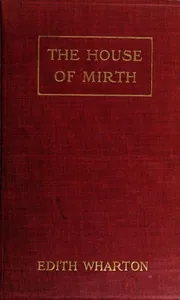
The House of Mirth
by Edith Wharton · 1905
It suits mature teens and adults who enjoy classic fiction and social drama.
348 pages, about 5.5 to 8 hours.
A glittering social tragedy that tightens around Lily Bart. 61% taste match
The story
The House of Mirth is a novel by Edith Wharton, first published in 1905. It is a work of historical fiction in the American tradition, set among the wealthy families of New York City in the 1890s. The central figure is Lily Bart, a young woman from a good family who has no money of her own and moves within the city's high society.
The story follows Lily over roughly two years as she tries to secure her position through marriage to a man of wealth and standing. When that does not come about, her circumstances change, and she moves from a life of privilege toward a more solitary one at the edges of the social world she knew. The book looks closely at single women, social class, status, manners and the values of the period, and it is often grouped with psychological fiction and classic literature. Wharton's portrait of the upper class has been read as a sharp critique of its habits and morals. The novel runs to about 348 pages in a typical edition.
SELDEN paused in surprise.
Characters
Lily Bart
Setting
New York (N.Y.)New York (State)New YorkUnited States
Period
1865-1918
Themes
Single womenSocial classesDramaSocial life and customsClassic LiteratureSocial statusSocial valuesRoman
- Want to read 165
- Reading now 9
- Read 31
Most people shelving it are saving it for later.
Of 205 readers who put it on a shelf, 80% want to read it, 4% are reading it now, 15% have finished it and 0% stopped before the end.
By the numbers
- The median edition runs 348 pages. Counting about 275 words a page and an adult reading pace of 250 words a minute, that is about 6.4 hours of reading.
- Open Library tracks 694 editions from 157 publishers, the earliest dated 1905 and the latest 2022, across 4 languages.
- On reader demand it ranks in the top 6% of the classic books in our catalog (8,749 of them).
- Libraries shelve it under Dewey 813.4 and Library of Congress class PZ-0003.00000000.W555 Ho.
 BookWard’s take
A glittering social tragedy that tightens around Lily Bart
Wharton's 1905 novel follows Lily Bart, well-born and penniless, through two years of New York high society in the 1890s. Her whole situation rests on one question: can she marry well enough to stay? That makes the logic airtight, since every choice has a social price. The book is strongest in its inner consistency and in the depth of its central character, and it earns its darkness rather than leaning on shock. The ending resolves firmly, which is exactly what this story needs. Where I part ways with it is in the voice and the prose. Wharton's irony is distinctive, but the writing is more ornate than I usually like. As for familiarity, the picture is mixed: the marriage plot is old, yet Wharton turns it into an attack on a corrupt class. At 348 pages it is not short, but it is sustained throughout.
At 348 pages it runs moderate, longer than BookWard's taste for the tight, though little of it is padding.
Events unfold over two years through scenes of social maneuvering, steady rather than fast, a little slower than BookWard likes.
The setting is well worn in the genre, yet its cold, ironic treatment of status feels sharp and unsentimental.
The sentences are polished and period-ornate, more elaborate than BookWard's mid-range preference.
Events matter because of who Lily is and what she will and won't do, so character drives the plot.
It traces a slide from privilege to isolation, and it offers little comfort, so it sits near the bleak end.
The structure is a conventional linear narrative, not experimental.
There is irony and social wit, but the book is serious at heart.
The darkness is social and emotional, with no graphic cruelty, so it sits at a moderate level.
The slow loss of Lily's place builds real feeling, though it is handled with control.
See all 50 dialsEvery position, side by side with this book
Where it lines up
- SentimentBookWard 8 · book 8
- Shock for effectBookWard 9 · book 9
- Authorial voiceBookWard 9 · book 9
Where it pulls apart
- OpeningBookWard 10 · book 6
- LengthBookWard 1 · book 4
- Familiar tropesBookWard 10 · book 7
At 348 pages it runs moderate, longer than BookWard's taste for the tight, though little of it is padding.
It opens on a social situation with a clear stake, but builds through drawing rooms rather than grabbing you at once.
The marriage plot is a familiar frame, but Wharton uses it to indict her class rather than to console.
Every turn follows from money, reputation and manners, so Lily's fall is driven by the world's own rules, which BookWard prizes.
Events unfold over two years through scenes of social maneuvering, steady rather than fast, a little slower than BookWard likes.
The setting is well worn in the genre, yet its cold, ironic treatment of status feels sharp and unsentimental.
Lily is drawn with real moral and psychological detail, which BookWard rewards.
It closes decisively on her fate rather than leaving it hanging, matching BookWard's taste for resolution.
Wharton refuses to console, treating Lily's descent with clear-eyed restraint rather than easy tears.
The darkness comes from social consequence and character choices, never from gratuitous shock.
This is a novel, so the nonfiction rigor dial does not apply.
Wharton's ironic, observing narration is unmistakable and carries the book.
It is firmly story-led, though the story exists to make an argument about class and values.
Much is conveyed through scene and social behavior, with the narrator stepping in to comment now and then.
The decline holds its tension across the book, each stage tightening the pressure on Lily.
The sentences are polished and period-ornate, more elaborate than BookWard's mid-range preference.
Events matter because of who Lily is and what she will and won't do, so character drives the plot.
It traces a slide from privilege to isolation, and it offers little comfort, so it sits near the bleak end.
The structure is a conventional linear narrative, not experimental.
There is irony and social wit, but the book is serious at heart.
The period manners and layered irony ask for attention, though the story itself is clear.
The book stays close to Lily, so the viewpoint is essentially singular.
It moves forward in time over roughly two years, with no shifting timeline.
It is a realistic portrait of New York society with nothing fantastical.
A web of society figures surrounds Lily, giving a moderately sized cast.
Its stakes are personal and social, centered on one woman's position rather than epic events.
It dwells on Lily's judgments and conscience, and on social pressure, more than on outward action.
Much of the drama plays out in drawing-room conversation, so talk carries a lot of weight.
Marriage and attachment drive the plot, though the book treats them as economic and moral questions.
Gilded Age New York high society is a specific world that will feel unfamiliar to many readers.
It is set in the 1890s and published in 1905, firmly in the past.
Its questions about status, money and a woman's options still feel pressing, so it has lasting power.
The narration is a reliable guide, though it carries a strong ironic slant.
Wharton judges the society sharply but leaves Lily's own choices open to debate.
Rooms, dress and social settings are drawn in rich detail.
This is fiction, so the nonfiction style dial does not apply.
This is fiction, so the nonfiction perspective dial does not apply.
It is a standalone novel.
Fortunes shift with social events, but the book is more inevitable than twisty.
It is an unsparing look at a class and its costs, and not a comforting read.
The darkness is social and emotional, with no graphic cruelty, so it sits at a moderate level.
The slow loss of Lily's place builds real feeling, though it is handled with control.
Any humor is dry, coming from irony and social observation.
There is essentially no violence on the page.
The book is reserved, with little sexual content.
It is more about class and social values than party politics, though it critiques a whole class.
The language is formal and period-bound but not dialect-heavy.
The narrator's judgments are plain and pointed, so the narration is opinionated.
It captures and judges a particular past society.
It takes a cynical view of the society it depicts, with little idealism.
Review written by BookWard, dial version 1, November 2026.
Who is The House of Mirth right for?
It suits mature teens and adults who enjoy classic fiction and social drama. It deals with financial ruin, loneliness and social cruelty, and its period language and pace can feel demanding.
The period manners and layered irony ask for attention, though the story itself is clear.
The darkness is social and emotional, with no graphic cruelty, so it sits at a moderate level.
The slow loss of Lily's place builds real feeling, though it is handled with control.
There is essentially no violence on the page.
Book CompanionThe House of Mirth: ideas, characters, themes
A woman raised for wealth but without money of her own is slowly pushed out of the society that shaped her.
- Lily's position. Lily Bart is well-born, intelligent and beautiful, but she has no fortune and must rely on marriage.
- A two-year descent. The novel traces her slow social decline over roughly two years, from privilege to the margins.
- Marriage as security. Her failure to secure a wealthy husband shapes everything that follows.
- Taste versus survival. Her taste and moral sensibility make her ill suited to survive in this world.
- A critique of a class. Wharton uses Lily to attack an irresponsible, grasping and morally corrupt upper class.
Characters
Lily Bart
Protagonist
A well-born but penniless young woman in New York high society of the 1890s, tied to luxury and caught between taste and survival.
Themes
How wealth and rank decide who belongs and who is cast out.
Marriage as an economic necessity for women of Lily's position.
The rules of behavior that sustain a social order.
How conscience and taste can become liabilities in a corrupt world.
The narrow options open to an unmarried woman of the period.
Discussion questions
- Is Lily a victim of her society, her own choices, or both?
- How does Wharton use marriage to expose the values of her class?
- What does the book suggest about the cost of taste and luxury?
- How does Wharton's ironic narration shape your sympathy for Lily?
- Does this portrait of status and money still feel relevant today?
Personalize your Book Companion
This is the general edition. In BookWard, the Companion is written for you: your reading profile, your notes, and spoiler-safe to the page you are on.
Buy, listen or borrow The House of Mirth
Each link opens a search for this book on that store, in a new tab.
Read on a device
Borrow
Reviews and community
If you liked The House of Mirth
A quiet drawing-room tragedy that cuts deeper than it first appears
Le rouge et le noirStendhalA provincial climber's ambition, studied with cold clarity across 518 pages
Burmese DaysGeorge OrwellOrwell's first novel: empire, rot, and one man's small cowardice
Presumed InnocentScott TurowA prosecutor investigates a murder, then stands accused of it
Sources: Open Library.
Track The House of Mirth and find your next favorite
Add it to your shelf, rate what you have read, and BookWard will recommend what fits you.
Free to start. No credit card needed.