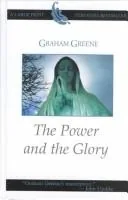
The Power and the Glory
by Graham Greene · 1940
Best suited to mature teens and adults comfortable with religious and moral themes.
254 pages, about 4 to 6 hours.
A hunted, drinking priest and the faith he cannot shed. 66% taste match
The story
The Power and the Glory is a novel by the British author Graham Greene, first published in 1940. It belongs to historical fiction and is often counted among the classics of British and Irish fiction, with elements of suspense. The book takes its title from the closing lines of the Lord's Prayer, and when it first appeared in the United States it was issued under the name The Labyrinthine Ways.
The story is set in Mexico in the early 1930s, a time when the Catholic Church was suppressed and clergy were persecuted. Its central figure is an unnamed priest who drinks heavily and carries a shameful past. He moves through the country carrying out the rites of the church among poor, landless peasants, pursued by a relentless police officer and wary of betrayal by the very people he tries to serve. His journey leaves him caught between oblivion and redemption. The novel looks at faith, clergy and Catholics under pressure, and at the ordinary social life of the people around them. Editions typically run to about 254 pages.
Setting
Mexico
Period
1930's
Themes
Anti-clericalismCatholic ChurchCatholicsClergyPersecutionSocial life and customsClassicsMulticultural
- Want to read 226
- Reading now 14
- Read 23
Most people shelving it are saving it for later.
Of 263 readers who put it on a shelf, 86% want to read it, 5% are reading it now, 9% have finished it and 0% stopped before the end.
By the numbers
- The median edition runs 254 pages. Counting about 275 words a page and an adult reading pace of 250 words a minute, that is about 4.7 hours of reading.
- Open Library tracks 130 editions from 74 publishers, the earliest dated 1940 and the latest 2018, across 9 languages.
- On reader demand it ranks in the top 6% of the classic books in our catalog (8,749 of them).
- Libraries shelve it under Dewey 823 and Library of Congress class PR-6013.00000000.R44 P6 1990.
 BookWard’s take
A hunted, drinking priest and the faith he cannot shed
Greene keeps this one short and tight at 254 pages, and the pursuit gives it a steady drive from the start. The unnamed priest at its center is a flawed man rather than a type, and that depth of character keeps the book clear of cliche: a whisky priest running from a remorseless police officer is not a figure you meet twice. The internal logic holds, since every choice follows from fear, shame or duty. Sentiment stays restrained, and the book earns its darkness through consequence rather than shock. The voice is distinct, spare and moral without preaching. Its moral picture is ambiguous by design: neither the priest nor his hunter is simply right or wrong.
At 254 pages it is compact and lean, which matches BookWard's love of tight books.
The chase keeps it moving, though Greene lingers over conscience, so it runs slightly slower than BookWard likes.
A flawed, unnamed priest in a persecuted church is a fresh angle on faith, well suited to BookWard.
The prose is clean and economical rather than ornate, with only occasional lyrical touches.
The chase supplies plot, but the book's real interest is the priest's conscience.
It is bleak in setting, with only a thin thread of grace running through it, cooler than BookWard's hopeful lean.
The story moves in a conventional line, a journey with a pursuer, much as BookWard likes.
It is grave in tone, with only rare dry irony.
Persecution, shame and fear give it real weight, a bit darker than BookWard's midpoint.
The feeling runs strong beneath a restrained surface, close to BookWard's range.
See all 50 dialsEvery position, side by side with this book
Where it lines up
- Shock for effectBookWard 9 · book 9
- Authorial voiceBookWard 9 · book 9
- LengthBookWard 1 · book 2
Where it pulls apart
- OpeningBookWard 10 · book 7
- Familiar tropesBookWard 10 · book 8
- Story or ideasBookWard 3 · book 6
At 254 pages it is compact and lean, which matches BookWard's love of tight books.
It opens on a hunted man in a place where his calling is a crime, which pulls you in quickly.
A drinking priest pursued across Mexico is an unusual premise and avoids stock figures, which BookWard values.
Each decision the priest makes follows from fear, shame or duty, so the story hangs together tightly.
The chase keeps it moving, though Greene lingers over conscience, so it runs slightly slower than BookWard likes.
A flawed, unnamed priest in a persecuted church is a fresh angle on faith, well suited to BookWard.
The priest is drawn with shame, fear and stubborn faith all at once, the depth BookWard prizes.
The central struggle reaches a clear conclusion, which fits BookWard's taste for resolution.
Greene refuses easy comfort or pity, keeping the tone unsentimental, as BookWard prefers.
Its bleakness comes from persecution and consequence, not from shocks added for effect, which BookWard respects.
Greene's spare, morally alert voice is unmistakable and a strong match for BookWard.
Faith and redemption matter, but they are carried through a hunt, so it stays story-led.
Greene mostly shows the world through scenes and encounters instead of explaining it, which suits BookWard.
The pursuit and the priest's inner struggle keep tension up through the middle with little drag.
The prose is clean and economical rather than ornate, with only occasional lyrical touches.
The chase supplies plot, but the book's real interest is the priest's conscience.
It is bleak in setting, with only a thin thread of grace running through it, cooler than BookWard's hopeful lean.
The story moves in a conventional line, a journey with a pursuer, much as BookWard likes.
It is grave in tone, with only rare dry irony.
The prose is accessible, but the moral weight asks for some attention, close to BookWard's comfort zone.
It leans on the priest but moves to other minds, including those around him.
The events follow one stretch of time in sequence, a touch more linear than BookWard's taste.
It is firmly grounded in the real politics of 1930s Mexico, a little more than BookWard's usual.
A handful of figures carry the story, in keeping with BookWard's middling preference.
It stays close to one man's flight, so it feels intimate despite its national backdrop.
Conscience and doubt drive the book more than its action, tilting inward.
Conversations between the priest and the people he meets carry much of the drama, matching BookWard's lean.
Love plays almost no role; faith and flight dominate.
Revolutionary-era Mexico with a banned church feels distant to most readers, which BookWard enjoys.
It is set in the 1930s and written in 1940, so it sits firmly in the past.
Questions of faith, guilt and mercy outlast its specific moment, which BookWard values.
The narration is plain and trustworthy, less slippery than BookWard's usual taste.
Neither priest nor police officer is easily judged, and the book resists simple verdicts, as BookWard likes.
Greene paints heat, poverty and decay with enough detail to anchor the story without overloading it.
It is a standalone novel.
Betrayal looms, but the book is more about dread than sudden reversals.
It confronts faith, failure and guilt without comfort, which BookWard welcomes.
Persecution, shame and fear give it real weight, a bit darker than BookWard's midpoint.
The feeling runs strong beneath a restrained surface, close to BookWard's range.
Any humor is dry and sparing, lighter on the broad end than BookWard's middle.
Persecution brings real danger and some brutality, though the book keeps much of it controlled.
Sexual content is limited and mostly part of the priest's past, below BookWard's midpoint.
The state's suppression of religion drives the plot, so politics is close to the foreground.
The language is plain and readable, easier than the dense end.
The narration observes with some moral edge but stays largely neutral.
The book looks back at a persecution already in motion, not toward the future.
Faith survives, but the book is skeptical of easy virtue, leaning cynical.
Review written by BookWard, dial version 1, November 2026.
Who is The Power and the Glory right for?
Best suited to mature teens and adults comfortable with religious and moral themes. It deals with persecution, alcoholism and danger, handled seriously rather than graphically.
The prose is accessible, but the moral weight asks for some attention, close to BookWard's comfort zone.
Persecution, shame and fear give it real weight, a bit darker than BookWard's midpoint.
The feeling runs strong beneath a restrained surface, close to BookWard's range.
Persecution brings real danger and some brutality, though the book keeps much of it controlled.
Book CompanionThe Power and the Glory: ideas, characters, themes
A hunted, drinking priest keeps performing the rites of a banned church while wrestling with his own failures.
- A banned church. The story is set in 1930s Mexico, where the Catholic Church was suppressed and clergy were persecuted.
- An unnamed priest. The central figure has no name in the story, an alcoholic carrying a shameful past.
- A relentless pursuer. A police officer hunts him, giving the book its engine of pursuit.
- Fear of betrayal. He is wary of being betrayed by the very people he tries to serve.
- Oblivion or redemption. His journey leaves him caught between escaping into nothing and finding some form of grace.
Characters
The priest
Protagonist
An unnamed, alcoholic Catholic priest with a shameful past who keeps serving poor peasants while on the run.
The police officer
Antagonist
A remorseless pursuer set on finding the priest.
Themes
What belief costs when practising it is a crime.
Whether a flawed man can still do real good.
How a state's suppression of religion shapes ordinary lives.
The risk of relying on people who may sell you out.
Discussion questions
- Why does Greene leave the priest unnamed?
- Is the priest's flawed character what makes his faith credible?
- How does the police officer mirror or oppose the priest?
- What does the book suggest about the gap between a person and the role they fill?
- Does the ending feel like redemption, and why?
Personalize your Book Companion
This is the general edition. In BookWard, the Companion is written for you: your reading profile, your notes, and spoiler-safe to the page you are on.
Buy, listen or borrow The Power and the Glory
Each link opens a search for this book on that store, in a new tab.
Read on a device
Borrow
Reviews and community
If you liked The Power and the Glory
Two ridges, two faiths, and one young man holding the line
Things Fall ApartChinua AchebeA compact, clear-eyed tragedy of a man and his clan
Petit paysGaël FayeA Burundian childhood breaks apart as history reaches the street
Burmese DaysGeorge OrwellOrwell's first novel: empire, rot, and one man's small cowardice
Sources: Open Library.
Track The Power and the Glory and find your next favorite
Add it to your shelf, rate what you have read, and BookWard will recommend what fits you.
Free to start. No credit card needed.