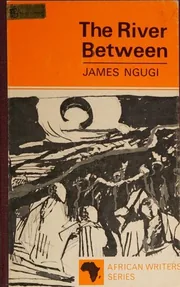
The river between
by Ngũgĩ wa Thiongʼo · 1965
Suits mature teens and adults, and is often read in school and university settings.
167 pages, about 2.5 to 4 hours.
Two ridges, two faiths, and one young man holding the line. 66% taste match
The story
The River Between is a historical novel by Ngũgĩ wa Thiongʼo, first published in 1965. It appeared as part of the Heinemann African Writers Series and runs to roughly 167 pages in its typical edition. The story is set in Kenya during the early decades of the twentieth century, a time when white settlement and Christian missionary activity were reaching the Gikuyu, also known as the Kikuyu people.
The action centres on two neighbouring ridges, Makuyu and Kameno, whose communities are divided over matters of faith. One side follows Joshua, a preacher of an intense form of Christianity, while the other holds to tribal customs and independence. Waiyaki, a young man descended from a line of prophets, tries to bring the two villages together. He sees education as the one thing that could link them, and the novel follows his efforts and the sacrifices they demand as the bitterness between the villages deepens. Religion, mission influence, and the survival of a people under pressure from outside forces are central to the book. It has appeared in more than two dozen editions.
Setting
Kenya
Themes
Kikuyu (African people)MissionsHistoryReligion
- Want to read 142
- Reading now 17
- Read 13
Most people shelving it are saving it for later.
Of 172 readers who put it on a shelf, 83% want to read it, 10% are reading it now, 8% have finished it and 0% stopped before the end.
By the numbers
- The median edition runs 167 pages. Counting about 275 words a page and an adult reading pace of 250 words a minute, that is about 3.1 hours of reading.
- Open Library tracks 26 editions from 10 publishers, the earliest dated 1965 and the latest 2017, across 4 languages.
- On reader demand it ranks in the top 9% of the classic books in our catalog (8,749 of them).
- Libraries shelve it under Dewey 823 and Library of Congress class PR-9381.90000000.N45R5 2015.
 BookWard’s take
Two ridges, two faiths, and one young man holding the line
Ngũgĩ's debut is a compact, controlled novel about a Gikuyu community splitting over mission Christianity and tribal custom. At 167 pages it never loosens its grip, and the brevity works in its favor. The structure is clean: two ridges, two camps, and Waiyaki trying to bridge them through education. That clarity makes the internal logic hold together, since every choice follows from the pressures on these communities. The prose is plain and rhythmic, closer to oral storytelling than ornament. The book favors restraint over shock, and it earns its sorrow from the situation itself rather than from spectacle. It feels strikingly original for its subject and vantage point in 1965. Readers wanting a fast, twisty plot may find it deliberate, but the pace stays steady and the momentum builds toward its conflict.
At 167 pages it says what it needs to and stops, which fits BookWard's love of the short and tight.
It moves steadily without rushing, slower than BookWard's taste for speed but never stalling.
A Gikuyu perspective on early colonial and mission change was a distinct, important voice in 1965 fiction.
The prose is clear and spare with a rhythmic, almost spoken quality rather than ornament.
Events are pushed by the conflict between communities and by Waiyaki's inner struggle in roughly equal measure.
The story leans toward tragedy and division, with hope held mostly in Waiyaki's aims.
It follows a conventional, linear arc built around two ridges and one conflict.
This is a serious book about a community under strain, with little room for comedy.
The tone is sombre and tragic, though it avoids gratuitous grimness.
Feeling runs deep beneath a restrained surface as the community fractures.
See all 50 dialsEvery position, side by side with this book
Where it lines up
- LengthBookWard 1 · book 1
- SentimentBookWard 8 · book 8
- Shock for effectBookWard 9 · book 9
Where it pulls apart
- OpeningBookWard 10 · book 6
- Familiar tropesBookWard 10 · book 7
- Story or ideasBookWard 3 · book 6
At 167 pages it says what it needs to and stops, which fits BookWard's love of the short and tight.
It opens on the landscape and the ridges rather than a jolt, so it builds into the story more than it grabs at once.
The clash of mission faith and custom could be a stock setup, but it is handled with specificity and restraint.
Each character's choices follow from the pressures of faith, custom and settlement, so the conflict feels earned and consistent.
It moves steadily without rushing, slower than BookWard's taste for speed but never stalling.
A Gikuyu perspective on early colonial and mission change was a distinct, important voice in 1965 fiction.
Waiyaki and the divided community are drawn with real weight, though some figures stand for positions as much as persons.
The novel drives toward a clear outcome to the central conflict rather than leaving it open.
The sorrow comes from the situation itself, told plainly, without melodrama or easy comfort.
Its darkness arises from history and belief colliding, not from cheap spectacle.
This is a novel, so the nonfiction rigor dial does not apply.
The telling has a distinct, almost oral cadence that feels like one author's own.
Ideas about faith, education and identity carry real weight, but they are dramatized through a story.
Customs and beliefs are partly explained to the reader, though much still comes through scene and conflict.
The short length and single central tension keep the momentum sustained from start to finish.
The prose is clear and spare with a rhythmic, almost spoken quality rather than ornament.
Events are pushed by the conflict between communities and by Waiyaki's inner struggle in roughly equal measure.
The story leans toward tragedy and division, with hope held mostly in Waiyaki's aims.
It follows a conventional, linear arc built around two ridges and one conflict.
This is a serious book about a community under strain, with little room for comedy.
The writing is accessible, though the cultural and religious stakes ask for some attention.
It follows Waiyaki closely while also showing both villages and their factions.
The story proceeds in a straightforward line through its early twentieth century setting.
It is grounded in historical Kenya, with belief and custom treated as part of lived reality.
A compact cast of leaders, families and neighbours keeps the focus manageable.
The scale is a pair of ridges, yet the stakes reflect a whole people's survival.
Waiyaki's inner conflict and the outward clash between factions share the stage evenly.
Conversation carries the debates over faith and custom without dominating the narration.
Personal ties matter, but the heart of the book is the communal divide.
For many readers the Gikuyu ridges and customs of this period will be an unfamiliar setting.
It is set in the early twentieth century, firmly in the past.
Questions of faith, identity and colonial pressure keep it resonant long after 1965.
The narration is straightforward and trustworthy, guiding the reader through events.
It refuses easy villains, showing real stakes and costs on every side of the divide.
The ridges, river and landscape are evoked with care and give the story its shape.
Fiction, so the nonfiction style dial does not apply.
Fiction, so the nonfiction perspective dial does not apply.
It stands alone as a complete novel.
The story follows a clear, foreseeable trajectory more than a string of surprises.
It asks hard questions about faith, loyalty and cultural survival with no comfortable answers.
The tone is sombre and tragic, though it avoids gratuitous grimness.
Feeling runs deep beneath a restrained surface as the community fractures.
There is little humor, and what exists is dry and understated.
Conflict is present but not graphically dwelt on.
Sexual content is minimal and not the focus.
Colonial settlement, mission influence and cultural survival sit at the center of the story.
The language is plain and readable, with some cultural terms as texture.
The narration observes with a clear moral sensibility but does not lecture.
It looks back at a formative period, mindful of what that history led to.
Waiyaki's hope for unity through education is idealistic, tested against hard realities.
Review written by BookWard, dial version 1, November 2026.
Who is The river between right for?
Suits mature teens and adults, and is often read in school and university settings. It deals with religious conflict, cultural loss and tragedy, handled seriously rather than graphically.
The writing is accessible, though the cultural and religious stakes ask for some attention.
The tone is sombre and tragic, though it avoids gratuitous grimness.
Feeling runs deep beneath a restrained surface as the community fractures.
Conflict is present but not graphically dwelt on.
Book CompanionThe river between: ideas, characters, themes
A young leader tries to unite two communities divided by faith, believing education is the one bridge between them.
- Two ridges, two camps. Makuyu and Kameno face each other across a river, split between mission Christianity and tribal custom.
- Waiyaki's mission. Descended from a line of prophets, he sees education as the link that could unify the people.
- Joshua's faith. One side follows Joshua and his intense brand of Christianity.
- Custom and independence. Others proudly hold to tribal ways and self-determination.
- The cost of unity. His plans demand sacrifice and raise issues that shape both his fate and the Gikuyu's survival.
Characters
Waiyaki
Young leader and visionary
Born to a line of prophets, he works to educate the tribe and bridge the divide.
Joshua
Preacher
A follower and promoter of a fiery form of Christianity on one of the ridges.
Themes
The pull between a new religion and inherited tradition.
Learning as a possible bridge between opposing groups.
How a community splits and what it takes to rejoin it.
Outside forces reshaping a people's life and survival.
What a would-be unifier must give up.
Discussion questions
- Why does Waiyaki believe education can unite the two ridges?
- How does the novel treat both Joshua's faith and tribal custom?
- What does the river itself come to represent?
- Is the division the fault of any one side?
- What does the book suggest about the cost of leading a divided people?
Personalize your Book Companion
This is the general edition. In BookWard, the Companion is written for you: your reading profile, your notes, and spoiler-safe to the page you are on.
Buy, listen or borrow The river between
Each link opens a search for this book on that store, in a new tab.
Read on a device
Borrow
Reviews and community
If you liked The river between
A hunted, drinking priest and the faith he cannot shed
Burmese DaysGeorge OrwellOrwell's first novel: empire, rot, and one man's small cowardice
Things Fall ApartChinua AchebeA compact, clear-eyed tragedy of a man and his clan
The CrucibleArthur MillerA tight, airtight play where fear turns neighbors into accusers
Sources: Open Library.
Track The river between and find your next favorite
Add it to your shelf, rate what you have read, and BookWard will recommend what fits you.
Free to start. No credit card needed.