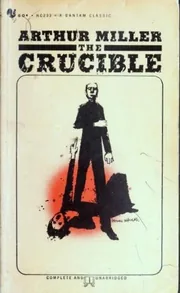
The Crucible
by Arthur Miller · 1953
It suits older teens and adults, and it is widely taught in schools.
151 pages, about 2.5 to 3.5 hours.
A tight, airtight play where fear turns neighbors into accusers. 68% taste match
What is inside
The Crucible is a stage play by Arthur Miller, first published in 1953. It dramatizes the witchcraft trials held in Salem, Massachusetts, in 1692, during the colonial period when the settlement belonged to the Massachusetts Bay Colony. Miller blends documented history with invention, so the work belongs to the tradition of historical drama as much as to the classics of American theater. He shaped it as an allegory for McCarthyism, the postwar era in which accusations of communism led the United States government to pursue its own citizens.
The action opens in an upper bedroom in the home of Reverend Samuel Parris. Among the figures who appear are Abigail Williams, Betty Parris, Tituba, Mary Warren, Mercy Lewis, Ann Putnam, Thomas Putnam, Susanna Walcott and John Proctor. Themes of accusation, guilt and martyrdom run through the courtroom drama. In a typical edition the text runs to about 151 pages, and it has appeared in 83 editions. It is also reprinted in several collections of Miller's plays and in anthologies of American literature, which makes it a common choice for classroom study.
A small upper bedroom in the home of Reverend Samuel Parris, Salem, Massachusetts, in the spring of the year 1692.
Characters
Samuel ParrisTitubaAbigail WilliamsSusanna WalcottAnn PutnamThomas Putnam
Setting
AndoverEnglandSalem (Mass.)SalemMassachusetts
Period
Colonial period, ca. 1600-17751692
Themes
literary criticismwitchcraft trialstrialsHistorical dramaTrials (Witchcraft)WitchcraftDramamartyrs
- Want to read 614
- Reading now 38
- Read 146
Most people shelving it are saving it for later.
Of 798 readers who put it on a shelf, 77% want to read it, 5% are reading it now, 18% have finished it and 0% stopped before the end.
By the numbers
- The median edition runs 151 pages. Counting about 275 words a page and an adult reading pace of 250 words a minute, that is about 2.8 hours of reading.
- Open Library tracks 83 editions from 48 publishers, the earliest dated 1953 and the latest 2019, across 4 languages.
- On reader demand it ranks in the top 1% of the classic books in our catalog (8,749 of them).
- Libraries shelve it under Dewey 812.52 and Library of Congress class PS-3525.00000000.I5156C7 1995.
 BookWard’s take
A tight, airtight play where fear turns neighbors into accusers
Miller's play runs just 151 pages, and it rewards readers who like their drama tight and quick. It is also airtight in its logic: each accusation sets off the next with a grim inevitability, so the whole thing feels less like a series of events than a trap closing. The opening grabs you at once. The action begins in an upper bedroom in the home of Reverend Samuel Parris, with the trouble already underway. Character work is solid for a stage piece, with John Proctor and Abigail Williams driving the drama, though the play leans on stated themes and makes its argument about accusation and guilt openly and urgently rather than quietly. That openness is by design, since Miller built it as an allegory for McCarthyism, and the politics are never hidden. It is a play to read in one sitting.
At about 151 pages it is compact, which suits BookWard's taste for tight, short books.
Scenes build quickly toward the courtroom, a brisk drive that fits BookWard's fast-pace taste.
Setting a McCarthy-era allegory inside the 1692 trials was a fresh move, though the history itself is well known.
The language is plain, formal and period-flavored rather than ornate.
Plot pressure and character choices drive it about equally, since Proctor's fate is the plot.
The play is grim, with accusation and martyrdom running through it, leaving little room for hope.
It follows a conventional stage form of acts and scenes, tidier than BookWard's average.
The tone is stern throughout, with almost no humor.
Trials, martyrdom and persecution give the content a dark, serious edge.
The stakes and the final decisions land with real intensity.
See all 50 dialsEvery position, side by side with this book
Where it lines up
- LengthBookWard 1 · book 1
- PaceBookWard 8 · book 8
- EndingBookWard 8 · book 8
Where it pulls apart
- Familiar tropesBookWard 10 · book 7
- ExpositionBookWard 2 · book 6
- Story or ideasBookWard 3 · book 6
At about 151 pages it is compact, which suits BookWard's taste for tight, short books.
The play opens in a bedroom already charged with trouble, so it grips almost at once, as BookWard likes.
The witch-trial setting is familiar ground, but the accusation-and-guilt drama avoids easy beats, close to BookWard's liking.
Each accusation follows from the last with tight cause and effect, matching BookWard's wish for airtight plotting.
Scenes build quickly toward the courtroom, a brisk drive that fits BookWard's fast-pace taste.
Setting a McCarthy-era allegory inside the 1692 trials was a fresh move, though the history itself is well known.
Proctor and Abigail Williams are drawn with real conflict, though a stage play paints in broader strokes than a novel.
The drama moves to a firm, decisive close, in line with BookWard's preference for resolution.
The play stays stern and avoids easy tears, though its moral appeals can run warm.
The darkness comes from the logic of the accusations, not from shock for its own sake, which BookWard values.
Miller's austere, urgent stage language is unmistakably his own, which BookWard prizes.
It is driven by a strong story, yet its argument about accusation and guilt is never far from the surface.
A good deal is stated outright in speeches, more explained than BookWard usually favors.
The tension holds from the opening bedroom to the courtroom without slackening, as BookWard wants.
The language is plain, formal and period-flavored rather than ornate.
Plot pressure and character choices drive it about equally, since Proctor's fate is the plot.
The play is grim, with accusation and martyrdom running through it, leaving little room for hope.
It follows a conventional stage form of acts and scenes, tidier than BookWard's average.
The tone is stern throughout, with almost no humor.
The period diction asks some effort but the action is easy to follow.
A stage play shows many characters directly, giving a spread of voices and positions.
The action unfolds in one straight sequence of events in 1692, with no time shifts.
The witchcraft is a belief held by the characters, so the world itself stays grounded.
Parris, Abigail, Tituba, Proctor and the Putnams make a fairly sizable community on stage.
The action stays confined to a small Massachusetts village and a few rooms, an intimate scale despite large stakes.
Because it is a play, we learn people through what they say and do, so outer action leads.
It is a play, so nearly everything is carried in dialogue, the heaviest use possible.
A past affair drives part of the plot, but romance is not the book's center.
Seventeenth-century colonial Salem is distant from most readers' lives, a setting BookWard enjoys.
The story is set in 1692, firmly in the past, though written in the 1950s.
Its warning about accusation and fear has kept it in classrooms and theaters for generations.
Right and wrong are often clear to the audience, yet the characters wrestle with muddy choices.
The play relies on dialogue and stage directions rather than rich scene-painting.
It stands alone as a single play.
The accusations spread in unexpected directions, though the broad arc is known from history.
It confronts uncomfortable ideas about guilt and conformity, pushing readers more than it soothes them.
Trials, martyrdom and persecution give the content a dark, serious edge.
The stakes and the final decisions land with real intensity.
There is almost no humor to speak of, and what exists is dry.
The harm is mostly legal and psychological, with little graphic violence on the page.
An earlier affair is part of the backstory but the play is not explicit.
It was written as an allegory for McCarthyism, so politics sit at the very center.
The period speech patterns need some adjusting to, but the meaning is clear.
Miller's sympathies are strongly signalled, so the drama carries a clear point of view.
It looks back to 1692 while speaking to the anxieties of the 1950s.
The play is skeptical of crowds and institutions, though it honors individual integrity.
Review written by BookWard, dial version 1, November 2026.
Who is The Crucible right for?
It suits older teens and adults, and it is widely taught in schools. It deals with false accusation, persecution and death, and includes references to an affair.
The period diction asks some effort but the action is easy to follow.
Trials, martyrdom and persecution give the content a dark, serious edge.
The stakes and the final decisions land with real intensity.
The harm is mostly legal and psychological, with little graphic violence on the page.
Book CompanionThe Crucible: ideas, characters, themes
A community in the grip of fear lets accusation replace evidence, and a man must decide whether to save himself by lying.
- A historical frame. The play dramatizes the 1692 Salem witch trials, mixing documented history with invention.
- An allegory. Miller wrote it as an allegory for McCarthyism, when people were persecuted as suspected communists.
- A crowded stage. Figures such as Abigail Williams, Betty Parris, Tituba and John Proctor drive the action.
- The setting. It opens in an upper bedroom in the home of Reverend Samuel Parris.
- Classroom staple. It is reprinted in collections of Miller's plays and in anthologies of American literature.
Characters
John Proctor
Central figure
A man caught up in the accusations whose choices carry the play's moral weight.
Abigail Williams
Accuser
A key figure in the crisis whose actions help set the trials in motion.
Reverend Samuel Parris
Village minister
The household where the play begins is his.
Tituba
Accused figure
One of the people drawn into the witchcraft accusations.
Betty Parris
Young girl at the center of the alarm
Her condition in the opening scene sets the crisis in motion.
Themes
How a charge, once spoken, can become impossible to disprove.
The weight of private wrongs against public pressure.
The cost of refusing to confess to something false.
How a frightened community pushes people to name others.
The way authority can turn on its own citizens.
Discussion questions
- Why does the play choose Salem in 1692 to speak about the 1950s?
- What makes a false accusation so hard to answer?
- How does guilt shape the choices Proctor makes?
- Where does the play show ordinary people going along with the crowd?
- Does the allegory still work if you know nothing about McCarthyism?
Personalize your Book Companion
This is the general edition. In BookWard, the Companion is written for you: your reading profile, your notes, and spoiler-safe to the page you are on.
Buy, listen or borrow The Crucible
Each link opens a search for this book on that store, in a new tab.
Read on a device
Borrow
Reviews and community
If you liked The Crucible
Two ridges, two faiths, and one young man holding the line
Burmese DaysGeorge OrwellOrwell's first novel: empire, rot, and one man's small cowardice
The Last Days of HitlerH. R. Trevor-RoperA ten-day bunker investigation that reads like a thriller
The Power and the GloryGraham GreeneA hunted, drinking priest and the faith he cannot shed
Sources: Open Library.
Track The Crucible and find your next favorite
Add it to your shelf, rate what you have read, and BookWard will recommend what fits you.
Free to start. No credit card needed.