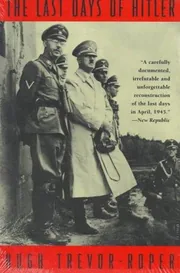
The Last Days of Hitler
by H. R. Trevor-Roper · 1947
Best suited to mature teens and adults interested in World War II history.
284 pages, about 4.5 to 6.5 hours.
A ten-day bunker investigation that reads like a thriller. 66% taste match
What it covers
The Last Days of Hitler is a work of history by H. R. Trevor-Roper, first published in 1947. It belongs to the shelves of history and politics and sits between biography and military and political history, centered on Adolf Hitler (1889-1945) and the collapse of his regime in Germany during the twentieth century.
The book grew out of an assignment from British Intelligence in Germany, given to the author late in 1945, to look into conflicting accounts of how Hitler died and to write a definitive report. Trevor-Roper drew on American counterintelligence files and on interviews with German prisoners. His account concentrates on the final ten days, April 20 to 29, 1945, spent in the underground bunker in Berlin, where rivalry among possible successors shaped events as the end of the war approached. It runs to roughly 284 pages in its median edition, and it has appeared in 49 editions.
NOW THAT the New Order is past, and the Thousand-Year Reich has crumbled in a decade, we are able at last, picking among the still rubble, to discover the truth about that fantastic and tragical episode.
Setting
Germany
Period
20th century
Themes
BiographyHeads of stateDeath and burialPolitics and governmentWorld War, 1939-1945Germany, biographyGermany, history, 1933-1945History
- Want to read 317
- Reading now 27
- Read 14
Most people shelving it are saving it for later.
Of 358 readers who put it on a shelf, 89% want to read it, 8% are reading it now, 4% have finished it and 0% stopped before the end.
By the numbers
- The median edition runs 284 pages. Counting about 275 words a page and an adult reading pace of 250 words a minute, that is about 5.2 hours of reading.
- Open Library tracks 49 editions from 28 publishers, the earliest dated 1947 and the latest 2013, across 3 languages.
- On reader demand it ranks in the top 6% of the classic books in our catalog (8,749 of them).
- Libraries shelve it under Dewey 943.0860924 and Library of Congress class DD-0247.00000000.H5 T7 1962.
 BookWard’s take
A ten-day bunker investigation that reads like a thriller
Trevor-Roper was sent by British Intelligence to settle conflicting accounts of Hitler's death, and the book never loses a detective's focus. It narrows to April 20-29, 1945, in the Berlin bunker, which gives it a tight frame and a quick hook. The rigor is real: it rests on American counterintelligence files and interviews with German prisoners. The prose has a confident, distinctive edge, so the author's presence is felt throughout. It favors narrative over analysis, which keeps the pace brisk for a work of history. The human drama comes from the rivalry among possible successors, where the characters are most vividly drawn. At 284 pages it is tight rather than sprawling, and it earns its darkness through evidence, not shock.
At about 284 pages it stays compact for a work of history, which suits BookWard's liking for tight books.
The tight ten-day window keeps events moving, a little slower than BookWard's fast preference but still brisk.
A real investigation into disputed evidence gives it a distinct angle among accounts of the war.
The prose is polished and mid-century in register, more formal than plain but not ornate.
It balances the sequence of events with the personalities jockeying for position.
The collapse of a regime and a death leave little room for brightness.
It follows a largely chronological historical arrangement, conventional for the genre.
It is a sober account of a grim subject with little humor.
It deals with the death of a dictator and the end of a regime, which is dark material.
The tone is controlled and investigative, with feeling arising from the events themselves.
See all 50 dialsEvery position, side by side with this book
Where it lines up
- EndingBookWard 8 · book 8
- Shock for effectBookWard 9 · book 9
- Rigor (nonfiction)BookWard 9 · book 9
Where it pulls apart
- LengthBookWard 1 · book 3
- OpeningBookWard 10 · book 8
- Familiar tropesBookWard 10 · book 8
At about 284 pages it stays compact for a work of history, which suits BookWard's liking for tight books.
The bunker and its final ten days give an immediate, compelling premise that BookWard values in an opening.
It was commissioned to produce a definitive report, so the case is built carefully from the evidence.
The tight ten-day window keeps events moving, a little slower than BookWard's fast preference but still brisk.
A real investigation into disputed evidence gives it a distinct angle among accounts of the war.
Competing successors in the bunker are drawn through their rivalries, giving real if historical depth.
The investigation aims at a definitive answer about Hitler's death, which fits BookWard's taste for resolution.
The subject invites no softness, and the account stays cool and evidence-driven.
The darkness comes from documented events and investigation, not from shock used for effect.
It draws on American counterintelligence files and interviews with German prisoners, matching BookWard's high bar.
Trevor-Roper writes with a confident, distinctive authority that suits an official investigation.
It is story-led, following a sequence of days in the bunker more than building an abstract thesis.
It explains events and context fairly directly, as history must, with some scene-like moments.
A narrow ten-day span keeps the narrative focused from start to finish.
The prose is polished and mid-century in register, more formal than plain but not ornate.
It balances the sequence of events with the personalities jockeying for position.
The collapse of a regime and a death leave little room for brightness.
It follows a largely chronological historical arrangement, conventional for the genre.
It is a sober account of a grim subject with little humor.
The subject and period references ask for some attention, but the narrative is accessible.
The accounts of many figures and prisoners feed the story, giving it multiple vantage points.
It moves forward through the final days in order, with a clear timeline.
It is entirely grounded in documented events and testimony.
A good number of figures around Hitler appear, making the cast fairly large.
One bunker and ten days is intimate in setting, though the stakes are national.
It leans slightly toward events and actions, with some attention to motives and states of mind.
Romance is not a concern of this account.
The underground bunker in Berlin at the war's end is an unfamiliar place for most readers.
It is a book about 1945, published in 1947, well in the past.
It remains a reference point on the subject decades after it first appeared.
The author acts as a reliable investigator weighing conflicting evidence.
Its judgments of the regime are fairly clear even as the facts are contested.
The bunker setting and its atmosphere are drawn in vivid, detailed terms.
It reads as narrative history more than as analysis, following events day by day.
The author stays a professional investigator, though his judgments color the account.
It stands alone as a single volume.
Conflicting accounts and the question of how Hitler died create some surprises for the reader.
The subject confronts hard realities of the regime's collapse.
It deals with the death of a dictator and the end of a regime, which is dark material.
The tone is controlled and investigative, with feeling arising from the events themselves.
Any humor would be dry at most, and the book is largely without it.
Sexual content is not a feature of this history.
Power struggles and the fate of a regime put politics at the center.
The language is formal and period-flavored but not dense.
The author weighs evidence and states conclusions, with a judging voice.
It looks back at a closing chapter of the war.
The picture of rivalry and collapse in the bunker is a cynical one.
Review written by BookWard, dial version 1, November 2026.
Who is The Last Days of Hitler right for?
Best suited to mature teens and adults interested in World War II history. It deals with death, war and the collapse of a brutal regime, though it is a documentary account.
The subject and period references ask for some attention, but the narrative is accessible.
It deals with the death of a dictator and the end of a regime, which is dark material.
The tone is controlled and investigative, with feeling arising from the events themselves.
Book CompanionThe Last Days of Hitler: ideas, characters, themes
A British intelligence assignment to settle conflicting accounts becomes a close study of Hitler's final ten days in the Berlin bunker.
- A commissioned investigation. Late in 1945 British Intelligence in Germany appointed Trevor-Roper to examine conflicting evidence and produce a definitive report on Hitler's death.
- Sources behind the account. He had access to American counterintelligence files and to German prisoners, which grounds the narrative in testimony.
- A ten-day focus. The book concentrates on April 20-29, 1945, in the underground bunker in Berlin.
- Rivalry among successors. The final days are marked by power play and competition among Hitler's potential successors.
- A long afterlife. First published in 1947, it has appeared in 49 editions and remains a standard reference.
Characters
Adolf Hitler
Subject of the investigation
The dictator whose final days in the bunker are the center of the book.
H. R. Trevor-Roper
Author and investigator
The British intelligence officer who gathered evidence and wrote the report that became this book.
Themes
How conflicting accounts are weighed to reach a reliable conclusion.
How rivals jockey for position as a regime collapses.
The final days of a system built around one man.
Treating the past like a case to be solved from files and testimony.
Discussion questions
- Why might an official investigation shape a historical narrative differently from a purely academic study?
- How does focusing on only ten days change what we understand about the regime's end?
- What role do the rivalries among possible successors play in the story?
- How reliable are prisoner testimonies and captured files, and how does an author weigh them?
- Why does a book from 1947 still matter to readers of history today?
Personalize your Book Companion
This is the general edition. In BookWard, the Companion is written for you: your reading profile, your notes, and spoiler-safe to the page you are on.
Buy, listen or borrow The Last Days of Hitler
Each link opens a search for this book on that store, in a new tab.
Read on a device
Borrow
Reviews and community
If you liked The Last Days of Hitler
Orwell's first novel: empire, rot, and one man's small cowardice
The Guns of AugustBarbara TuchmanThirty days in 1914, told as high drama with real authority
The Spy and the TraitorBen MacintyreA Cold War spy story told with a novelist's grip
The Power and the GloryGraham GreeneA hunted, drinking priest and the faith he cannot shed
Sources: Open Library.
Track The Last Days of Hitler and find your next favorite
Add it to your shelf, rate what you have read, and BookWard will recommend what fits you.
Free to start. No credit card needed.