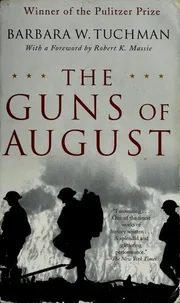
The Guns of August
by Barbara Tuchman · 1962
It suits adult and older teen readers with an interest in history, and its length and density reward patience.
575 pages, about 9 to 13.5 hours.
Thirty days in 1914, told as high drama with real authority. 57% taste match
What it covers
The Guns of August is a work of narrative history by Barbara Tuchman, first published in 1962. It belongs to the history and politics shelf and deals with the origins and opening campaigns of the First World War, set largely on the Western Front and across Europe in 1914.
The book follows the outbreak of war in the summer of 1914 and the first thirty days of fighting that came after it. It looks at the war plans that the German, French, English, and Russian General Staffs had prepared years in advance, and at the statesmen, field marshals, admirals, and monarchs who expected the conflict to end within weeks. Instead, the fighting that began that August led into four years of deadlocked war. The narrative opens in May 1910 at the funeral of Edward VII of England, attended by nine kings, and moves from there toward the crisis of 1914. A Pulitzer Prize went to the book in 1963, and it has appeared in many editions, including a 25th anniversary printing with a new preface by the author. The standard edition runs to roughly 575 pages.
SO GORGEOUS was the spectacle on the May morning of 1910 when nine kings rode in the funeral of Edward VII of England that the crowd, waiting in hushed and black-clad awe, could not keep back gasps of admiration.
Setting
Western FrontEurope
Period
1871-191820th century
Themes
CampaignsEuropean War, 1914-1918Western FrontWorld War, 1914-1918Modern HistoryCausesHistoryFront occidental
- Want to read 250
- Reading now 17
- Read 27
Most people shelving it are saving it for later.
Of 294 readers who put it on a shelf, 85% want to read it, 6% are reading it now, 9% have finished it and 0% stopped before the end.
By the numbers
- The median edition runs 575 pages. Counting about 275 words a page and an adult reading pace of 250 words a minute, that is about 11 hours of reading.
- Open Library tracks 52 editions from 40 publishers, the earliest dated 1962 and the latest 2022, across 4 languages.
- On reader demand it ranks in the top 5% of the classic books in our catalog (8,749 of them).
- Libraries shelve it under Dewey 940.421 and Library of Congress class D--0521.00000000.
 BookWard’s take
Thirty days in 1914, told as high drama with real authority
Tuchman opens at the funeral of Edward VII, with nine kings riding behind the coffin, and builds toward August 1914 with the pull of a good novel. The hook is immediate, and the month of fighting moves briskly across 575 pages. Her voice is distinctive too: the portraits of generals and statesmen are vivid, never generic. This is narrative history, led by story through and through, and that is a large part of its appeal. As history it reads as authoritative and carries a Pulitzer, though its drama sometimes leans on striking character sketches. The real demand is length; this is a long book, and it asks for more patience than a tighter account would.
At roughly 575 pages it is a long book, well over BookWard's preference for tight and short.
The thirty days of fighting move briskly, though the buildup to war slows things somewhat.
A month-by-month narrative of the first thirty days was a fresh approach, though the subject itself is well covered.
The writing is polished and stately without becoming showy, a touch more ornate than BookWard's middle.
It is driven by events and decisions, though the personalities of generals and statesmen shape them.
The subject is the start of a catastrophic war, so the outlook is bleak.
It runs in a conventional chronological sweep from 1910 to the first month of war.
There is dry irony in the portraits, but the subject is deadly serious.
The subject is the start of a war that cost a generation, a dark theme.
The human cost and tragedy of figures like Samsonov bring real intensity without melodrama.
See all 50 dialsEvery position, side by side with this book
Where it lines up
- Character depthBookWard 8 · book 8
- Shock for effectBookWard 9 · book 9
- Authorial voiceBookWard 9 · book 9
Where it pulls apart
- LengthBookWard 1 · book 8
- OpeningBookWard 10 · book 8
- Familiar tropesBookWard 10 · book 8
At roughly 575 pages it is a long book, well over BookWard's preference for tight and short.
The funeral of nine kings in the first sentence pulls you in at once, which BookWard rewards.
It avoids the dry survey approach, though some romantic-history flourishes are familiar, still strong for BookWard.
The chain from the war plans of 1914 to the opening battles is laid out clearly and coherently.
The thirty days of fighting move briskly, though the buildup to war slows things somewhat.
A month-by-month narrative of the first thirty days was a fresh approach, though the subject itself is well covered.
Joffre, Samsonov, von Kluck and others are drawn as full human portraits, which BookWard values.
It closes on the opening clash and the settling into four years of deadlock, giving a clear if grim resolution.
The tone is dramatic but controlled, with irony rather than sentimentality, close to BookWard's restraint.
The darkness comes from real events and their consequences, never from shock for its own sake, matching BookWard.
It is solid, widely respected history with a Pulitzer behind it, though it is more narrative than strictly academic.
Tuchman's confident, wry, portrait-driven voice is unmistakable, exactly what BookWard prizes.
It is firmly story-led, telling events as unfolding drama, in line with BookWard.
Much is explained outright, such as the war plans, but it is balanced with scenes and portraits.
The momentum holds across a long book, with only the diplomatic buildup slowing the middle.
The writing is polished and stately without becoming showy, a touch more ornate than BookWard's middle.
It is driven by events and decisions, though the personalities of generals and statesmen shape them.
The subject is the start of a catastrophic war, so the outlook is bleak.
It runs in a conventional chronological sweep from 1910 to the first month of war.
There is dry irony in the portraits, but the subject is deadly serious.
It is engaging and readable, though the dense cast and military detail take some effort.
It moves among German, French, British and Russian perspectives, giving many viewpoints.
The account is chronological, running from the 1910 funeral toward the 1914 fighting.
It is nonfiction history, wholly grounded in real events.
Kings, statesmen, field marshals and admirals fill the book, making for a very large cast.
It covers the armies and diplomacy of a continent, an epic canvas.
The focus is on campaigns, plans and decisions, though portraits reveal some inner motives.
As history it relies on narration and documents rather than extended exchanges.
Romance has no place in this account of war planning and battle.
The prewar courts and battlefields of 1914 Europe are distant to most modern readers.
The story is set over a century ago, in 1910 to 1914.
Pulitzer-winning and still read widely, it has lasted well beyond its 1962 publication.
The historian narrates plainly and reliably, with no tricks.
Tuchman makes clear judgments on folly and blame, though leaders' motives are shown with nuance.
Scenes such as the royal funeral and the battlefield portraits are richly drawn.
It reads as narrative history, led by scene and character more than analysis.
Tuchman writes with her own authority and judgments rather than staying detached.
It stands on its own as a complete work.
The outcomes are historically known, so there are few real surprises.
It confronts how blunder and pride led nations into catastrophe, which is bracing reading.
The subject is the start of a war that cost a generation, a dark theme.
The human cost and tragedy of figures like Samsonov bring real intensity without melodrama.
Where there is humor it is dry and ironic.
Battles are described, but the focus is on strategy rather than graphic detail.
Sexual content is essentially absent.
Diplomacy, alliances and war plans are the heart of the book.
The language is clear and formal, with some military and French terms.
Tuchman offers pointed judgments of leaders and their blunders.
It looks back to the origins of a war a half century earlier.
The tone is skeptical about the wisdom of the powerful, with a cynical edge.
Review written by BookWard, dial version 1, November 2026.
Who is The Guns of August right for?
It suits adult and older teen readers with an interest in history, and its length and density reward patience. It deals with war and its toll, though without graphic sexual content.
It is engaging and readable, though the dense cast and military detail take some effort.
The subject is the start of a war that cost a generation, a dark theme.
The human cost and tragedy of figures like Samsonov bring real intensity without melodrama.
Battles are described, but the focus is on strategy rather than graphic detail.
Book CompanionThe Guns of August: ideas, characters, themes
Tuchman shows how war plans fixed years in advance, together with human misjudgment, carried Europe into a catastrophe no one expected to last beyond weeks.
- A funeral of kings. The book opens at the 1910 funeral of Edward VII, attended by nine kings, setting the scene of Europe's old order.
- Plans made years before. The German, French, English and Russian General Staffs had completed their war plans long before hostilities began.
- The offensive creed. France built its strategy around attack, while Germany intended to invade France and Russia planned to invade East Prussia.
- Plans that ignored each other. None of the plans allowed for what the others would do, nor recognized their own flaws.
- Weeks that became years. Leaders expected a quick victory, but the August fighting led into four years of deadlocked war.
Characters
Joffre
French commander
He is shown rebuilding his shattered French armies after the early battles.
Samsonov
Russian commander
He dies a suicide after the annihilation of the Russian 2nd Army.
von Kluck
German commander
He stubbornly commits a fatal mistake during the campaign.
Admiral Souchon
German naval commander
He chooses a desperate and fateful course for Constantinople.
Edward VII
English king
His funeral in 1910 opens the book.
Themes
How a generation of planning made the clash seem unavoidable.
How pride, belief and fear shaped decisions more than reason.
How rigid war plans collided with events they did not foresee.
How individual commanders and statesmen shaped the outcome.
How the opening battles began a loss of life across a generation.
Discussion questions
- Why did each General Staff trust its own plan despite knowing the others' plans?
- How does the opening funeral of nine kings set the tone for the book?
- Which commander's decision seems most consequential, and why?
- How does Tuchman's narrative style shape your view of events?
- What does the book suggest about expecting a short war?
Personalize your Book Companion
This is the general edition. In BookWard, the Companion is written for you: your reading profile, your notes, and spoiler-safe to the page you are on.
Buy, listen or borrow The Guns of August
Each link opens a search for this book on that store, in a new tab.
Read on a device
Borrow
Reviews and community
If you liked The Guns of August
A ten-day bunker investigation that reads like a thriller
HitlerAlan BullockBullock's landmark life of Hitler, built on a chronological sweep
The Spy and the TraitorBen MacintyreA Cold War spy story told with a novelist's grip
The Poisonwood BibleBarbara KingsolverA family's undoing in the Congo, told by five women
Sources: Open Library.
Track The Guns of August and find your next favorite
Add it to your shelf, rate what you have read, and BookWard will recommend what fits you.
Free to start. No credit card needed.