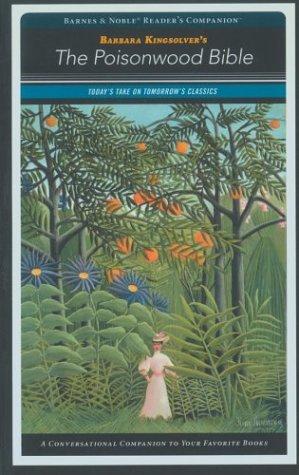
The Poisonwood Bible
by Barbara Kingsolver
★ Top 25 book of 1998 · #13 on Best Books of 1998
A wife and her four daughters narrate how their fierce, evangelical Baptist husband and father uproots them to the Belgian Congo in 1959. Over three decades, their family is undone and then slowly rebuilt.
Best for: Readers of epic family sagas set in postcolonial Africa
The Poisonwood Bible is #13 on BookWard's Best Books of 1998, out of 36 1998 books that cleared our data bar.
What The Poisonwood Bible is about
In 1959 the Price family leaves Georgia for the village of Kilanga in the Belgian Congo. Nathan, the father, is a fierce evangelical Baptist missionary, and he brings his wife Orleanna and their four daughters, Rachel, Leah, Adah and Ruth May, into a world that does not bend to his certainty. Even his demonstration garden struggles in the climate.
Orleanna opens the story, and the daughters then take turns telling it, each seeing the same events differently. Set against the political turmoil of the Congo in the 1960s, the family faces cultural misunderstanding, faith pushed to fanaticism and the weight of guilt. The title comes from Nathan's mispronunciation of a Kikongo phrase. Barbara Kingsolver writes in a sweeping, lyrical style that rewards patient readers who like family sagas with moral questions at their core.
The Poisonwood Bible on the Best Books of 1998
The Poisonwood Bible came out in 1998. Of the 36 books first published in 1998 that met BookWard's data bar, it ranks #13 on our Best Books of 1998 list.
Why it made the list: 251 readers have shelved it on Open Library; readers rate it 4.2 out of 5 (31 ratings). The list ranks each year’s books on how many readers have picked them up, how highly readers rate them, and how many are reading them right now.
Nearby on the 1998 list
- Rainbow Six Tom Clancy, #11
- Skellig David Almond, #12
- Working with Emotional Intelligence Daniel Goleman, #14
- A Beautiful Mind Sylvia Nasar, #15
See all Best Books of 1998 Best books by year
More years: Best Books of 1997 Best Books of 1999.
The numbers behind it
- Readers: 198 want to read it, 3 are reading it now and 50 have read it, according to Open Library.
- Ratings: 4.2 out of 5 from 31 Open Library ratings.
| Signal | This book (0 to 100) | Weight |
|---|---|---|
| Reach | 58 | 55% |
| Reader love | 81 | 25% |
| Being read right now | 3 | 20% |
Questions about The Poisonwood Bible
When was The Poisonwood Bible published?
The Poisonwood Bible by Barbara Kingsolver was first published in 1998.
Was The Poisonwood Bible one of the best books of 1998?
The Poisonwood Bible is #13 on BookWard's Best Books of 1998, out of 36 1998 books that cleared our data bar. 251 readers have shelved it on Open Library; readers rate it 4.2 out of 5 (31 ratings).
Why is The Poisonwood Bible on the Best Books of 1998 list?
251 readers have shelved it on Open Library; readers rate it 4.2 out of 5 (31 ratings).
More of the best books of 1998
- Harry Potter and the Chamber of Secrets J. K. Rowling, #1
- Holes Louis Sachar, #2
- A Clash of Kings George R. R. Martin, #3
- Among the Hidden Margaret Peterson Haddix, #4
- Who Moved My Cheese? Spencer Johnson, #5
- No, David! David Shannon, #6
See the full Best Books of 1998, the Top 100, or new books on Rising.
How we know
This page uses public data: Open Library reader counts and ratings, and Wikipedia page views for recent years. The description is paraphrased from real source text. Rankings reflect reading interest, not quality or sales, and can be affected by data gaps. Lists update monthly.
Suited to mature teens and adults who enjoy long, serious literary fiction.
Depends on the edition you pick.
A family's undoing in the Congo, told by five women. 59% taste match
 BookWard’s take
A family's undoing in the Congo, told by five women
Barbara Kingsolver gives the Price family's move to the Belgian Congo in 1959 to a mother and four daughters, each with a distinct voice. That is where it earns real admiration: each narrator is drawn so sharply you could identify her from a single paragraph, and the characters have genuine depth. The shifting perspectives are a strength too, letting the reader see what the father cannot. Length is where I part company with it, since this is a long, sprawling novel that follows the family across three decades. The pace is steadier than fast, and the prose is richer than plain. Patient readers who want a moral reckoning with colonialism will find it rewarding.
A long, multi-decade family saga; BookWard prefers tight books, so this is a real commitment.
It moves at a measured, immersive pace through village life and political change, slower than BookWard likes.
Telling one story through a mother and four daughters of different ages and temperaments is a distinctive approach.
The language is rich and image-heavy, a touch more ornate than BookWard's middle-leaning taste.
The drama grows out of who these people are and how they respond, so character leads plot.
The book carries real loss, but it also traces reconstruction and survival over the decades.
Rotating narrators and a framing mother's voice are inventive without being hard to follow.
A young narrator's wry observations bring flashes of humor, but the book is mostly serious.
The family suffers real hardship and tragedy, which gives the book a serious edge.
The family's trials land with real feeling, though the book is not melodramatic.
See all 50 dialsEvery position, side by side with this book
Where it lines up
- OriginalityBookWard 9 · book 8
- Character depthBookWard 8 · book 9
- Shock for effectBookWard 9 · book 8
Where it pulls apart
- LengthBookWard 1 · book 9
- OpeningBookWard 10 · book 6
- Familiar tropesBookWard 10 · book 8
A long, multi-decade family saga; BookWard prefers tight books, so this is a real commitment.
It opens with a mother's reflective narration and a family preparing to leave, which builds gradually rather than grabbing at once.
A missionary family abroad could be familiar ground, but the five-voice treatment keeps it away from stock postcolonial tropes.
The family's choices and their consequences follow from character and circumstance, which suits BookWard's taste for coherence.
It moves at a measured, immersive pace through village life and political change, slower than BookWard likes.
Telling one story through a mother and four daughters of different ages and temperaments is a distinctive approach.
Each of the five narrators is individually drawn and changes over time, which BookWard rates highly.
The decades-long arc brings the family's story to a considered close rather than leaving it hanging.
It is emotionally open at times, though it generally avoids easy sentimentality.
Its darker turns come out of the family's choices and the setting, not from shock for its own sake.
This is a novel, so the rigor dial does not apply.
Five clearly separate narrating voices make this one of the book's greatest strengths.
Ideas about faith and colonialism are woven into a story that still centers on the family.
Most understanding comes through scene and the girls' own observations, in line with BookWard's preference.
The middle holds up through the sheer variety of voices, though a long book will have slower stretches.
The language is rich and image-heavy, a touch more ornate than BookWard's middle-leaning taste.
The drama grows out of who these people are and how they respond, so character leads plot.
The book carries real loss, but it also traces reconstruction and survival over the decades.
Rotating narrators and a framing mother's voice are inventive without being hard to follow.
A young narrator's wry observations bring flashes of humor, but the book is mostly serious.
Long and thematically weighty, it asks for patience but is never obscure.
Five narrators give it many perspectives, which BookWard enjoys.
The story moves forward through time in the main, with the mother's reflective frame looking back.
It is firmly realistic, rooted in a real place and period.
The core family is small, though the village and wider community broaden it.
It spans decades and touches national upheaval, but the center stays on one family.
It balances events with each narrator's private reckoning, leaning slightly inward.
Conversation matters, but the narration carries more of the weight than the dialogue does.
Relationships appear, but romance is not the main thread.
The Belgian Congo of 1959 and after is unfamiliar to most readers, and the book makes it vivid.
The story is set in the past, beginning in 1959.
Questions of faith, power and family keep it relevant long after 1998.
The narrators are sincere and mostly reliable, though each sees only part of the picture.
The book asks hard questions about faith and colonialism without handing down tidy verdicts.
Village life, landscape and climate are rendered in rich, sensory detail.
This is fiction, so the nonfiction-style dial does not apply.
This is fiction, so the nonfiction perspective dial does not apply.
It stands alone as a single novel.
Events turn in unexpected directions, though the story is more about consequence than surprise.
It confronts uncomfortable questions about religion, power and responsibility.
The family suffers real hardship and tragedy, which gives the book a serious edge.
The family's trials land with real feeling, though the book is not melodramatic.
What humor there is leans dry and observational.
Political upheaval and danger bring violence into the story without dominating it.
Sexual content is minimal.
Colonialism and political turmoil are central to the setting and themes.
Occasional Kikongo and distinct narrator voices add texture without making it hard going.
The narrators hold strong views, and the book clearly takes a stance on its themes.
Much of the telling looks back, with the mother reflecting on the past.
It sits between cynicism and idealism, with faith tested but not entirely discarded.
Review written by BookWard, dial version 1, November 2026.
Who is The Poisonwood Bible right for?
Suited to mature teens and adults who enjoy long, serious literary fiction. It deals with illness, political violence and the death and loss of family members.
Long and thematically weighty, it asks for patience but is never obscure.
The family suffers real hardship and tragedy, which gives the book a serious edge.
The family's trials land with real feeling, though the book is not melodramatic.
Political upheaval and danger bring violence into the story without dominating it.
Book CompanionThe Poisonwood Bible: ideas, characters, themes
A missionary family's move to the Belgian Congo in 1959 is told through the five women of the family, showing how certainty, faith and power look different from each perspective.
- A five-voice structure. The mother opens most sections, and the four daughters then take turns narrating, so the same events are seen from several angles.
- A title with a double meaning. The father's mispronunciation turns 'precious' into 'poisonwood', a small error that captures the gap between intention and effect.
- Culture clash from the start. Even the family's first garden and first church service show how far their assumptions are from local conditions.
- Daughters who grow differently. Each girl adapts to village life in her own way, which gives the book its range of temperaments.
- Decades of consequence. The story follows the family over about thirty years, tracing both their undoing and their rebuilding.
Characters
Orleanna Price
The mother
She narrates the introductory chapters and reflects on the family's story.
Nathan Price
The father
A fierce evangelical Baptist who brings his family and his mission to the Congo.
Rachel
Eldest daughter
One of the four Price daughters who narrate.
Leah
Daughter and twin
A 14-year-old who helps her father plant the demonstration garden.
Ruth May
Youngest daughter
The five-year-old who befriends the village children.
Themes
What happens when certainty meets a world that does not fit it.
The costs of outsiders imposing their ideas on a place and its people.
How a household is shaped, strained and rebuilt by shared hardship.
How good intentions and unexamined assumptions go wrong.
How people rebuild their lives after loss.
Discussion questions
- How does hearing the story from five narrators change what you believe about the events?
- What does the poisonwood mistranslation suggest about the father's mission?
- Which daughter's way of adapting do you find most convincing, and why?
- How does the book treat the line between good intentions and harm?
- Why might the mother's reflective voice open most of the sections?
Personalize your Book Companion
This is the general edition. In BookWard, the Companion is written for you: your reading profile, your notes, and spoiler-safe to the page you are on.
Buy, listen or borrow The Poisonwood Bible
Each link opens a search for this book on that store, in a new tab.
Read on a device
Borrow
Reviews and community
If you liked The Poisonwood Bible
Four lives, one flat, and the Emergency pressing in
FlashlightSusan ChoiA family wrecked by one night on a breakwater
PachinkoMin Jin LeeFour generations of a Korean family in Japan, told with patience
East of EdenJohn SteinbeckSteinbeck's sprawling Cain and Abel saga, built to outlast its length
Find your own best books
Add what you have read, rate it, and BookWard will recommend what to read next.
Free to start. No credit card needed.