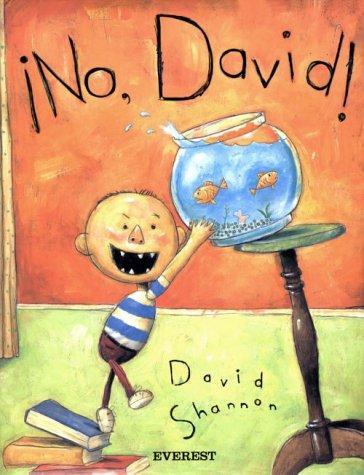
No, David!
by David Shannon
★ Top 10 book of 1998 · #6 on Best Books of 1998
A young boy gets into all sorts of naughty mischief and is scolded again and again for his behavior. In the end, though, he receives a hug, giving the story a warm finish.
Best for: Families sharing a story about misbehavior that ends with a hug
No, David! is #6 on BookWard's Best Books of 1998, out of 36 1998 books that cleared our data bar.
No, David! on the Best Books of 1998
No, David! came out in 1998. Of the 36 books first published in 1998 that met BookWard's data bar, it ranks #6 on our Best Books of 1998 list.
Why it made the list: 490 readers have shelved it on Open Library; readers rate it 3.9 out of 5 (21 ratings); 24 are reading it right now. The list ranks each year’s books on how many readers have picked them up, how highly readers rate them, and how many are reading them right now.
Nearby on the 1998 list
- Among the Hidden Margaret Peterson Haddix, #4
- Who Moved My Cheese? Spencer Johnson, #5
- The 7 Habits of Highly Effective Teens Sean Covey, #7
- Bag of Bones Stephen King, #8
See all Best Books of 1998 Best books by year
More years: Best Books of 1997 Best Books of 1999.
The numbers behind it
- Readers: 425 want to read it, 24 are reading it now and 41 have read it, according to Open Library.
- Ratings: 3.9 out of 5 from 21 Open Library ratings.
| Signal | This book (0 to 100) | Weight |
|---|---|---|
| Reach | 86 | 55% |
| Reader love | 56 | 25% |
| Being read right now | 81 | 20% |
Questions about No, David!
When was No, David! published?
No, David! by David Shannon was first published in 1998.
Was No, David! one of the best books of 1998?
No, David! is #6 on BookWard's Best Books of 1998, out of 36 1998 books that cleared our data bar. 490 readers have shelved it on Open Library; readers rate it 3.9 out of 5 (21 ratings); 24 are reading it right now.
Why is No, David! on the Best Books of 1998 list?
490 readers have shelved it on Open Library; readers rate it 3.9 out of 5 (21 ratings); 24 are reading it right now.
More of the best books of 1998
- Harry Potter and the Chamber of Secrets J. K. Rowling, #1
- Holes Louis Sachar, #2
- A Clash of Kings George R. R. Martin, #3
- Among the Hidden Margaret Peterson Haddix, #4
- Who Moved My Cheese? Spencer Johnson, #5
- The 7 Habits of Highly Effective Teens Sean Covey, #7
See the full Best Books of 1998, the Top 100, or new books on Rising.
How we know
This page uses public data: Open Library reader counts and ratings, and Wikipedia page views for recent years. The description is paraphrased from real source text. Rankings reflect reading interest, not quality or sales, and can be affected by data gaps. Lists update monthly.
It suits toddlers and early readers, and works well read aloud with a grown-up.
Depends on the edition you pick.
A tiny vocabulary, one naughty boy, and a hug at the end. 56% taste match
 BookWard’s take
A tiny vocabulary, one naughty boy, and a hug at the end
David Shannon built this from a homemade book he made as a child, when "no" and "David" were the only words he could spell. That origin shows. The text is almost nothing, and the pictures do the work: a boy drawing on the wall, flooding the bath, picking his nose, each met with a scolding. It is about as short as a book can get, which is a point in its favor. It hooks at once, since the first spread is already trouble. The warmth is the quiet surprise: the book keeps its comedy dry and holds the tenderness back until the final page, when David's mother hugs him. It is driven by its story, moves fast, and ends fully resolved. A confident, funny picture book that trusts its young readers.
A picture book built on almost no words, about as short as a book can be, which is the extreme BookWard favors.
Each spread delivers one new misdeed, so the book moves briskly from page to page.
The premise is universal, but its roots in a child's homemade book and its bare vocabulary give it a distinct identity.
The language is deliberately plain, built from the simplest words a child could spell.
A string of incidents drives it, though David's personality sits close behind them.
It ends on forgiveness and a hug, which leaves the book on a warm, reassuring note.
A straightforward run of misdeeds followed by a resolution, with no formal experiment.
The humor of a child pushing every limit is the engine of the whole book.
The misbehavior is mild and comic, and the book ends in affection.
Feeling stays light for most of the book and rises at the remorse and the hug.
See all 50 dialsEvery position, side by side with this book
Where it lines up
- LengthBookWard 1 · book 1
- Shock for effectBookWard 9 · book 9
- OpeningBookWard 10 · book 9
Where it pulls apart
- Familiar tropesBookWard 10 · book 4
- Character depthBookWard 8 · book 4
- Internal logicBookWard 10 · book 8
A picture book built on almost no words, about as short as a book can be, which is the extreme BookWard favors.
David is already misbehaving on the first spread, so there is no warm-up and nothing to wait through.
A naughty child scolded by a parent is familiar ground, though the pared-down treatment keeps it from feeling stock.
Misbehavior leads to scolding and then to a consequence, a simple cause-and-effect chain that holds together cleanly.
Each spread delivers one new misdeed, so the book moves briskly from page to page.
The premise is universal, but its roots in a child's homemade book and its bare vocabulary give it a distinct identity.
David is drawn as an energetic type rather than a layered person, which fits a book this brief.
The vase breaks, David is put in timeout, and his mother hugs him, so the story closes with a clear resolution.
The comedy is dry for most of the book, and the tenderness is saved for the last page rather than spread throughout.
Nothing here is dark for effect; the mischief is gentle and the consequences are mild.
This is a picture-book story, so the nonfiction rigor dial does not apply.
This is entirely story, a sequence of incidents with no argument or thesis behind it.
Nothing is explained; the pictures and a few words carry everything.
At this length there is no middle to sag, and the energy holds from the first page to the last.
The language is deliberately plain, built from the simplest words a child could spell.
A string of incidents drives it, though David's personality sits close behind them.
It ends on forgiveness and a hug, which leaves the book on a warm, reassuring note.
A straightforward run of misdeeds followed by a resolution, with no formal experiment.
The humor of a child pushing every limit is the engine of the whole book.
Almost no reading effort is required, which makes it easy for the youngest readers.
We stay with David and his mother's reactions, so there is effectively one viewpoint.
Events run forward in order with no jumps in time.
The setting is an ordinary home with everyday mischief and nothing fantastical.
David and his mother carry the book, so the cast is tiny.
The stakes stay inside one household, which keeps the scale intimate.
The book shows what David does rather than what he thinks, so it leans toward action.
Spoken lines are few, though the repeated "No, David!" is the heart of the book.
There is no romance, only a parent and child.
The domestic setting is immediately familiar to nearly any reader.
It reads as a modern household and its mischief is perennial rather than tied to a decade.
Being told "no" is a universal childhood experience, which is what keeps the book fresh.
The pictures show events plainly, so there is no unreliable narration to speak of.
Behaving badly earns a scolding and the final hug shows love remains, so the lesson is clear.
Words are sparse, with the illustrations supplying the visual detail.
It is warm and close to a child's own experience rather than detached.
It launched a long-running run of David books, so it sits at the start of a series.
The structure is predictable, apart from the late, escalating vase incident.
A gentle, comforting read that asks nothing difficult of its audience.
The misbehavior is mild and comic, and the book ends in affection.
Feeling stays light for most of the book and rises at the remorse and the hug.
The physical, exaggerated mischief is broad rather than dry, in its pictures especially.
The worst moment is a broken vase, so there is no real violence.
There is no sexual content of any kind.
It carries no political content.
The language is as plain as it can be, built from just a few simple words.
The book mostly presents events without commentary, though the mother's exasperation colors them.
It is concerned with the present moment of a child's day, with a mild nod to learning better.
It assumes love survives misbehavior, which is a gently idealistic view of family.
Review written by BookWard, dial version 1, November 2026.
Who is No, David! right for?
It suits toddlers and early readers, and works well read aloud with a grown-up. Nothing in it is upsetting; the worst moments are a scolding and a timeout.
Almost no reading effort is required, which makes it easy for the youngest readers.
The misbehavior is mild and comic, and the book ends in affection.
Feeling stays light for most of the book and rises at the remorse and the hug.
The worst moment is a broken vase, so there is no real violence.
Book CompanionNo, David!: ideas, characters, themes
Every child hears "no" constantly, and this book turns that shared experience into comedy while ending on the reassurance that love stays put.
- A book from a child's own hand. It grew out of a homemade book Shannon made as a child using only the two words he could spell, "no" and "David."
- A tribute to a universal experience. Shannon remade it as a tribute to the common childhood experience of being told "no."
- A catalog of misdeeds. David draws on the living room wall, overflows the bath, plays with his food and picks his nose.
- Escalation to the vase. The mischief builds until David breaks a vase with a baseball bat and is put in timeout.
- The turn to tenderness. Noticing David's remorse, his mother embraces him and says she loves him.
Characters
David
The mischievous young boy
He cycles through misbehaviors and shows remorse after the vase breaks.
David's mother
The scolding parent
She admonishes each transgression, then hugs David and tells him she loves him.
Themes
Children test boundaries, and adults answer with scolding.
The final hug shows affection survives misbehavior.
David's regret after the vase marks a shift from mischief to feeling.
The book treats naughtiness as a normal, even funny, part of growing up.
Discussion questions
- Which of David's misdeeds seems the funniest to you, and why?
- Why do you think the book uses so few words?
- How does David's mother feel at the start compared with the end?
- What changes when David breaks the vase?
- Have you ever been told "no" and how did it feel?
Personalize your Book Companion
This is the general edition. In BookWard, the Companion is written for you: your reading profile, your notes, and spoiler-safe to the page you are on.
Buy, listen or borrow No, David!
Each link opens a search for this book on that store, in a new tab.
Read on a device
Borrow
Reviews and community
If you liked No, David!
A toddler's laundromat meltdown, told with perfect comic timing
Beezus and RamonaBeverly ClearyBeezus meets her match in a four-year-old sister
Ramona and Her FatherBeverly ClearyA short, warm Ramona story about money trouble and a father's worry
The Tale of Peter RabbitBeatrix PotterA tiny garden chase that still moves faster than most thrillers
Find your own best books
Add what you have read, rate it, and BookWard will recommend what to read next.
Free to start. No credit card needed.