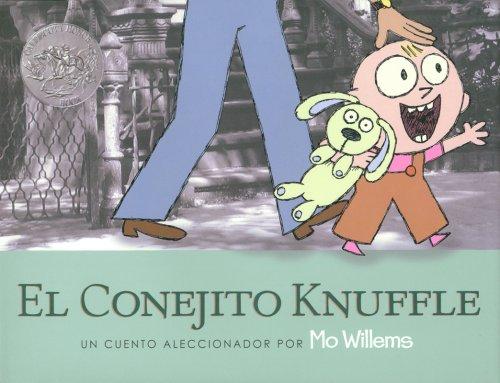
Knuffle Bunny
by Mo Willems
★ Top 25 book of 2004 · #21 on Best Books of 2004
During a trip to the laundromat, little Trixie realizes something precious is missing. Too young to talk, she struggles to make her father understand what has gone wrong.
Best for: Parents sharing a funny, relatable picture book with toddlers and young children
Knuffle Bunny is #21 on BookWard's Best Books of 2004, out of 48 2004 books that cleared our data bar.
What Knuffle Bunny is about
Trixie is too young to talk, which becomes a real problem on a trip to the laundromat with her father. Trixie's beloved stuffed rabbit, Knuffle Bunny, gets left behind at the laundromat, and because she cannot talk yet, Trixie cannot tell her father why she is upset. Mo Willems, who wrote and illustrated this 2004 picture book, turns that familiar toddler frustration into a warm and funny story about a child and a parent trying to understand each other. Trixie is named after his own daughter, and knuffle comes from the Dutch word knuffel. The book earned a 2005 Caldecott Honor and led to an animated short, a musical play and two sequels. It is a good pick for parents and small children who know how much a favourite toy can matter.
Knuffle Bunny on the Best Books of 2004
Knuffle Bunny came out in 2004. Of the 48 books first published in 2004 that met BookWard's data bar, it ranks #21 on our Best Books of 2004 list.
Why it made the list: 243 readers have shelved it on Open Library; readers rate it 4.2 out of 5 (12 ratings). The list ranks each year’s books on how many readers have picked them up, how highly readers rate them, and how many are reading them right now.
Nearby on the 2004 list
- Collapse Jared Diamond, #19
- Going Postal Terry Pratchett, #20
- The Gruffalo's Child Julia Donaldson, #22
See all Best Books of 2004 Best books by year
More years: Best Books of 2003 Best Books of 2005.
The numbers behind it
- Readers: 218 want to read it, 7 are reading it now and 18 have read it, according to Open Library.
- Ratings: 4.2 out of 5 from 12 Open Library ratings.
| Signal | This book (0 to 100) | Weight |
|---|---|---|
| Reach | 56 | 55% |
| Reader love | 63 | 25% |
| Being read right now | 27 | 20% |
Questions about Knuffle Bunny
When was Knuffle Bunny published?
Knuffle Bunny by Mo Willems was first published in 2004.
Was Knuffle Bunny one of the best books of 2004?
Knuffle Bunny is #21 on BookWard's Best Books of 2004, out of 48 2004 books that cleared our data bar. 243 readers have shelved it on Open Library; readers rate it 4.2 out of 5 (12 ratings).
Why is Knuffle Bunny on the Best Books of 2004 list?
243 readers have shelved it on Open Library; readers rate it 4.2 out of 5 (12 ratings).
More of the best books of 2004
- Darkly Dreaming Dexter Jeffry P. Lindsay, #1
- Rich Dad, Poor Dad for Teens Robert T. Kiyosaki, #2
- The Ruins of Gorlan John Flanagan, #3
- Blink Malcolm Gladwell, #4
- Alexander Hamilton Ron Chernow, #5
- She Comes First Ian Kerner, #6
See the full Best Books of 2004, the Top 100, or new books on Rising.
How we know
This page uses public data: Open Library reader counts and ratings, and Wikipedia page views for recent years. The description is paraphrased from real source text. Rankings reflect reading interest, not quality or sales, and can be affected by data gaps. Lists update monthly.
It suits toddlers and early readers, and parents will enjoy it as much as the children.
Depends on the edition you pick.
A toddler's laundromat meltdown, told with perfect comic timing. 61% taste match
 BookWard’s take
A toddler's laundromat meltdown, told with perfect comic timing
Mo Willems built Knuffle Bunny around one small crisis: a girl too young to talk realizes her stuffed rabbit is gone and cannot make her father understand. The hook is immediate, since the trouble starts on the walk home, and the pace never drags. For a picture book the tone is unusually restrained, and the humor comes from the gap between Trixie's despair and her father's baffled calm. The ending is fully resolved and earns its payoff without syrup. It also scores high on originality in a genre full of familiar bedtime tropes, and its voice is distinctive and unmistakable. It won a 2005 Caldecott Honor, and it reads aloud beautifully to a small child or a tired adult.
A picture book that wastes no pages, which is exactly how BookWard likes it.
Short scenes and quick page turns keep it moving, close to BookWard's preferred speed.
A story told through a toddler who cannot speak, with photographed settings and drawn figures, feels fresh in picture books.
The text is plain and spare, and the pictures supply most of the flavor.
A single event drives it, but Trixie's feelings are what make it land, so the balance is nearly even.
It ends in joy and relief, with a small triumph for Trixie.
A straightforward linear tale, though the mix of photo backgrounds and drawn characters is a stylish touch.
The comedy of a baffled parent and an inconsolable toddler is the engine of the book.
A gentle book whose worst moment is a toddler's meltdown.
Trixie's despair and joy come through vividly, though always at a child's scale.
See all 50 dialsEvery position, side by side with this book
Where it lines up
- LengthBookWard 1 · book 1
- PaceBookWard 8 · book 8
- Authorial voiceBookWard 9 · book 9
Where it pulls apart
- OpeningBookWard 10 · book 8
- Familiar tropesBookWard 10 · book 8
- ViewpointsBookWard 7 · book 1
A picture book that wastes no pages, which is exactly how BookWard likes it.
The crisis arrives within a few pages of the laundromat trip, so there is no warm-up to wait through.
It sidesteps the usual sweet bedtime formula and builds comedy from a very specific, true-to-life tantrum.
Every beat follows from the last, from the lost toy to the cause of the meltdown to the way it is solved.
Short scenes and quick page turns keep it moving, close to BookWard's preferred speed.
A story told through a toddler who cannot speak, with photographed settings and drawn figures, feels fresh in picture books.
Trixie's frustration and her father's rising bewilderment are drawn with real specificity in very few words.
The toy is found and Trixie says her first words, a tidy resolution that fits BookWard's taste.
The warmth is real but kept in check by humor, so it stays on the right side of sugary.
There is no shock for effect, only the small, believable drama of a lost toy.
Not applicable to a picture-book story.
Willems's deadpan timing and expressive illustrations are unmistakable and instantly his.
This is entirely story-led, with one clear incident carrying the whole book.
Nothing is explained outright; the pictures and Trixie's reactions do all the work.
At this length there is no middle to sag, and every page earns its place.
The text is plain and spare, and the pictures supply most of the flavor.
A single event drives it, but Trixie's feelings are what make it land, so the balance is nearly even.
It ends in joy and relief, with a small triumph for Trixie.
A straightforward linear tale, though the mix of photo backgrounds and drawn characters is a stylish touch.
The comedy of a baffled parent and an inconsolable toddler is the engine of the book.
Easy for young listeners and effortless for adults reading aloud.
We stay with Trixie's experience throughout.
Events run in order from the laundromat and back again.
Entirely grounded in an ordinary family errand.
Essentially just Trixie and her parents.
The stakes are one toy and one afternoon, which is the point.
Trixie's feelings and the visible chase back to the laundromat share the page about equally.
Spoken lines are brief, and the big moment is a single word.
There is no romance at all.
A laundromat and a neighborhood walk are about as familiar as settings get.
Published in 2004, and its look is of the early 2000s, though the tantrum is perennial.
The experience of a lost comfort object is evergreen, and the book has stayed a classic.
The telling is straightforward and trustworthy.
There is no moral puzzle, just a child, a parent and a lost toy.
Description is minimal in the text and lives mostly in the illustrations.
Not applicable to fiction.
Not applicable to fiction.
It has two sequel books, though this one stands comfortably alone.
The surprises are small, like the moment the toy is finally found.
A comforting read with nothing difficult in it.
A gentle book whose worst moment is a toddler's meltdown.
Trixie's despair and joy come through vividly, though always at a child's scale.
Gently broad physical comedy sits alongside dry parental exasperation.
None.
None.
Absent.
Plain, simple language throughout.
Mostly neutral narration that lets the pictures judge.
Rooted in the present moment of one family's day.
A warm view of family patience and being understood.
Review written by BookWard, dial version 1, November 2026.
Who is Knuffle Bunny right for?
It suits toddlers and early readers, and parents will enjoy it as much as the children. Nothing here is sensitive beyond a toddler's loud, tearful meltdown.
Easy for young listeners and effortless for adults reading aloud.
A gentle book whose worst moment is a toddler's meltdown.
Trixie's despair and joy come through vividly, though always at a child's scale.
None.
Book CompanionKnuffle Bunny: ideas, characters, themes
A toddler who cannot yet speak must find a way to tell her father that something precious is missing.
- The trip to the laundromat. Trixie and her father go on an ordinary errand, which sets up the story.
- The realization. On the way home Trixie realizes Knuffle Bunny has been left behind.
- The communication gap. Because she cannot talk yet, Trixie cannot explain, and her father cannot work out what is wrong.
- The return trip. Her mother notices the toy is missing, and the family hurries back to search.
- The first words. When the bunny is found, Trixie exclaims "Knuffle Bunny!", her first words.
Characters
Trixie
Protagonist
A toddler too young to speak who is deeply attached to her stuffed rabbit.
Trixie's father
Caregiver
He takes Trixie to the laundromat and struggles to understand her distress.
Trixie's mother
Parent
She notices right away that Knuffle Bunny is missing.
Knuffle Bunny
Beloved toy
Trixie's stuffed rabbit, the object at the center of the whole crisis.
Themes
The difficulty of making yourself understood before you have the words.
How a comfort object can matter enormously to a small child.
The patience and confusion of caring for a child you cannot yet fully read.
How an ordinary errand can hold a very big feeling.
Discussion questions
- Why can't Trixie tell her father what is wrong?
- How do the pictures show what the words leave out?
- Have you ever lost something that mattered a lot to you?
- How does Trixie's father seem to feel during the tantrum?
- Why do you think the first words are the ones Trixie chooses?
Personalize your Book Companion
This is the general edition. In BookWard, the Companion is written for you: your reading profile, your notes, and spoiler-safe to the page you are on.
Buy, listen or borrow Knuffle Bunny
Each link opens a search for this book on that store, in a new tab.
Read on a device
Borrow
Reviews and community
If you liked Knuffle Bunny
A tiny vocabulary, one naughty boy, and a hug at the end
Ramona and Her FatherBeverly ClearyA short, warm Ramona story about money trouble and a father's worry
Beezus and RamonaBeverly ClearyBeezus meets her match in a four-year-old sister
The Tale of Peter RabbitBeatrix PotterA tiny garden chase that still moves faster than most thrillers
Find your own best books
Add what you have read, rate it, and BookWard will recommend what to read next.
Free to start. No credit card needed.