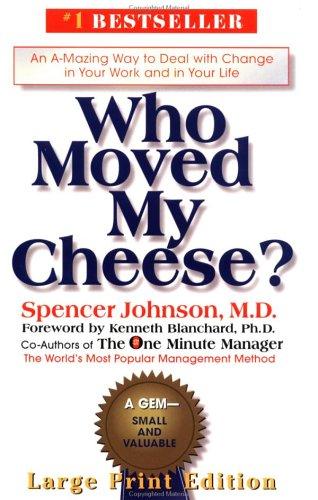
Who Moved My Cheese?
by Spencer Johnson
★ Top 5 book of 1998 · #5 on Best Books of 1998
This short parable follows two mice and two little people searching a maze for cheese, a metaphor for what you want in life. When unexpected change hits, one character copes and records his lessons, showing readers how to handle change with less stress.
Best for: Readers of any age wanting a quick story about coping with change
Who Moved My Cheese? is #5 on BookWard's Best Books of 1998, out of 36 1998 books that cleared our data bar.
What Who Moved My Cheese? is about
Two mice and two tiny people live in a maze, and all four are hunting for Cheese. For a while they find it in the same spot, Cheese Station C, and the two little people, Hem and Haw, settle in and make themselves at home. The mice, Sniff and Scurry, keep things simple and stay alert. When the supply at Station C runs dry, the mice head off to look elsewhere, while Hem and Haw stay put, confused, upset and hungry.
Spencer Johnson uses this small fable to talk about the things we chase in life: a good job, a loving relationship, money, health or peace of mind. It is framed as a story told by a business manager named Michael to old high school classmates after a reunion. It is meant for readers of any age and can be finished in under an hour. Anyone facing a shake-up at work or at home, or who tends to dig in when things shift, will find a plain, friendly nudge here.
Who Moved My Cheese? on the Best Books of 1998
Who Moved My Cheese? came out in 1998. Of the 36 books first published in 1998 that met BookWard's data bar, it ranks #5 on our Best Books of 1998 list.
Why it made the list: 1,821 readers have shelved it on Open Library; readers rate it 3.8 out of 5 (93 ratings); 136 are reading it right now. The list ranks each year’s books on how many readers have picked them up, how highly readers rate them, and how many are reading them right now.
It earns Being read right now.
Nearby on the 1998 list
- A Clash of Kings George R. R. Martin, #3
- Among the Hidden Margaret Peterson Haddix, #4
- No, David! David Shannon, #6
- The 7 Habits of Highly Effective Teens Sean Covey, #7
See all Best Books of 1998 Best books by year
More years: Best Books of 1997 Best Books of 1999.
The numbers behind it
- Readers: 1,536 want to read it, 136 are reading it now and 149 have read it, according to Open Library.
- Ratings: 3.8 out of 5 from 93 Open Library ratings.
| Signal | This book (0 to 100) | Weight |
|---|---|---|
| Reach | 94 | 55% |
| Reader love | 31 | 25% |
| Being read right now | 94 | 20% |
Questions about Who Moved My Cheese?
When was Who Moved My Cheese? published?
Who Moved My Cheese? by Spencer Johnson was first published in 1998.
Was Who Moved My Cheese? one of the best books of 1998?
Who Moved My Cheese? is #5 on BookWard's Best Books of 1998, out of 36 1998 books that cleared our data bar. 1,821 readers have shelved it on Open Library; readers rate it 3.8 out of 5 (93 ratings); 136 are reading it right now.
Why is Who Moved My Cheese? on the Best Books of 1998 list?
1,821 readers have shelved it on Open Library; readers rate it 3.8 out of 5 (93 ratings); 136 are reading it right now.
More of the best books of 1998
- Harry Potter and the Chamber of Secrets J. K. Rowling, #1
- Holes Louis Sachar, #2
- A Clash of Kings George R. R. Martin, #3
- Among the Hidden Margaret Peterson Haddix, #4
- No, David! David Shannon, #6
- The 7 Habits of Highly Effective Teens Sean Covey, #7
See the full Best Books of 1998, the Top 100, or new books on Rising.
How we know
This page uses public data: Open Library reader counts and ratings, and Wikipedia page views for recent years. The description is paraphrased from real source text. Rankings reflect reading interest, not quality or sales, and can be affected by data gaps. Lists update monthly.
Written for all ages, it suits adults and younger readers alike and takes less than an hour to read.
Depends on the edition you pick.
A cheese-in-a-maze parable that makes its point and gets out. 40% taste match
 BookWard’s take
A cheese-in-a-maze parable that makes its point and gets out
Spencer Johnson's 1998 fable runs on a single idea, that change comes whether you plan for it or not, and it never wanders from it. That makes it Tight and short, and it opens at once on a reunion where one man begins telling a story. The mice, Sniff and Scurry, and the Littlepeople, Hem and Haw, are deliberately types rather than Deeply drawn characters, and the lesson is Explained outright instead of shown in scene. Familiar tropes are everywhere, and the moral is Clear to the point of being handed over. BookWard prizes originality and earned subtlety, so this sits well off its usual taste. As a quick, fully resolved idea-led fable, though, it does exactly what it sets out to do.
A parable that takes under an hour to read, it stays as short and compact as a book can, which BookWard likes.
With a short, uncluttered story, events move briskly from the cheese running out to the search for more.
Fables about adapting to change are familiar territory, so the idea feels more useful than fresh.
The language is deliberately plain and simple, written for readers of all ages.
Events are driven by the cheese running out and how each character responds, which is plot built around the message.
The book argues that adapting leads to something better, which gives it an upbeat, encouraging outlook.
A frame story of old classmates wraps a linear fable, which is a neat device but a conventional one.
The tone is earnest and instructive, with light touches of whimsy but not much humor.
Hunger and fear of change are the worst it gets, and the tone stays gentle throughout.
Feelings like frustration and fear appear, but the book keeps them mild and instructive.
See all 50 dialsEvery position, side by side with this book
Where it lines up
- LengthBookWard 1 · book 1
- PaceBookWard 8 · book 8
- EndingBookWard 8 · book 8
Where it pulls apart
- Familiar tropesBookWard 10 · book 2
- Shock for effectBookWard 9 · book 1
- Rigor (nonfiction)BookWard 9 · book 2
A parable that takes under an hour to read, it stays as short and compact as a book can, which BookWard likes.
It starts quickly with a reunion and a story about to be told, though the real pull is the maze, not a dramatic opening.
The fable form, the plain animal-and-person archetypes and the business-book lesson are all well-worn, which cuts against BookWard's taste for the fresh.
The cheese-and-maze metaphor holds together cleanly from start to finish, and each character's choices follow from who they are.
With a short, uncluttered story, events move briskly from the cheese running out to the search for more.
Fables about adapting to change are familiar territory, so the idea feels more useful than fresh.
Sniff, Scurry, Hem and Haw stand for ways of reacting to change, not rounded people, so depth is thin by design.
The story resolves its central question and delivers its lesson plainly, leaving little open.
It is warm and encouraging in tone, though it stays brisk and avoids heavy emotional pull.
Nothing here relies on shock; the stakes are an empty cheese station and a fear of moving on.
It is a motivational fable built on metaphor and assertion, not evidence or research.
The simple parable tone is recognizable and consistent, though it reads as a self-help register, not a singular voice.
The story exists to carry a lesson about change, so the idea clearly leads and the plot serves it.
The moral is stated outright, with the lessons written on the maze walls and spelled out for the reader.
It is short enough that it never has room to sag, and every scene advances the point.
The language is deliberately plain and simple, written for readers of all ages.
Events are driven by the cheese running out and how each character responds, which is plot built around the message.
The book argues that adapting leads to something better, which gives it an upbeat, encouraging outlook.
A frame story of old classmates wraps a linear fable, which is a neat device but a conventional one.
The tone is earnest and instructive, with light touches of whimsy but not much humor.
Short, plain and openly explained, it asks almost nothing of the reader.
The story follows four characters in the maze, with a framing narrator, though it stays close to a simple shared line.
The fable moves forward in order, with only the reunion frame stepping outside the main story.
Mice and tiny Littlepeople in a maze make it a fable-world, though the metaphor is plainly real-life.
Four main characters in the maze plus a small group at the reunion keep the cast very small.
The stakes are personal and domestic, with a handful of characters and one hunt for food.
The characters act and move through the maze, but the real drama is each one's attitude to change.
Hem and Haw talk through their predicament, but speech is balanced with narration and not dominant.
There is no romantic thread; the book is about work, change and fear.
The maze is a simple, symbolic place, easy to grasp and not truly foreign.
First published in 1998, it reads as a business-culture parable that still feels current.
Change at work and in life is a lasting subject, and the fable form keeps it from dating badly.
The story is told straightforwardly by a character recounting a parable, with no reason to doubt it.
The lesson is stated plainly and unambiguously, with little room to read it any other way.
The maze and cheese stations are sketched in broad strokes, not rich detail.
It is told as a story with characters and incident, not as analysis or argument.
The frame story gives it a personal, conversational feel rather than a distant, detached one.
It stands on its own, though a later sequel exists, Out of the Maze, published in 2018.
The main turn, the cheese running out, arrives early and the rest follows a predictable arc.
It is reassuring and easy, offering encouragement more than any real challenge to the reader.
Hunger and fear of change are the worst it gets, and the tone stays gentle throughout.
Feelings like frustration and fear appear, but the book keeps them mild and instructive.
Any humor is light and gentle, in the form of a mild fable rather than broad comedy.
There is no violence in a story about cheese and a maze.
There is no sexual content at all.
The book is about personal and workplace change, not politics.
The language is plain throughout, with no dialect or dense phrasing.
It tells you directly what to think and how to act, which makes it strongly opinionated.
The message is about moving on and looking for what comes next, so it faces forward.
It holds that facing change brings better things, an optimistic and idealistic view.
Review written by BookWard, dial version 1, November 2026.
Who is Who Moved My Cheese? right for?
Written for all ages, it suits adults and younger readers alike and takes less than an hour to read. Nothing in it is sensitive beyond the stress and fear that come with change.
Short, plain and openly explained, it asks almost nothing of the reader.
Hunger and fear of change are the worst it gets, and the tone stays gentle throughout.
Feelings like frustration and fear appear, but the book keeps them mild and instructive.
There is no violence in a story about cheese and a maze.
Book CompanionWho Moved My Cheese?: ideas, characters, themes
Change is inevitable, and the people who adapt quickly, instead of clinging to what used to work, find new Cheese sooner.
- Cheese stands for what you want. In the story, Cheese is a metaphor for whatever you want in life, from a job to a relationship to peace of mind.
- The Maze is where you look. The Maze represents the organization, family or community in which you search for what you want.
- Two mice and two Littlepeople. Sniff and Scurry act on instinct and keep moving, while Hem and Haw rely on habit and settle at Cheese Station C.
- Fear is the obstacle. Haw only moves once he accepts that running the maze is the way to get Cheese again and faces his fear of moving on.
- The handwriting on the wall. Haw writes what he learns on the maze walls as he explores, which is how the book passes its lessons to the reader.
Characters
Sniff
A mouse
Simple and instinctive, he keeps running the maze and is always ready to move on.
Scurry
A mouse
Sniff's companion, equally quick to accept that the cheese is gone and carry on.
Hem
A Littleperson
Protests that there ought to be Cheese and refuses to leave Cheese Station C.
Haw
A Littleperson
Eventually accepts change, faces his fear and goes exploring, writing observations on the maze walls.
Michael
Business manager and storyteller
Tells the allegory to his old classmates after a reunion, explaining how it changed his fear of change.
Themes
Circumstances shift whether you want them to or not, and the book treats this as the central fact of life.
Hem's and Haw's reluctance to move shows how fear of the unknown keeps people stuck.
The mice and, later, Haw show that quick adjustment is what leads to new Cheese.
The Littlepeople grow attached to Cheese Station C and keep returning to what used to work.
Haw writes his lessons on the maze walls, turning his journey into advice for others.
Discussion questions
- Which character do you most resemble when your own plans change: the mice, Hem or Haw?
- What counts as Cheese in your own life, and what is your Maze?
- Why does the book use mice and tiny people instead of ordinary characters?
- Is the message that change is always good, or only that it is unavoidable?
- Does a short, plainly stated fable teach better than a longer, more nuanced book on the same subject?
Personalize your Book Companion
This is the general edition. In BookWard, the Companion is written for you: your reading profile, your notes, and spoiler-safe to the page you are on.
Buy, listen or borrow Who Moved My Cheese?
Each link opens a search for this book on that store, in a new tab.
Read on a device
Borrow
Reviews and community
If you liked Who Moved My Cheese?
A short, upbeat twelve-lesson manual that trades rigor for encouragement
The Compound EffectDarren HardySmall habits, big results: a short, forceful self-help pitch
The Phoenix ProjectGene KimA business novel that teaches DevOps through one manager's crisis
The Four AgreementsDon Miguel RuizFour short rules for living, delivered plainly and without padding
Find your own best books
Add what you have read, rate it, and BookWard will recommend what to read next.
Free to start. No credit card needed.