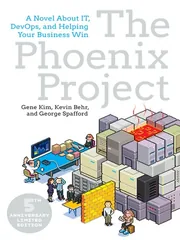
The Phoenix Project
by Gene Kim, Kevin Behr · 2013
Suits adult readers and working professionals, and is accessible to curious students interested in how tech teams run.
345 pages, about 5.5 to 8 hours.
A business novel that teaches DevOps through one manager's crisis. 41% taste match
What it covers
The Phoenix Project, first published in 2013, is a business novel from Gene Kim that sits in the Business & Money category. It is a work of fiction built around information technology, and it draws on ideas from DevOps, project management, planning, and management more broadly. The story follows an IT manager given a fixed window of ninety days to deal with a project that has run over budget and fallen behind schedule. That project carries the code name that gives the book its title.
The book uses its narrative to look at how technology work is organized inside a company, with attention to security measures and the handling of knowledge across a team. It runs to roughly 345 pages in its median edition, and about fifteen editions exist. Readers interested in IT operations, workplace management, or the way a story can frame professional practice will find the subject matter laid out through a single manager's assignment.
Themes
ITDevOpsProject ManagementInformation TechnologyPlanningManagementKnowledge managementSecurity measures
- Want to read 157
- Reading now 14
- Read 89
Readers are split between finishing it and saving it for later.
Of 260 readers who put it on a shelf, 60% want to read it, 5% are reading it now, 34% have finished it and 0% stopped before the end.
By the numbers
- The median edition runs 345 pages. Counting about 275 words a page and an adult reading pace of 250 words a minute, that is about 6.3 hours of reading.
- Open Library tracks 15 editions from 4 publishers, the earliest dated 2013 and the latest 2025.
- On reader demand it ranks in the top 2% of the modern books in our catalog (15,152 of them).
- Libraries shelve it under Dewey 813.6 and Library of Congress class PS-3611.00000000.I4538 P56 2018.
 BookWard’s take
A business novel that teaches DevOps through one manager's crisis
The Phoenix Project wraps its lessons about IT operations in a story: an IT manager has ninety days to rescue a late, over-budget initiative. It feels story-led, though the real payload is a set of ideas about how technology work should flow. The explaining is done outright, with characters often stating the principles in dialogue rather than letting scenes carry them, which is not how this reviewer likes to be taught. The opening is immediate, dropping the reader into a department already in trouble, and the pace stays brisk. It leans on familiar tropes, but that is part of the deal, since the crisis-and-mentor shape is the delivery system. As for rigor, this is a teaching fable rather than a measured study. Readers who want ideas wrapped in plot will get what they came for.
At 345 pages it is moderate, longer than a pamphlet but lean for a business book; BookWard prefers tighter.
A ninety-day deadline keeps events moving, close to the brisk pace BookWard enjoys.
Teaching DevOps through a novel was a fresh move for IT books, even if the story machinery is conventional.
The writing is plain and functional, aimed at clarity over ornament.
Events and problem-solving drive the book far more than any inner change in its people.
The premise of rescuing a failing project points toward optimism about what better practice can achieve.
A straightforward narrative with a single assignment and a countdown, nothing experimental.
The tone is earnest and workplace-serious, with little comedy.
The trouble is corporate stress and failure, not anything grim.
Pressure and frustration appear, but feelings stay in the background of a practical story.
See all 50 dialsEvery position, side by side with this book
Where it lines up
- EndingBookWard 8 · book 8
- PaceBookWard 8 · book 7
- OpeningBookWard 10 · book 8
Where it pulls apart
- Familiar tropesBookWard 10 · book 3
- ExpositionBookWard 2 · book 8
- Character depthBookWard 8 · book 3
At 345 pages it is moderate, longer than a pamphlet but lean for a business book; BookWard prefers tighter.
It opens on a department already in crisis, which pulls the reader in quickly and suits BookWard well.
The crisis-turnaround and wise-mentor shape is a familiar business-fable template, which cuts against BookWard's dislike of tropes.
The scenarios hold together well enough to teach from, though they are built to illustrate a method, not to withstand scrutiny.
A ninety-day deadline keeps events moving, close to the brisk pace BookWard enjoys.
Teaching DevOps through a novel was a fresh move for IT books, even if the story machinery is conventional.
Characters serve the lessons and are drawn broadly, short of the depth BookWard values.
A business turnaround story resolves its central problem, matching BookWard's taste for closure.
It reaches for uplift and triumph at the close, a bit warmer than BookWard's restrained preference.
The stakes are professional rather than shocking, so darkness is never used for effect.
It uses fiction to convey practice, so claims are illustrated by story rather than backed by study.
The voice is clear and workmanlike, serving the message more than showing a distinctive style.
The story exists to carry the ideas about IT and DevOps, so it leans idea-led, unlike BookWard's story-first lean.
Principles are frequently spelled out in conversation, the opposite of BookWard's preference for showing in scene.
A steady stream of new problems and fixes holds momentum, though the lesson-per-chapter rhythm can feel repetitive.
The writing is plain and functional, aimed at clarity over ornament.
Events and problem-solving drive the book far more than any inner change in its people.
The premise of rescuing a failing project points toward optimism about what better practice can achieve.
A straightforward narrative with a single assignment and a countdown, nothing experimental.
The tone is earnest and workplace-serious, with little comedy.
Accessible to general readers, with technical terms explained as the story goes.
The story follows one manager's assignment, keeping a single viewpoint.
The ninety-day window gives it a linear, forward-moving timeline.
Entirely grounded in the ordinary world of corporate IT.
A moderate roster of colleagues and executives, enough to represent a company's functions.
Stakes live inside one company and its IT department, an intimate organizational scale.
Attention goes to meetings, outages, and decisions rather than introspection.
Ideas travel mostly through conversations among colleagues, making the book dialogue-heavy.
This is workplace drama with no romantic thread at its center.
The corporate IT setting will be familiar to those in tech and new to outsiders.
Published in 2013 about modern technology work, it reads as fairly current, though tools date quickly.
The management principles last longer than the specific technology, but the details tie it to its period.
A straightforward account of a manager's assignment, with no sign of narrator trickery.
It argues for a clear way of working, with good and bad practice sharply drawn.
Settings are sketched only as needed to frame the action and the lessons.
Presented as a novel, it is firmly narrative rather than analytical in form.
Told through a single character's experience, it feels close rather than detached.
A standalone book, though it is the third by its author.
Setbacks and reversals arrive as the project unfolds, but the overall direction is predictable.
It reassures more than it unsettles, offering a path out of dysfunction.
The trouble is corporate stress and failure, not anything grim.
Pressure and frustration appear, but feelings stay in the background of a practical story.
Any humor is light and wry, tied to office frustrations.
No violence to speak of.
No sexual content to speak of.
Office politics appear within the company, though broader politics stay out.
Plain language with some IT jargon.
It argues openly for a particular way of working, so the stance is strong.
It points toward improved ways of working ahead rather than dwelling on the past.
It believes organizations can fix themselves with better practice, a decidedly idealistic view.
Review written by BookWard, dial version 1, November 2026.
Who is The Phoenix Project right for?
Suits adult readers and working professionals, and is accessible to curious students interested in how tech teams run. Nothing sensitive in content; the main strain is workplace stress.
Accessible to general readers, with technical terms explained as the story goes.
The trouble is corporate stress and failure, not anything grim.
Pressure and frustration appear, but feelings stay in the background of a practical story.
No violence to speak of.
Book CompanionThe Phoenix Project: ideas, characters, themes
A failing IT initiative can be rescued by changing how work flows through an organization, told as the story of one manager's ninety-day assignment.
- A deadline forces the stakes. The IT manager has ninety days to rescue a late, over-budget project, which gives the story its urgency.
- IT work is a business matter. The book frames technology operations as central to whether a company succeeds, not a back-office concern.
- DevOps as a way of working. Ideas from DevOps, project management, and planning are presented through events in the story.
- Security and knowledge matter. The book gives attention to security measures and how knowledge is handled across a team.
- Fiction as a teaching tool. A single manager's assignment is used to lay out professional practice in narrative form.
Characters
The IT manager
Protagonist
Given ninety days to rescue the troubled project that gives the book its title.
Themes
How a team or company can alter its habits to get better results.
The idea that technology operations decide business outcomes.
Taking a late, over-budget effort and bringing it back under control.
Using a narrative to make professional lessons easier to absorb.
Departments working together rather than in isolation.
Discussion questions
- Does framing these ideas as a novel make them easier or harder to take seriously?
- Which problems in the book match ones you have seen at work?
- How realistic is a ninety-day turnaround?
- Where does the story feel like it is stopping to teach?
- What would you change first in your own team after reading it?
Personalize your Book Companion
This is the general edition. In BookWard, the Companion is written for you: your reading profile, your notes, and spoiler-safe to the page you are on.
Buy, listen or borrow The Phoenix Project
Each link opens a search for this book on that store, in a new tab.
Read on a device
Borrow
Reviews and community
If you liked The Phoenix Project
92 named conversation techniques, built to be used at your next party
The Lean StartupEric RiesA business method built on testing ideas against real customers early
Never Split the DifferenceChris VossHostage-negotiation tactics, turned into a handbook for everyday deals
I Will Teach You to Be RichRamit SethiA practical six-week money system with a bossy, friendly voice
Sources: Open Library.
Track The Phoenix Project and find your next favorite
Add it to your shelf, rate what you have read, and BookWard will recommend what fits you.
Free to start. No credit card needed.