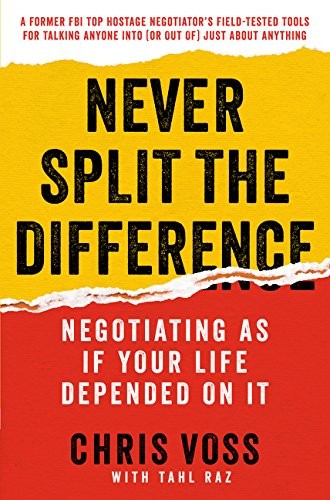
Never Split the Difference
by Chris Voss
★ Top 5 book of 2016 · #4 on Best Books of 2016
Former FBI hostage negotiator Chris Voss distills techniques from his career, from Kansas City streets to international kidnapping cases, into practical negotiation principles. He shows how they apply to work, buying a car, raises, rent and family life.
Best for: Professionals and everyday people who want to negotiate better at work and home
Never Split the Difference is #4 on BookWard's Best Books of 2016, out of 70 2016 books that cleared our data bar.
What Never Split the Difference is about
Chris Voss policed the streets of Kansas City, Missouri, before becoming the FBI's lead international kidnapping negotiator. Here he lays out what he learned there, along with the lessons he later taught to students in leading business schools. His argument is that good negotiation is less about compromise than about listening, understanding the other person's emotions, and persuading with care. He illustrates the ideas with high-stakes stories, from the dangerous streets of Haiti to a bank robbery in Brooklyn that went wrong.
Voss then turns these crisis skills toward ordinary life. The techniques have helped businesses, MBA students looking for better jobs, and even parents handling their children. Anyone who negotiates a salary, a deal or a family disagreement will find practical, confidently told advice.
Never Split the Difference on the Best Books of 2016
Never Split the Difference came out in 2016. Of the 70 books first published in 2016 that met BookWard's data bar, it ranks #4 on our Best Books of 2016 list.
Why it made the list: 1,679 readers have shelved it on Open Library; readers rate it 4.2 out of 5 (77 ratings); 80 are reading it right now. The list ranks each year’s books on how many readers have picked them up, how highly readers rate them, and how many are reading them right now.
It earns Being read right now.
Nearby on the 2016 list
- Dog Man Dav Pilkey, #2
- The Subtle Art of Not Giving a F*ck Mark Manson, #3
- The Hidden Oracle Rick Riordan, #5
- Born a Crime Trevor Noah, #6
See all Best Books of 2016 Best books by year
More years: Best Books of 2015 Best Books of 2017.
The numbers behind it
- Readers: 1,504 want to read it, 80 are reading it now and 95 have read it, according to Open Library.
- Ratings: 4.2 out of 5 from 77 Open Library ratings.
| Signal | This book (0 to 100) | Weight |
|---|---|---|
| Reach | 90 | 55% |
| Reader love | 77 | 25% |
| Being read right now | 90 | 20% |
Questions about Never Split the Difference
When was Never Split the Difference published?
Never Split the Difference by Chris Voss was first published in 2016.
Was Never Split the Difference one of the best books of 2016?
Never Split the Difference is #4 on BookWard's Best Books of 2016, out of 70 2016 books that cleared our data bar. 1,679 readers have shelved it on Open Library; readers rate it 4.2 out of 5 (77 ratings); 80 are reading it right now.
Why is Never Split the Difference on the Best Books of 2016 list?
1,679 readers have shelved it on Open Library; readers rate it 4.2 out of 5 (77 ratings); 80 are reading it right now.
More of the best books of 2016
- It Ends with Us Colleen Hoover, #1
- Dog Man Dav Pilkey, #2
- The Subtle Art of Not Giving a F*ck Mark Manson, #3
- The Hidden Oracle Rick Riordan, #5
- Born a Crime Trevor Noah, #6
- Ikigai Héctor García, #7
See the full Best Books of 2016, the Top 100, or new books on Rising.
How we know
This page uses public data: Open Library reader counts and ratings, and Wikipedia page views for recent years. The description is paraphrased from real source text. Rankings reflect reading interest, not quality or sales, and can be affected by data gaps. Lists update monthly.
Suits adult and older teen readers interested in work, money or communication.
Depends on the edition you pick.
Hostage-negotiation tactics, turned into a handbook for everyday deals. 55% taste match
 BookWard’s take
Hostage-negotiation tactics, turned into a handbook for everyday deals
Chris Voss, a former FBI lead international kidnapping negotiator, builds his argument around real crises, from a Brooklyn bank robbery gone horribly wrong to the streets of Haiti, and then carries the same techniques into salary talks, car buying and family disputes. The opening hooks at once because the stakes are lives, not margins. The book leans toward story over abstract ideas: each principle arrives through a scene, which works well for a reader who would rather be shown a lesson than have it explained. The voice is distinctive, the plain talk of a working negotiator. Rigor is the open question, since anecdote carries much of the proof. Readers wanting airtight logic should weigh the cases against the claims.
A full-length handbook, not a sprawling one; each chapter delivers a technique and moves on, which suits a taste for tight books.
Short scenes alternate with short lessons, so it moves briskly and rarely lingers.
Applying crisis-negotiation methods to ordinary deals is a distinctive angle, even if some advice echoes other business books.
The writing is plain and functional, close to BookWard's slightly plain-leaning preference.
Technique and situation drive the book, not any character's development.
The premise is that skill can turn bad situations around, which gives it a constructive, hopeful outlook.
A conventional run of chapters, each pairing a story with a principle.
The tone is serious and practical, with only light moments.
Kidnapping and robbery cases bring weight, handled in service of the lessons.
Stakes can be tense, but the dominant register is practical rather than moving.
See all 50 dialsEvery position, side by side with this book
Where it lines up
- OpeningBookWard 10 · book 9
- PaceBookWard 8 · book 7
- EndingBookWard 8 · book 7
Where it pulls apart
- Familiar tropesBookWard 10 · book 5
- LengthBookWard 1 · book 5
- Internal logicBookWard 10 · book 6
A full-length handbook, not a sprawling one; each chapter delivers a technique and moves on, which suits a taste for tight books.
It opens inside a live hostage crisis, so the pull is immediate, exactly the kind of start BookWard rewards.
The business-advice genre has its stock moves, though the hostage cases give familiar lessons a fresher setting.
The techniques follow a clear sequence, but the case for them rests on stories more than tested argument.
Short scenes alternate with short lessons, so it moves briskly and rarely lingers.
Applying crisis-negotiation methods to ordinary deals is a distinctive angle, even if some advice echoes other business books.
People appear as negotiators and counterparts in service of a lesson, not as fully drawn individuals.
Each chapter closes its lesson cleanly, which fits BookWard's liking for resolution.
Stakes are real, but the telling stays practical and rarely lingers on feeling.
The dark situations serve the lessons rather than existing for effect, which BookWard values.
Evidence leans on first-person field stories more than studies, a weaker fit for BookWard's taste for rigor.
Voss writes in the confident, plain voice of a practitioner, easy to tell apart from generic business prose.
Ideas arrive wrapped in stories, so it sits nearer story-led, which BookWard prefers.
Scenes come first, but the lessons are then spelled out as rules, pulling it toward explaining.
The chapter-by-chapter structure keeps each section purposeful, so the middle holds up well.
The writing is plain and functional, close to BookWard's slightly plain-leaning preference.
Technique and situation drive the book, not any character's development.
The premise is that skill can turn bad situations around, which gives it a constructive, hopeful outlook.
A conventional run of chapters, each pairing a story with a principle.
The tone is serious and practical, with only light moments.
Easy to follow and easy to put into practice, with no heavy lifting required.
Told from Voss's own vantage throughout.
Mostly follows his career and its cases in a workable order, with occasional steps back.
Entirely grounded in real events and real negotiations.
Appears as a small set of recurring colleagues and counterparts rather than a crowd.
Moves between high-stakes crises and everyday deals, but stays at human, personal scale.
Concerned with tactics, behaviour and what is said aloud, more than inner reflection.
Negotiation is conversation, so exchanges and sample phrases carry much of the teaching.
Essentially absent; family and partner disputes appear only as places to use the techniques.
Takes readers into unfamiliar crisis settings, then back to familiar office and home scenes.
Rooted in contemporary practice and modern business settings.
Human negotiation habits endure, though the framing is clearly of its business-book moment.
Voss tells his own account straightforwardly, with no sense of a narrator hiding the ball.
The ethics are mostly clear, aimed at winning better outcomes, with few gray areas explored.
Setting is sketched quickly to support the scene, not dwelt on.
Leans narrative, built from retold episodes more than analysis.
Voss draws heavily on his own career, so it reads as a personal account.
A standalone book, complete in itself.
Some cases turn unexpectedly, but the structure is mostly instruction, not reveals.
It asks readers to rethink instincts about winning and compromise, though gently.
Kidnapping and robbery cases bring weight, handled in service of the lessons.
Stakes can be tense, but the dominant register is practical rather than moving.
Humor is occasional and dry rather than broad.
Crimes and crises are recounted, but the focus stays on talking people down.
Not a feature of the book.
Concerned with personal and professional dealings, not political argument.
Clear, plain language with no dense or dialect-heavy passages.
Strongly opinionated: Voss argues firmly for his methods and against conventional compromise.
Draws on past cases but aims at what readers will do next.
Optimistic that better outcomes are achievable with the right approach, while staying hard-nosed.
Review written by BookWard, dial version 1, November 2026.
Who is Never Split the Difference right for?
Suits adult and older teen readers interested in work, money or communication. It recounts kidnappings and a robbery gone wrong, handled without graphic focus.
Easy to follow and easy to put into practice, with no heavy lifting required.
Kidnapping and robbery cases bring weight, handled in service of the lessons.
Stakes can be tense, but the dominant register is practical rather than moving.
Crimes and crises are recounted, but the focus stays on talking people down.
Book CompanionNever Split the Difference: ideas, characters, themes
Negotiation is a skill of understanding and influencing the other side, learned from hostage work, and it applies to everyday deals.
- Crisis lessons, daily use. Techniques refined in kidnapping cases are presented as usable in salary talks, purchases and family disputes.
- Stories carry the method. Cases such as a Brooklyn bank robbery and work in Haiti illustrate each principle.
- Never split the difference. The title signals a challenge to the habit of settling halfway as the default.
- A career behind it. Voss moves from Kansas City policing to FBI international kidnapping work to teaching in business schools.
- Life as negotiation. The book treats buying a car, asking for a raise and renegotiating rent as the same underlying skill.
Characters
Chris Voss
Author and narrator
A former FBI lead international kidnapping negotiator who later taught negotiation at business schools.
Themes
Shaping outcomes by understanding the person across the table.
Questioning whether meeting in the middle is really a good result.
How life-or-death pressure sharpens skills that help in ordinary disputes.
Turning hard-won field experience into techniques others can use.
Discussion questions
- Where in your own life have you settled halfway when you could have pushed for more?
- How convincing are stories from crisis work as evidence for everyday negotiating advice?
- Which technique would you most want to try, and in what situation?
- Does treating life as a series of negotiations help or distort relationships like family and friends?
- What would stronger evidence, such as studies, have added to the book's claims?
Personalize your Book Companion
This is the general edition. In BookWard, the Companion is written for you: your reading profile, your notes, and spoiler-safe to the page you are on.
Buy, listen or borrow Never Split the Difference
Each link opens a search for this book on that store, in a new tab.
Read on a device
Borrow
Reviews and community
If you liked Never Split the Difference
A dying woman has one week to find her attacker
The Street LawyerJohn GrishamA big-firm lawyer walks out and takes a secret file with him
The Boy Who Harnessed the WindWilliam KamkwambaA Malawian teenager builds a windmill from scrap and stubbornness
The 50Th LawRobert GreeneFearlessness as strategy, told through 50 Cent and history's hard cases
Find your own best books
Add what you have read, rate it, and BookWard will recommend what to read next.
Free to start. No credit card needed.