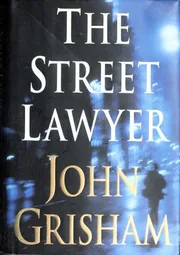
The Street Lawyer
by John Grisham · 1989
Suits adult and mature teen readers who enjoy legal thrillers.
413 pages, about 6.5 to 9.5 hours.
A big-firm lawyer walks out and takes a secret file with him. 56% taste match
The story
The Street Lawyer is a legal thriller by John Grisham, first published in 1989 and set in Washington, D.C. It follows Michael Brock, an associate at Drake & Sweeney, a large law firm in the city. Brock is working long billable hours and is close to being named a partner when a homeless man holds nine lawyers hostage inside the firm's offices. The standoff ends violently, and the experience pushes Brock to reconsider the life he has built.
Brock walks away from his career at the firm and takes up work among the city's homeless, offering legal help to people who have little power of their own. His past does not stay behind him, though. A confidential file connected to Drake & Sweeney comes into his possession, and with it a conspiracy that has already cost lives. His former partners come to see him as a threat, and he is drawn into a conflict with the firm he left.
The novel combines courtroom and law firm settings with a mystery about corruption among lawyers. It runs about 413 pages in its typical edition and has appeared in many editions over the years.
THE MAN with the rubber boots stepped into the elevator behind me, but I didn't see him at first.
Setting
Washington (D.C.)
Themes
Legal storiesLawyersLiteratureMysteryWashington (D.C.)Homeless personsRoman américainPolitical correctness
- Want to read 163
- Reading now 16
- Read 42
Most people shelving it are saving it for later.
Of 221 readers who put it on a shelf, 74% want to read it, 7% are reading it now, 19% have finished it and 0% stopped before the end.
By the numbers
- The median edition runs 413 pages. Counting about 275 words a page and an adult reading pace of 250 words a minute, that is about 7.6 hours of reading.
- Open Library tracks 59 editions from 41 publishers, the earliest dated 1989 and the latest 2018, across 8 languages.
- On reader demand it ranks in the top 3% of the modern books in our catalog (15,152 of them).
- Libraries shelve it under Dewey 813.54 and Library of Congress class PS-3557.00000000.R5355 S715 2000.
 BookWard’s take
A big-firm lawyer walks out and takes a secret file with him
The Street Lawyer opens with a hostage standoff in a plush D.C. law firm, so the hook is immediate, and a quick start is exactly what a thriller should deliver. At 413 pages it runs longer than I'd like, but the pace stays brisk and the middle holds. Michael Brock's turn from billable hours to legal work for the homeless gives the book real moral weight, and the conspiracy plot keeps its logic tight. The familiar legal-thriller machinery means it leans on well-worn tropes, and the originality is modest. Still, the lead is drawn with more care than the genre usually bothers with, and the ending resolves. A solid, readable thriller with a conscience.
At 413 pages it is longer than BookWard's taste for tight books, though the story justifies most of it.
Scenes move quickly and the stakes keep rising, close to BookWard's preferred speed.
The premise is a sturdy variation on a familiar genre template rather than something new, which sits below BookWard's appetite.
The prose is clean and functional rather than ornate, a bit plainer than BookWard's middle ground.
Events drive the book, though Brock's inner change powers them, leaving it leaning toward plot.
Brock finds purpose in helping others, so the book ends up more hopeful than bleak, as BookWard likes.
It follows a conventional forward line from crisis to conflict, more traditional than BookWard's middle.
The tone is serious throughout, with little humor, which is more earnest than BookWard's lean toward wit.
A deadly standoff and a conspiracy that has taken lives give it a serious edge without turning bleak.
Brock's guilt and the plight of the homeless carry real feeling, kept in check by the thriller frame.
See all 50 dialsEvery position, side by side with this book
Where it lines up
- PaceBookWard 8 · book 8
- EndingBookWard 8 · book 8
- OpeningBookWard 10 · book 9
Where it pulls apart
- Familiar tropesBookWard 10 · book 4
- LengthBookWard 1 · book 6
- OriginalityBookWard 9 · book 4
At 413 pages it is longer than BookWard's taste for tight books, though the story justifies most of it.
A homeless man takes nine lawyers hostage in the opening stretch, which grabs the reader at once, just as BookWard likes.
The big-firm conspiracy and the lawyer with a reawakened conscience are well-worn legal-thriller ground, short of BookWard's preference for fresh material.
The plot runs on a clear chain of cause and consequence, from the standoff to the file to the firm's response.
Scenes move quickly and the stakes keep rising, close to BookWard's preferred speed.
The premise is a sturdy variation on a familiar genre template rather than something new, which sits below BookWard's appetite.
Brock's change of heart gives him a real arc, though the supporting cast is drawn more lightly than BookWard prefers.
The central conflict with the firm is brought to a firm close, in line with BookWard's liking for resolution.
The story invites sympathy for the homeless and does not shy from feeling, so it is a little warmer than BookWard's restraint.
The violence of the opening standoff serves the story's turn instead of being decoration, which BookWard values.
This is a novel, so the dial does not apply.
Grisham's plain, assured storytelling is recognisable, though less distinctive than BookWard's ideal.
Ideas about wealth and justice are carried by the plot, so it is story-led, as BookWard prefers.
Legal and firm detail is mostly woven into scenes, with some explaining, near BookWard's taste for showing.
The mystery thread keeps tension up across the whole length, matching BookWard's wish for a sustained middle.
The prose is clean and functional rather than ornate, a bit plainer than BookWard's middle ground.
Events drive the book, though Brock's inner change powers them, leaving it leaning toward plot.
Brock finds purpose in helping others, so the book ends up more hopeful than bleak, as BookWard likes.
It follows a conventional forward line from crisis to conflict, more traditional than BookWard's middle.
The tone is serious throughout, with little humor, which is more earnest than BookWard's lean toward wit.
The writing is easy to follow, a lighter read than BookWard's mid-level effort.
The story stays with Brock's perspective, narrower than BookWard's taste for many viewpoints.
Events unfold in order without time jumps, more linear than BookWard's usual mix.
It is firmly grounded in a real Washington, D.C. of law firms and shelters.
A modest circle of lawyers and clients keeps the cast manageable.
The story centers on one man and one firm, personal rather than epic.
Action and confrontation lead, though Brock's reflection on his choices is a steady undercurrent.
Much of the drama plays out in conversations and confrontations between lawyers and clients.
Relationships matter to Brock's life, but the book is driven by the conspiracy, not a love story.
The world of a big D.C. firm and the city's homeless services is less familiar to most readers than everyday settings.
The book is set in a late-twentieth-century Washington, not the present day, but it feels recent.
Its concerns about money, conscience and the poor have lasting relevance, though the legal-thriller packaging dates a little.
The account of Brock's story is straightforward and trustworthy.
The book sides clearly with conscience over profit, clearer than BookWard's taste for ambiguity.
Settings are sketched efficiently without lingering, lighter than rich description.
This is fiction, so the dial does not apply.
This is fiction, so the dial does not apply.
It reads as a standalone novel.
The file and the conspiracy supply turns that keep the reader guessing, close to BookWard's liking for surprises.
It asks the reader to look at homelessness and corporate ethics, but remains an engaging thriller more than a hard book.
A deadly standoff and a conspiracy that has taken lives give it a serious edge without turning bleak.
Brock's guilt and the plight of the homeless carry real feeling, kept in check by the thriller frame.
Humor is sparse and mostly dry when it appears.
The opening standoff and the conspiracy's deadly reach bring some violence, though it is not the focus.
Sexual content is minimal.
Homelessness and legal aid are core to the story, giving it a clear social stance.
The language is plain and accessible, with only some legal terms.
The story leans toward one side of its moral argument, giving it a mild point of view.
Brock's move is about starting over, a turn toward a better future more than dwelling on the past.
A man gives up wealth to serve the powerless, an idealistic arc that outweighs the cynicism of the firm.
Review written by BookWard, dial version 1, November 2026.
Who is The Street Lawyer right for?
Suits adult and mature teen readers who enjoy legal thrillers. It includes a violent hostage standoff, deaths tied to a conspiracy, and a sympathetic but sometimes stark look at homelessness.
The writing is easy to follow, a lighter read than BookWard's mid-level effort.
A deadly standoff and a conspiracy that has taken lives give it a serious edge without turning bleak.
Brock's guilt and the plight of the homeless carry real feeling, kept in check by the thriller frame.
The opening standoff and the conspiracy's deadly reach bring some violence, though it is not the focus.
Book CompanionThe Street Lawyer: ideas, characters, themes
A rising big-firm lawyer leaves his career after a violent hostage standoff and finds that his past, and a dangerous secret, will not let him go.
- A crisis that changes everything. A homeless man takes nine lawyers hostage at Drake & Sweeney, and the aftermath shakes Michael Brock's sense of the life he has built.
- From billable hours to the street. Brock gives up his near-partnership and takes up legal work for homeless people who have little power.
- A file he should not have. A confidential file tied to the firm comes into his hands and exposes a conspiracy that has already cost lives.
- Former colleagues turned enemies. The partners he left now see him as a threat, turning his new life into a conflict with his old one.
- Law as both weapon and shield. The book sets the money and power of a large firm against the needs of the voiceless, in courtroom and law firm settings.
Characters
Michael Brock
Protagonist
A Drake & Sweeney associate near partnership who leaves for legal work among the homeless after the hostage crisis.
Themes
What a person gives up, or refuses to give up, once they see the human cost of success.
How the law serves those with money and neglects those without.
How a respected institution can hide wrongdoing behind prestige.
Whether a person can walk away from a career and the life that came with it.
Discussion questions
- Why does the hostage standoff change Brock when it might have changed no one else?
- Is Brock's leap from partnership track to street work believable, and what does it cost him?
- How does the book portray the firm's response to someone who knows its secrets?
- What does the novel suggest lawyers owe to people who cannot pay?
- Does the thriller plot strengthen or distract from the social questions it raises?
Personalize your Book Companion
This is the general edition. In BookWard, the Companion is written for you: your reading profile, your notes, and spoiler-safe to the page you are on.
Buy, listen or borrow The Street Lawyer
Each link opens a search for this book on that store, in a new tab.
Read on a device
Borrow
Reviews and community
If you liked The Street Lawyer
A young lawyer, a crooked insurer, and a case worth winning
The ClientJohn GrishamA boy, a dead body, and a lawyer worth rooting for
The FirmJohn GrishamA fast, polished legal thriller that made Grisham a household name
Strangers in TimeDavid BaldacciTwo wartime orphans, a bookshop, and a widower with secrets
Sources: Open Library.
Track The Street Lawyer and find your next favorite
Add it to your shelf, rate what you have read, and BookWard will recommend what fits you.
Free to start. No credit card needed.