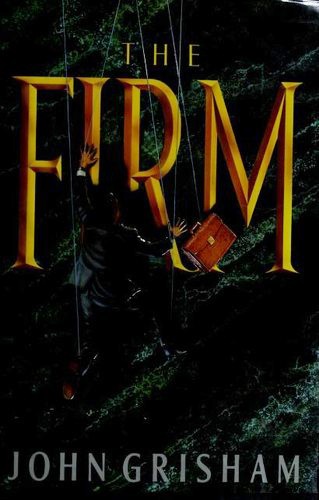
The Firm
by John Grisham
★ Top 5 book of 1991 · #5 on Best Books of 1991
This legal thriller was John Grisham's second book. It was the first of his novels to win a wide readership.
Best for: Legal thriller fans curious about the book that made Grisham popular
The Firm is #5 on BookWard's Best Books of 1991, out of 23 1991 books that cleared our data bar.
What The Firm is about
Mitch McDeere graduated third in his class at Harvard Law School, has a loving wife in Abby, and has a family past he'd rather leave behind: one brother is in prison and another died in Vietnam. Then a small Memphis tax firm, Bendini, Lambert and Locke, offers him a big salary, a new car and a low-interest mortgage. It looks like the break of a lifetime. But two of the firm's lawyers have just died in a diving accident, and Mitch begins to grow suspicious. John Grisham's second book, and the first to find a wide readership, is a legal thriller about ambition, temptation and what a good offer can cost. It moves quickly and suits anyone who likes a story where the pressure keeps rising.
The Firm on the Best Books of 1991
The Firm came out in 1991. Of the 23 books first published in 1991 that met BookWard's data bar, it ranks #5 on our Best Books of 1991 list.
Why it made the list: 459 readers have shelved it on Open Library; readers rate it 4 out of 5 (22 ratings); 28 are reading it right now. The list ranks each year’s books on how many readers have picked them up, how highly readers rate them, and how many are reading them right now.
Nearby on the 1991 list
- American Psycho Bret Easton Ellis, #3
- Shiloh Phyllis Reynolds Naylor, #4
- Reaper Man Terry Pratchett, #6
- Chrysanthemum Kevin Henkes, #7
See all Best Books of 1991 Best books by year
More years: Best Books of 1990 Best Books of 1992.
The numbers behind it
- Readers: 364 want to read it, 28 are reading it now and 66 have read it, according to Open Library.
- Ratings: 4 out of 5 from 22 Open Library ratings.
| Signal | This book (0 to 100) | Weight |
|---|---|---|
| Reach | 83 | 55% |
| Reader love | 43 | 25% |
| Being read right now | 87 | 20% |
Questions about The Firm
When was The Firm published?
The Firm by John Grisham was first published in 1991.
Was The Firm one of the best books of 1991?
The Firm is #5 on BookWard's Best Books of 1991, out of 23 1991 books that cleared our data bar. 459 readers have shelved it on Open Library; readers rate it 4 out of 5 (22 ratings); 28 are reading it right now.
Why is The Firm on the Best Books of 1991 list?
459 readers have shelved it on Open Library; readers rate it 4 out of 5 (22 ratings); 28 are reading it right now.
More of the best books of 1991
- Outlander Diana Gabaldon, #1
- Needful Things Stephen King, #2
- American Psycho Bret Easton Ellis, #3
- Shiloh Phyllis Reynolds Naylor, #4
- Reaper Man Terry Pratchett, #6
- Chrysanthemum Kevin Henkes, #7
See the full Best Books of 1991, the Top 100, or new books on Rising.
How we know
This page uses public data: Open Library reader counts and ratings, and Wikipedia page views for recent years. The description is paraphrased from real source text. Rankings reflect reading interest, not quality or sales, and can be affected by data gaps. Lists update monthly.
Suits adult and older teen readers who enjoy thrillers.
Depends on the edition you pick.
A fast, polished legal thriller that made Grisham a household name. 51% taste match
 BookWard’s take
A fast, polished legal thriller that made Grisham a household name
The Firm, published in 1991, is the book that turned John Grisham into a bestselling name, and it earns that through momentum. A young Harvard-trained lawyer accepts a job offer too generous to be real, and the book moves briskly from that uneasy premise. The hook is as strong as they come: the setup is clear and compelling almost immediately. The pace is fast, and the logic is tidy, with each piece of the trap clicking into place. Where it falls short for me is in familiarity and originality: this is a well-worn genre shape, executed with confidence rather than reinvention. The characters are serviceable more than deep, since plot does the heavy lifting. If you want a sharp, propulsive thriller with a clean ending, this delivers. If you crave surprise in form or voice, expect polish instead.
A full-length commercial thriller that runs longer than BookWard's taste for tight, though it rarely feels padded.
Short, driving chapters keep it moving, matching BookWard's preference for speed.
A polished take on a well-established genre mould rather than a fresh idea, short of BookWard's appetite for originality.
Plain, efficient sentences built for clarity and speed rather than ornament.
Plot drives the book from first page to last, with character in support.
Dark conspiracy theme, yet the outlook leans toward ingenuity and survival rather than despair.
A conventional forward-moving thriller structure with no formal experiments.
A serious, tense tone with little levity.
See all 50 dialsEvery position, side by side with this book
Where it lines up
- PaceBookWard 8 · book 8
- EndingBookWard 8 · book 8
- OpeningBookWard 10 · book 9
Where it pulls apart
- Familiar tropesBookWard 10 · book 4
- LengthBookWard 1 · book 6
- Rigor (nonfiction)BookWard 9 · book 3
A full-length commercial thriller that runs longer than BookWard's taste for tight, though it rarely feels padded.
A too-good job offer sets the trap almost at once, which is exactly the fast start BookWard likes.
It works inside familiar legal-thriller and innocent-in-over-his-head conventions, which sits below BookWard's wish to avoid tropes.
The scheme and the protagonist's countermoves fit together cleanly, close to the airtight plotting BookWard values.
Short, driving chapters keep it moving, matching BookWard's preference for speed.
A polished take on a well-established genre mould rather than a fresh idea, short of BookWard's appetite for originality.
Mitch is drawn with enough background to care about, but characters serve the plot more than they deepen it.
The central conflict is brought to a firm conclusion, in line with BookWard's liking for resolution.
Marriage and loyalty carry some warmth, but the book stays mostly matter-of-fact about feelings.
Menace and deaths raise the stakes and mostly serve the plot, though some darkness is there for tension.
Nonfiction rigor does not apply to this novel.
Clear, confident and readable, but closer to genre-standard than strikingly personal.
Firmly story-led: the scheme and the escape drive everything, with ideas kept in the background.
Legal and financial detail is mostly folded into scenes, with occasional explaining where the mechanics need it.
Tension holds steady across the book without a long dead stretch, which suits BookWard.
Plain, efficient sentences built for clarity and speed rather than ornament.
Plot drives the book from first page to last, with character in support.
Dark conspiracy theme, yet the outlook leans toward ingenuity and survival rather than despair.
A conventional forward-moving thriller structure with no formal experiments.
A serious, tense tone with little levity.
Easy to read, and the legal material is made accessible, a notch below what BookWard tolerates.
Events unfold in a straight line from the job offer onward.
Entirely realistic and grounded in the world of law and crime.
A manageable ensemble of partners, associates, investigators and family rather than a sprawling roster.
A personal fight against one firm, though the stakes reach into organised crime.
Driven by action, investigation and pursuit more than inner reflection.
Conversations carry much of the intrigue, from interviews to tense confrontations.
His marriage matters to the story, but romance is not the engine.
The world of a Memphis law firm is specific, but readers will find it fairly familiar in thriller terms.
A product of the early 1990s, so it reads as a period piece today.
The premise of a too-good-to-be-true job travels well, even if the details date.
A straightforward, trustworthy narration with no games played.
Right and wrong are fairly clear, with a little moral compromise in how the hero fights back.
Setting is sketched efficiently with enough detail to ground scenes, not to linger.
Review written by BookWard, dial version 1, November 2026.
Who is The Firm right for?
Suits adult and older teen readers who enjoy thrillers. It deals with murder, organised crime and threats, which may unsettle younger readers.
Easy to read, and the legal material is made accessible, a notch below what BookWard tolerates.
Book CompanionThe Firm: ideas, characters, themes
A talented, hungry young lawyer discovers that a perfect job offer hides a trap and must outwit the firm that owns him.
- The offer. A small Memphis tax firm tempts Mitch McDeere with a salary, car and mortgage that seem too generous.
- The warning signs. Deaths of firm lawyers and memorial plaques make Mitch start to doubt what he has joined.
- Investigation. Mitch hires a private investigator to look into the deaths, which raises the danger.
- The FBI. An agent approaches Mitch and puts him in an impossible position between the firm and the law.
- A popular breakthrough. Published in 1991, it was Grisham's second book and the first to find wide popularity.
Characters
Mitch McDeere
Protagonist
A Harvard-trained accountant and lawyer who joins the firm and starts to question it.
Abby McDeere
Mitch's wife
His high-school sweetheart, whose life is drawn into his troubles.
Eddie Lomax
Private investigator
A former cellmate of Mitch's brother, hired to look into the deaths.
Wayne Tarrance
FBI agent
The agent who confronts Mitch about the firm.
Themes
How the wish for success makes a person easy to lure.
Whom to believe when employer, investigator and government all want something.
What Mitch owes his marriage, his family and his employer.
How an outwardly respectable institution can hide something rotten.
Discussion questions
- Which warning signs should Mitch have noticed sooner, and which only make sense in hindsight?
- Is the firm's offer a trap anyone would fall for, or was Mitch especially vulnerable?
- How does Mitch's background shape the choices he makes under pressure?
- Does the story ask you to sympathise with Mitch, or only to root for him to escape?
- How well does a 1991 setting hold up for a modern reader?
Personalize your Book Companion
This is the general edition. In BookWard, the Companion is written for you: your reading profile, your notes, and spoiler-safe to the page you are on.
Buy, listen or borrow The Firm
Each link opens a search for this book on that store, in a new tab.
Read on a device
Borrow
Reviews and community
If you liked The Firm
A hitchhiking drifter, a Texas ranch, and a family worth fearing
The ClientJohn GrishamA boy, a dead body, and a lawyer worth rooting for
The PartnerJohn GrishamA faked death, a missing fortune, and a fugitive in Brazil
The Street LawyerJohn GrishamA big-firm lawyer walks out and takes a secret file with him
Find your own best books
Add what you have read, rate it, and BookWard will recommend what to read next.
Free to start. No credit card needed.