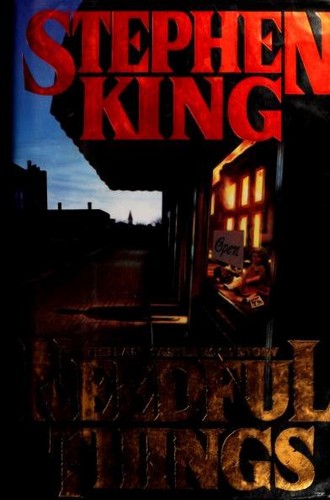
Needful Things
by Stephen King
★ Top 5 book of 1991 · #2 on Best Books of 1991
A new shop selling antiques and collectibles opens in the town of Castle Rock, run by the newcomer Leland Gaunt. He trades items for pranks and strange deeds, and the townspeople slide steadily into aggression, chaos, and death.
Best for: Horror fans who enjoy small-town unrest in Stephen King's Castle Rock
Needful Things is #2 on BookWard's Best Books of 1991, out of 23 1991 books that cleared our data bar.
What Needful Things is about
Castle Rock, Maine, is a town where everyone knows everyone else's business, and when Leland Gaunt opens a new shop there, people line up. The charming elderly newcomer always seems to have exactly the item each customer has been longing for, and at prices that feel almost too good. The one extra condition is that each buyer must play a prank on someone else in town.
Those pranks play on old grudges and private histories, and what begins as mischief turns into rising aggression, chaos and death. Sheriff Alan Pangborn, who first appeared in The Dark Half, is left to make sense of a community coming apart. Stephen King published this 1991 horror novel as the last Castle Rock story, and it was the first he wrote after recovering from addiction. The tone is dark and darkly funny, with a sharp eye on greed and what people will pay to get what they want.
Needful Things on the Best Books of 1991
Needful Things came out in 1991. Of the 23 books first published in 1991 that met BookWard's data bar, it ranks #2 on our Best Books of 1991 list.
Why it made the list: 771 readers have shelved it on Open Library; readers rate it 4.1 out of 5 (34 ratings); 39 are reading it right now. The list ranks each year’s books on how many readers have picked them up, how highly readers rate them, and how many are reading them right now.
It earns Being read right now.
Nearby on the 1991 list
- Outlander Diana Gabaldon, #1
- American Psycho Bret Easton Ellis, #3
- Shiloh Phyllis Reynolds Naylor, #4
See all Best Books of 1991 Best books by year
More years: Best Books of 1990 Best Books of 1992.
The numbers behind it
- Readers: 624 want to read it, 39 are reading it now and 108 have read it, according to Open Library.
- Ratings: 4.1 out of 5 from 34 Open Library ratings.
| Signal | This book (0 to 100) | Weight |
|---|---|---|
| Reach | 91 | 55% |
| Reader love | 61 | 25% |
| Being read right now | 91 | 20% |
Questions about Needful Things
When was Needful Things published?
Needful Things by Stephen King was first published in 1991.
Was Needful Things one of the best books of 1991?
Needful Things is #2 on BookWard's Best Books of 1991, out of 23 1991 books that cleared our data bar. 771 readers have shelved it on Open Library; readers rate it 4.1 out of 5 (34 ratings); 39 are reading it right now.
Why is Needful Things on the Best Books of 1991 list?
771 readers have shelved it on Open Library; readers rate it 4.1 out of 5 (34 ratings); 39 are reading it right now.
More of the best books of 1991
- Outlander Diana Gabaldon, #1
- American Psycho Bret Easton Ellis, #3
- Shiloh Phyllis Reynolds Naylor, #4
- The Firm John Grisham, #5
- Reaper Man Terry Pratchett, #6
- Chrysanthemum Kevin Henkes, #7
See the full Best Books of 1991, the Top 100, or new books on Rising.
How we know
This page uses public data: Open Library reader counts and ratings, and Wikipedia page views for recent years. The description is paraphrased from real source text. Rankings reflect reading interest, not quality or sales, and can be affected by data gaps. Lists update monthly.
Best suited to adult readers and older teens comfortable with horror.
Depends on the edition you pick.
A charming shopkeeper turns a whole town against itself. 54% taste match
 BookWard’s take
A charming shopkeeper turns a whole town against itself
Needful Things is a long, sprawling Castle Rock novel that earns its length through a huge cast and a slow-tightening trap. Leland Gaunt opens a shop where everyone finds the one object they crave, and each bargain comes with a small prank to play on a neighbour. The opening is gentler than the premise suggests, since King takes his time introducing the town, but the pace picks up as grudges escalate. The devil-in-a-shop idea is an old one, yet the execution feels fresh. The internal logic is tight: every petty feud was already there, and Gaunt only feeds it. The characters are its real strength, and the ending delivers a full reckoning rather than a shrug.
A big, many-threaded novel that takes its time, the opposite of BookWard's preference for tight books.
The early chapters build steadily, then the pranks and consequences pick up speed toward the end.
The core idea is borrowed from older bargain stories, but the town-wide chain reaction gives it its own shape.
Plain, conversational and brisk, more storyteller than stylist.
Plot machinery matters, but it runs on who these people are and what they secretly want.
Greed and spite win much of the day, so the outlook leans dark.
A conventional narrative told in order, moving among townspeople.
Gallows humor and sly small-town comedy run through the dread, though serious horror dominates.
Deaths and cruelty pile up as the town turns on itself.
Rage, grief and desire run hot, particularly as feuds boil over.
See all 50 dialsEvery position, side by side with this book
Where it lines up
- Character depthBookWard 8 · book 8
- Authorial voiceBookWard 9 · book 9
- EndingBookWard 8 · book 9
Where it pulls apart
- LengthBookWard 1 · book 10
- Familiar tropesBookWard 10 · book 5
- OpeningBookWard 10 · book 6
A big, many-threaded novel that takes its time, the opposite of BookWard's preference for tight books.
The shop and its charming owner intrigue early, but the opening spends time on the town before the trap closes.
A devil-like bargainer is a familiar figure, though the small-town execution feels fresh, a middling fit for BookWard.
Gaunt's pranks work because the townspeople's old grudges already existed, so the chain of escalation holds together well.
The early chapters build steadily, then the pranks and consequences pick up speed toward the end.
The core idea is borrowed from older bargain stories, but the town-wide chain reaction gives it its own shape.
Dozens of townspeople get private histories and motives, which lifts it well above a stock horror cast.
The story builds to a full, conclusive reckoning rather than leaving things ambiguous, which BookWard values.
Some warmth surrounds the sheriff and his sweetheart, but the book mostly stays hard-edged.
Deaths grow out of the characters' own flaws and feuds, so the darkness feels earned more than staged.
This is a novel, so the dial does not apply.
King's chatty, confident narration is unmistakable and carries the reader through a huge cast.
Driven by plot and a crowd of people rather than by an argument, though temptation is a clear theme.
King explains town histories and motives directly in places, a bit more telling than BookWard likes.
With so many threads, momentum can slacken, but the rising feuds keep pulling things forward.
Plain, conversational and brisk, more storyteller than stylist.
Plot machinery matters, but it runs on who these people are and what they secretly want.
Greed and spite win much of the day, so the outlook leans dark.
A conventional narrative told in order, moving among townspeople.
Gallows humor and sly small-town comedy run through the dread, though serious horror dominates.
Easy to read, though the sheer number of names asks for some attention.
The story moves among a great many townspeople, making this very much a many-voice book.
Events unfold in a straightforward sequence as the shop's influence spreads.
Gaunt is plainly supernatural, set against an otherwise realistic Maine town.
A large community of townspeople fills the book, which is central to how the story works.
Contained within one town, though the stakes reach the whole community.
Private temptations drive things, but the pranks and clashes make for plenty of action.
Conversation carries a lot of the story, from bargains in the shop to street-level feuds.
A sheriff and his sweetheart offer a thread, but it is minor next to the town's collapse.
Castle Rock is a familiar King setting and the small-town Maine texture feels instantly recognizable.
Published in 1991, it feels like a story from the recent past rather than the present day.
Temptation and neighborly spite are lasting subjects, though the texture is of its time.
The narration is an omniscient storyteller who tells you straight what is going on.
Gaunt is clearly villainous, though many townspeople are tempted by their own flaws.
King fills in town and shop with plenty of detail, from the odd collectibles to the small-town texture.
This is a novel, so the dial does not apply.
This is a novel, so the dial does not apply.
It is billed as the last Castle Rock story and leans on that shared setting, but stands alone as a read.
The prank chain keeps producing turns, though its direction is easy to sense.
A page-turner that unsettles without asking much intellectual effort.
Deaths and cruelty pile up as the town turns on itself.
Rage, grief and desire run hot, particularly as feuds boil over.
Some broad, almost cartoonish comedy sits alongside the horror.
The escalation brings killings and public brawls, so violence is a significant part of the story.
Sexual content is not a focus of the plot.
The book is about neighbors and temptation, not politics.
Plain, accessible language with some local speech color.
The narrator has a wry, knowing attitude toward the townspeople's failings.
Rooted in the town's old grudges and private histories, so it looks backward.
Human weakness is the engine of the plot, which leaves the worldview cynical.
Review written by BookWard, dial version 1, November 2026.
Who is Needful Things right for?
Best suited to adult readers and older teens comfortable with horror. It contains violence, deaths, addiction themes and cruelty between neighbors.
Easy to read, though the sheer number of names asks for some attention.
Deaths and cruelty pile up as the town turns on itself.
Rage, grief and desire run hot, particularly as feuds boil over.
The escalation brings killings and public brawls, so violence is a significant part of the story.
Book CompanionNeedful Things: ideas, characters, themes
A shop that gives everyone the thing they crave quietly turns a community's old grudges into open violence.
- The shop opens. A new store called Needful Things arrives in Castle Rock, and its owner, Leland Gaunt, seems to have the perfect item for every customer.
- Low prices, odd terms. Gaunt sells at surprisingly low prices but asks each buyer to play a prank on someone else in town.
- Grudges as fuel. Gaunt knows the town's private histories and uses the pranks to push existing conflicts toward open escalation.
- The ones who might resist. Sheriff Alan Pangborn and Polly Chalmers are the people most likely to question Gaunt, so he handles them with care.
- A town unravels. As the deeds and pranks accumulate, aggression, chaos and death spread through the community.
Characters
Leland Gaunt
Proprietor of Needful Things
A charming older gentleman who always has the right item and a price that includes a prank.
Alan Pangborn
Sheriff of Castle Rock
A main protagonist who first appeared in King's earlier novel The Dark Half.
Polly Chalmers
Sewing shop owner and Alan's sweetheart
Her arthritic hands make her an easy target for one of Gaunt's offers.
Nettie Cobb
Polly's housekeeper
One of the townspeople drawn into the escalating feuds.
Themes
How easily a perfectly fitted desire can pull ordinary people off course.
Old grievances hidden beneath a polite surface can be turned into open hostility.
Cheap deals that come with hidden obligations.
Wanting a particular object can crowd out judgment and decency.
What neighbors know about each other becomes a weapon.
Discussion questions
- Why does Gaunt ask for pranks rather than just money?
- Which townspeople seem most responsible for their own downfall, and why?
- How does the Castle Rock setting shape the story's feel?
- Do Alan and Polly resist Gaunt differently from the rest of the town?
- Is the book more about one outside villain or about the town itself?
Personalize your Book Companion
This is the general edition. In BookWard, the Companion is written for you: your reading profile, your notes, and spoiler-safe to the page you are on.
Buy, listen or borrow Needful Things
Each link opens a search for this book on that store, in a new tab.
Read on a device
Borrow
Reviews and community
If you liked Needful Things
King's desert horror: a possessed deputy, a praying boy, a long fight
Doctor SleepStephen KingKing's Shining sequel trades haunted hotel dread for road-trip menace
The ShiningStephen KingA haunted hotel and a father coming apart, slowly and surely
Under the DomeStephen KingAn invisible dome traps a Maine town, and the people inside are the danger
Find your own best books
Add what you have read, rate it, and BookWard will recommend what to read next.
Free to start. No credit card needed.