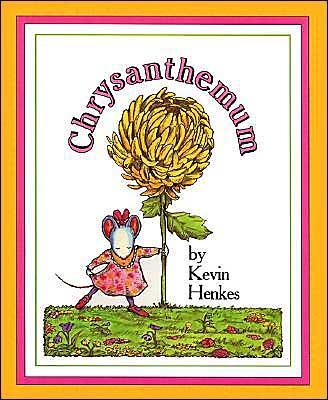
Chrysanthemum
by Kevin Henkes
★ Top 10 book of 1991 · #7 on Best Books of 1991
A little girl is delighted by her own name until she begins school, where classmates start teasing her about it. This picture book looks at how being laughed at can change the way a child feels about herself.
Best for: Young children dealing with teasing, and parents reading aloud with them
Chrysanthemum is #7 on BookWard's Best Books of 1991, out of 23 1991 books that cleared our data bar.
What Chrysanthemum is about
Chrysanthemum is a young mouse who loves her name and thinks it is perfect, until she starts school. Classmates Jo, Rita and Victoria tease her for being named after a flower and for having a name too long to fit on a name tag. At home, her parents comfort her with favorite foods and a game of Parcheesi, and her father quietly reads up on child psychology. Then the music teacher, Mrs. Twinkle, arrives, and she has a surprise of her own about names. Kevin Henkes wrote and illustrated this 1991 picture book, which has earned a place on several lists of the best books for children. It is a warm, funny story about teasing, confidence and feeling at home in your own name.
Chrysanthemum on the Best Books of 1991
Chrysanthemum came out in 1991. Of the 23 books first published in 1991 that met BookWard's data bar, it ranks #7 on our Best Books of 1991 list.
Why it made the list: 197 readers have shelved it on Open Library; readers rate it 4.6 out of 5 (11 ratings). The list ranks each year’s books on how many readers have picked them up, how highly readers rate them, and how many are reading them right now.
Nearby on the 1991 list
- The Firm John Grisham, #5
- Reaper Man Terry Pratchett, #6
- Witches Abroad Terry Pratchett, #8
- Xenocide Orson Scott Card, #9
See all Best Books of 1991 Best books by year
More years: Best Books of 1990 Best Books of 1992.
The numbers behind it
- Readers: 163 want to read it, 5 are reading it now and 29 have read it, according to Open Library.
- Ratings: 4.6 out of 5 from 11 Open Library ratings.
| Signal | This book (0 to 100) | Weight |
|---|---|---|
| Reach | 43 | 55% |
| Reader love | 91 | 25% |
| Being read right now | 30 | 20% |
Questions about Chrysanthemum
When was Chrysanthemum published?
Chrysanthemum by Kevin Henkes was first published in 1991.
Was Chrysanthemum one of the best books of 1991?
Chrysanthemum is #7 on BookWard's Best Books of 1991, out of 23 1991 books that cleared our data bar. 197 readers have shelved it on Open Library; readers rate it 4.6 out of 5 (11 ratings).
Why is Chrysanthemum on the Best Books of 1991 list?
197 readers have shelved it on Open Library; readers rate it 4.6 out of 5 (11 ratings).
More of the best books of 1991
- Outlander Diana Gabaldon, #1
- Needful Things Stephen King, #2
- American Psycho Bret Easton Ellis, #3
- Shiloh Phyllis Reynolds Naylor, #4
- The Firm John Grisham, #5
- Reaper Man Terry Pratchett, #6
See the full Best Books of 1991, the Top 100, or new books on Rising.
How we know
This page uses public data: Open Library reader counts and ratings, and Wikipedia page views for recent years. The description is paraphrased from real source text. Rankings reflect reading interest, not quality or sales, and can be affected by data gaps. Lists update monthly.
It suits young children, roughly preschool through early primary, and works well as a read-aloud.
Depends on the edition you pick.
A gentle, funny picture book about a name worth keeping. 57% taste match
 BookWard’s take
A gentle, funny picture book about a name worth keeping
Chrysanthemum is a picture book that earns its quiet charm. It opens on a young mouse who adores her own name, then watches that confidence get tested by classmates, and the setup is clear from the first pages. It is short, as picture books should be, and the tone stays warm without turning syrupy. There is a real restraint in how Kevin Henkes lets the teasing sting before the comfort arrives. The ending is fully resolved, which suits the form. The school-teasing story is a familiar one, so the plot itself is not especially fresh, but Henkes's voice is distinctive and the humor is light and dry. It has stayed on teacher and librarian lists since 1991, a sign that it keeps its hold on readers.
A picture book, it is as tight and short as books come, which suits BookWard's taste for economy.
It moves briskly through its few scenes without feeling rushed, a little gentler than BookWard's fast preference.
The core story is familiar, though the flower-name conceit and the teacher's twist give it a fresh touch.
The language is plain and rhythmic, written to be read aloud rather than admired for ornament.
The events exist to test one character's sense of self, which makes it lean character-driven.
Confidence is restored and kindness wins, so it lands on the hopeful side, which BookWard likes.
It follows a simple, conventional beginning, trouble and resolution.
Gentle humor runs through the name tag gag and the flower nicknames without making it a comedy.
The teasing and nightmare are mild and handled with care.
Real hurt and relief come through, but always at a child-friendly pitch.
See all 50 dialsEvery position, side by side with this book
Where it lines up
- LengthBookWard 1 · book 1
- Shock for effectBookWard 9 · book 9
- Story or ideasBookWard 3 · book 3
Where it pulls apart
- Familiar tropesBookWard 10 · book 4
- OriginalityBookWard 9 · book 5
- OpeningBookWard 10 · book 8
A picture book, it is as tight and short as books come, which suits BookWard's taste for economy.
It sets up a girl who loves her name and the threat to it almost immediately, though gently rather than with a jolt.
Teasing at school followed by a kind rescue is a well-worn pattern, so it leans on familiar tropes more than BookWard prefers.
Each event follows plainly from the last, and the resolution through the music teacher's own name fits the setup neatly.
It moves briskly through its few scenes without feeling rushed, a little gentler than BookWard's fast preference.
The core story is familiar, though the flower-name conceit and the teacher's twist give it a fresh touch.
Chrysanthemum's pride, hurt and recovery feel real within a few pages, though the bullies stay fairly simple.
The ending ties off cleanly, including a satisfying final note about the teacher's baby, matching BookWard's love of resolution.
It is warm and comforting yet kept light by humor, sitting in the middle rather than at BookWard's restrained end.
Even the nightmare of losing petals stays gentle; nothing here is dark for effect.
This is fiction, so the nonfiction rigor dial does not apply.
Henkes's spare, wry storytelling and mouse-world details give it a recognizable personality.
This is firmly story-led, built on a single small, clear event rather than an argument.
Feelings and conflict are shown through scenes and dialogue, with little explaining beyond what a child needs.
With so few pages there is no middle to sag; the tension holds from teasing to turnaround.
The language is plain and rhythmic, written to be read aloud rather than admired for ornament.
The events exist to test one character's sense of self, which makes it lean character-driven.
Confidence is restored and kindness wins, so it lands on the hopeful side, which BookWard likes.
It follows a simple, conventional beginning, trouble and resolution.
Gentle humor runs through the name tag gag and the flower nicknames without making it a comedy.
It reads effortlessly in a single sitting, even for very young listeners.
We stay with Chrysanthemum throughout, a single perspective.
Events unfold in plain order from school start to the baby's birth.
The characters are talking mice, but the world and its problems are everyday and grounded.
A small circle of family, classmates and one teacher carries the whole story.
The stakes are one girl's feelings about her name, about as intimate as a story gets.
Much of the weight sits in how Chrysanthemum feels, balanced by simple classroom action.
Taunts, comfort and the teacher's reveal are carried through speech, with moderate dialogue overall.
There is no romance, only family and classmates.
A familiar school and home setting makes it instantly relatable to children.
It reads as timeless domestic life rather than a marked time, though first published in 1991.
Long-running praise from teachers and librarians shows how well the theme of name and belonging endures.
A plain, trustworthy narrator tells events as they happen.
The kindness-over-cruelty message is stated clearly, without ambiguity.
Illustration carries the setting, so the text itself stays sparse.
This is fiction, so the nonfiction style dial does not apply.
This is fiction, so the nonfiction perspective dial does not apply.
It stands on its own as a complete story.
The teacher's name reveal is a small, warm surprise rather than a plot twist.
It comforts more than it challenges, offering reassurance about being teased.
The teasing and nightmare are mild and handled with care.
Real hurt and relief come through, but always at a child-friendly pitch.
The humor is dry and understated rather than broad slapstick.
There is no violence, only words and a brief bad dream.
There is no sexual content.
Nothing political appears here.
The vocabulary is plain, apart from the long, fun-to-say title name.
The narration mostly stays neutral, letting events and illustrations speak.
It looks toward a brighter school year for Chrysanthemum, mildly forward-looking.
It believes that kindness and self-acceptance win, a clearly idealistic outlook.
Review written by BookWard, dial version 1, November 2026.
Who is Chrysanthemum right for?
It suits young children, roughly preschool through early primary, and works well as a read-aloud. The teasing and a short nightmare scene are mild but may resonate with children who have been teased.
It reads effortlessly in a single sitting, even for very young listeners.
The teasing and nightmare are mild and handled with care.
Real hurt and relief come through, but always at a child-friendly pitch.
There is no violence, only words and a brief bad dream.
Book CompanionChrysanthemum: ideas, characters, themes
A little mouse who loves her name learns that other people's teasing cannot take away what makes her special.
- A name she adores. Chrysanthemum begins the story certain that her name is absolutely perfect.
- Teasing at school. Classmates Jo, Rita and Victoria mock her for being named after a flower and for a name too long for a name tag.
- Comfort at home. Her parents soothe her with favorite foods and a game of Parcheesi while her father reads books on child psychology.
- A nightmare. She dreams she grows petals that Victoria picks off one by one.
- Mrs. Twinkle's turn. The music teacher shares that her own name, Delphinium, is long and floral, and considers naming her baby Chrysanthemum, which changes how everyone sees it.
Characters
Chrysanthemum
Protagonist
A young mouse who loves her name and has to hold onto that love when teased.
Jo, Rita and Victoria
Classmates who tease
Three girl mice who mock her name until the teacher changes their minds.
Mrs. Twinkle
Music teacher
Expecting a baby and named Delphinium, she shows that a long flower name is something to admire.
Chrysanthemum's parents
Supportive family
They comfort her with favorite foods and a game of Parcheesi while her father reads up on child psychology.
Themes
Your name is part of who you are and worth being proud of.
Small unkind words can hurt a child badly.
Feeling accepted by peers matters as much as being happy with yourself.
Comfort at home helps a child face trouble at school.
One respected voice can shift how a group treats someone.
Discussion questions
- Why did Chrysanthemum love her name at the start, and how did that change at school?
- How did her parents try to help, and what did you notice about their different ways of comforting her?
- Why do you think Jo, Rita and Victoria changed their minds when Mrs. Twinkle spoke?
- Have you ever felt unsure about something that makes you different? What helped?
- What would you say to someone being teased for their name?
Personalize your Book Companion
This is the general edition. In BookWard, the Companion is written for you: your reading profile, your notes, and spoiler-safe to the page you are on.
Buy, listen or borrow Chrysanthemum
Each link opens a search for this book on that store, in a new tab.
Read on a device
Borrow
Reviews and community
If you liked Chrysanthemum
A graphic memoir where a stomachache becomes a story about anxiety
GhostsRaina TelgemeierA warm, spooky story of sisters, illness and moving on
The Ugly DucklingHans Christian AndersenA short fairy tale about an unloved duckling who becomes a swan
Roller GirlVictoria JamiesonA graphic novel where friendship strains harder than the skates
Find your own best books
Add what you have read, rate it, and BookWard will recommend what to read next.
Free to start. No credit card needed.