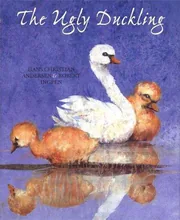
The Ugly Duckling
by Hans Christian Andersen · 1851
It suits young children who enjoy fairy tales and animal stories, and works well read aloud.
32 pages, about 0.5 to 0.5 hours.
A short fairy tale about an unloved duckling who becomes a swan. 50% taste match
The story
The Ugly Duckling is a Danish fairy tale written by Hans Christian Andersen, the poet and author who lived from 1805 to 1875. It belongs to the tradition of children's literature and is told as a short story for young readers, with the opening scene set on a summer day. The story follows a duckling who is unloved and looked upon as ugly by those around him, and who in time turns out to be a swan. Ducks and swans share the pages, and the tale touches on how a young creature sees himself.
Andersen's story is an original work rather than a retelling of older folklore, and it is rooted in Denmark. It first appeared in Copenhagen in 1843 as part of New Fairy Tales, alongside three other tales by the same author. The book is often found as a slim picture-book-length volume of around 32 pages, and the tale has been published in 122 editions, including translations into English. It has also been adapted for opera, musical theater, and animated film. It suits children who enjoy fairy tales, animal stories, and classic Danish children's fiction.
It was a beautiful summer day.
Setting
Denmark
Themes
DucklingsSwansFairy talesChildren's stories, DanishFolkloreDucksChildren's literatureSelf-perception
- Want to read 368
- Reading now 20
- Read 57
Most people shelving it are saving it for later.
Of 445 readers who put it on a shelf, 83% want to read it, 4% are reading it now, 13% have finished it and 0% stopped before the end.
By the numbers
- The median edition runs 32 pages. Counting about 275 words a page and an adult reading pace of 250 words a minute, that is about 35 minutes of reading.
- Open Library tracks 122 editions from 92 publishers, the earliest dated 1851 and the latest 2020, across 6 languages.
- On reader demand it ranks in the top 3% of the classic books in our catalog (8,749 of them).
- Libraries shelve it under Dewey 839.8136 and Library of Congress class PZ-0008.00000000.A542Ug 2005b.
Read it
A digital copy can be borrowed for free.
1 ebook provider carry it and a scanned copy is on the Internet Archive.
 BookWard’s take
A short fairy tale about an unloved duckling who becomes a swan
Andersen's tale runs to about 32 pages in picture-book form, and it is tight and gets on with it. The opening and the pace follow suit: a duckling is rejected almost at once, and the story keeps moving through the seasons. Where it parts company with my own taste is in its familiar shape. The ugly outcast who proves beautiful is now a well-worn pattern, though Andersen wrote it as an original tale, not a retelling. Character depth is modest by design, since the duckling carries the whole story. The ending is fully resolved, and the outlook is hopeful. The sentiment runs warmer than I usually like, but this is a classic worth knowing for how a young creature sees himself.
At about 32 pages it is as compact as a book gets, which matches BookWard's love of the tight and short.
The tale moves briskly through the duckling's journey, close to the quick pace BookWard enjoys.
Andersen's story is an original work rather than retold folklore, though its idea has since become familiar.
The language is plain and clear, made for young readers, and sits near BookWard's mid-range.
Events matter, but the duckling's inner experience of being unloved is what gives them weight.
The unloved duckling is shown to be a swan, so the tale lands on a hopeful note.
It follows a simple, conventional shape from rejection to transformation.
The tone is gentle and serious about the duckling's plight, with little comedy.
The duckling's loneliness and rejection are sad, but the tale stays gentle overall.
The duckling's hurt and eventual joy carry real feeling, within a soft children's frame.
See all 50 dialsEvery position, side by side with this book
Where it lines up
- LengthBookWard 1 · book 1
- Sagging middleBookWard 8 · book 8
- PaceBookWard 8 · book 7
Where it pulls apart
- Familiar tropesBookWard 10 · book 4
- Internal logicBookWard 10 · book 6
- OpeningBookWard 10 · book 7
At about 32 pages it is as compact as a book gets, which matches BookWard's love of the tight and short.
The duckling's rejection begins almost immediately, so the story draws you in quickly, though not with sharp urgency.
The outcast who proves beautiful is a familiar shape now, which sits below BookWard's wish to avoid tropes.
A fairy tale runs on its own gentle rules, which hold together well enough without being airtight.
The tale moves briskly through the duckling's journey, close to the quick pace BookWard enjoys.
Andersen's story is an original work rather than retold folklore, though its idea has since become familiar.
The duckling carries the story with real feeling, but as a fairy tale figure he is drawn simply.
The duckling's fate is fully settled by the close, which suits BookWard's liking for resolution.
The tale leans on tenderness and consolation, warmer than BookWard's preference for restraint.
The duckling's hardships are real but kept within a children's tale, not used for shock.
This is a fairy tale, so the rigor dial does not apply.
Andersen's storytelling manner is recognizable and gives the tale a character of its own.
It is story-led, following one duckling's path, though the idea of self-perception sits close behind.
The tale mostly shows events as they happen, with some plain narrator commentary, which fits BookWard's taste for scene.
At this length the story has no room to sag and holds interest to the end.
The language is plain and clear, made for young readers, and sits near BookWard's mid-range.
Events matter, but the duckling's inner experience of being unloved is what gives them weight.
The unloved duckling is shown to be a swan, so the tale lands on a hopeful note.
It follows a simple, conventional shape from rejection to transformation.
The tone is gentle and serious about the duckling's plight, with little comedy.
A short tale for young readers asks very little effort, easier than BookWard usually seeks.
The story stays with the duckling and the world around him, from a single vantage.
Events unfold in order across a stretch of time, with no jumps or shifts.
Talking animals place it in fairy tale territory, a step away from the grounded.
A duckling meets a few creatures along the way, keeping the cast small.
The story is intimate, centered on one creature's experience and nothing larger.
The duckling's feelings about himself share the page with his travels, giving a balanced focus.
Fairy tale narration carries most of the telling, so spoken exchanges stay light.
Romance plays no part in this tale of self-perception.
A Danish countryside of ducks and swans is easy to picture, even if the setting is of another era.
Written in the nineteenth century, it belongs to the past, well away from the present day.
Its story of belonging has lasted for generations, with adaptations in opera, musical and film.
A plain storyteller guides us honestly, with no hint of unreliability.
The tale carries a clear message about how a young creature sees himself, with little ambiguity.
Summer scenes and seasons are sketched with moderate richness, enough to set a mood.
This is fiction, so the nonfiction style dial does not apply.
This is fiction, so the perspective dial does not apply.
It stands alone as a single tale, though it first appeared alongside others in a collection.
The swan reveal is the one surprise, and a familiar one by now.
A comforting tale aimed at young readers, it offers reassurance more than challenge.
The duckling's loneliness and rejection are sad, but the tale stays gentle overall.
The duckling's hurt and eventual joy carry real feeling, within a soft children's frame.
What humor there is stays mild and dry, never broad.
The story keeps hardship mild and offstage, suited to young readers.
There is no sexual content in this children's tale.
Politics are absent, as the tale concerns a duckling and his place among others.
The language is simple and clear, with no dense or dialect-heavy passages.
The narrator sympathizes openly with the duckling, taking a clear side.
The tale looks ahead to the duckling's growth and what he will become.
It believes that the unloved can find their place, an idealistic view of the world.
Review written by BookWard, dial version 1, November 2026.
Who is The Ugly Duckling right for?
It suits young children who enjoy fairy tales and animal stories, and works well read aloud. The duckling's rejection and loneliness may stir sadness in sensitive readers.
A short tale for young readers asks very little effort, easier than BookWard usually seeks.
The duckling's loneliness and rejection are sad, but the tale stays gentle overall.
The duckling's hurt and eventual joy carry real feeling, within a soft children's frame.
The story keeps hardship mild and offstage, suited to young readers.
Book CompanionThe Ugly Duckling: ideas, characters, themes
An unloved, ugly duckling endures rejection until he turns out to be a swan, in a tale about how a young creature sees himself.
- The duckling is unloved. From the start, those around him look upon the duckling as ugly and do not welcome him.
- Ducks and swans share the pages. The story sets ordinary ducks against the swan he will become.
- A summer opening. The tale begins on a summer day before the duckling's troubles take hold.
- Transformation into a swan. In time the duckling turns out to be a swan, settling his story.
- An original Danish tale. Andersen wrote it as an original story, first published in Copenhagen in 1843 in New Fairy Tales.
Characters
The duckling
Protagonist
An unloved creature seen as ugly by those around him, who in time turns out to be a swan.
Themes
Where a creature finds acceptance among others.
How the duckling comes to see himself.
How looks shape the way others treat us.
The promise that hardship can give way to something better.
Discussion questions
- Why do the others treat the duckling as ugly?
- How does the duckling see himself over the course of the story?
- What does the swan ending say about appearances?
- Is the tale comforting, or does it ask something more of the reader?
- Why do you think this story has been adapted so often?
Personalize your Book Companion
This is the general edition. In BookWard, the Companion is written for you: your reading profile, your notes, and spoiler-safe to the page you are on.
Buy, listen or borrow The Ugly Duckling
Each link opens a search for this book on that store, in a new tab.
Read on a device
Borrow
Reviews and community
If you liked The Ugly Duckling
A gentle, funny picture book about a name worth keeping
A Little PrincessFrances Hodgson BurnettA kind girl keeps her dignity when fortune turns against her
A House for Hermit CrabEric CarleA gentle, tidy picture book about outgrowing your home
The reluctant dragonKenneth GrahameA gentle dragon, a kind boy, and one very polite compromise
Sources: Open Library.
Track The Ugly Duckling and find your next favorite
Add it to your shelf, rate what you have read, and BookWard will recommend what fits you.
Free to start. No credit card needed.