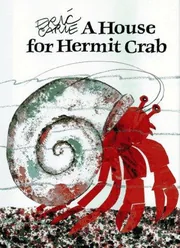
A House for Hermit Crab
by Eric Carle · 1987
It suits early readers around first and second grade, and also works as a read-aloud for younger children curious about sea life.
32 pages, about 0.5 to 0.5 hours.
A gentle, tidy picture book about outgrowing your home. 54% taste match
About the book
A House for Hermit Crab is a children's picture book by Eric Carle, first published in 1987. It is a work of fiction about a hermit crab who has grown too big for his shell and has to find a new place to live. The story begins in January, when Hermit Crab announces that it is time to move.
The book follows him as he settles into a larger shell and sets about making it his own, adding sea creatures he meets along his travels to decorate and improve his new home. Marine animals and the ocean setting run through the story, which also deals with moving house, getting along with neighbors, adjusting to change, and building self-confidence.
Running to about 32 pages, it is aimed at early readers in the first and second grades and has appeared in many editions over the years. It suits young children who are curious about sea life, or who are facing a move or other change of their own.
"Time to move," said Hermit Crab one day in January.
Themes
Hermit crabsCrabsMarine animalsDwellingsPicture booksSelf-confidenceNeighborsAdjustment (Psychology)
- Want to read 244
- Reading now 5
- Read 43
Most people shelving it are saving it for later.
Of 292 readers who put it on a shelf, 84% want to read it, 2% are reading it now, 15% have finished it and 0% stopped before the end.
By the numbers
- The median edition runs 32 pages. Counting about 275 words a page and an adult reading pace of 250 words a minute, that is about 35 minutes of reading.
- Open Library tracks 32 editions from 26 publishers, the earliest dated 1987 and the latest 2017, across 4 languages.
- On reader demand it ranks in the top 3% of the modern books in our catalog (15,152 of them).
- Libraries shelve it under Dewey 741 and Library of Congress class PZ-0007.00000000.C2147Hp 1988.
 BookWard’s take
A gentle, tidy picture book about outgrowing your home
A House for Hermit Crab is a 32-page picture book, and it knows exactly how little room it has. It opens in January with Hermit Crab announcing it is time to move, so there is no warm-up, and the whole book runs on one clear job: make the new shell a home. The pace is brisk because each page adds a sea creature and moves on. The logic is tidy, since every addition follows from the last. The sentiment stays warm but light, with a quiet pull toward hope and self-confidence rather than anything syrupy. The weak spot is familiarity: the journey-and-gather shape is a classic one. Still, the appeal here is how fully resolved and economical it feels, even if it is not out to surprise.
Each page brings a new creature and a new change, which keeps things moving without rushing.
The hermit crab and shell premise is fresh for young readers, even if the shape is familiar.
The language is plain and simple, written for early readers.
The plot of finding and decorating a home drives it more than inner growth does.
It ends in a settled, optimistic place, framing change as manageable and even good.
A straightforward month-by-month progression with no formal experiments.
The tone is kind and light rather than comic.
The content is entirely gentle.
Feelings run mild and reassuring rather than intense.
See all 50 dialsEvery position, side by side with this book
Where it lines up
- LengthBookWard 1 · book 1
- Shock for effectBookWard 9 · book 9
- Story or ideasBookWard 3 · book 3
Where it pulls apart
- Familiar tropesBookWard 10 · book 4
- Character depthBookWard 8 · book 3
- OriginalityBookWard 9 · book 5
Hermit Crab announces the move right away, so the story starts moving on the first page.
A traveling-and-collecting structure is a well-worn picture-book pattern, though it is handled cleanly here.
Each page brings a new creature and a new change, which keeps things moving without rushing.
The hermit crab and shell premise is fresh for young readers, even if the shape is familiar.
Hermit Crab is a simple, clearly drawn figure, closer to a type than a deep portrait, as picture books allow.
The story resolves its one question about finding and making a home, leaving nothing hanging.
The tone is warm and encouraging, leaning gently sentimental rather than restrained.
Nothing here is dark or shocking; the stakes are small and the story never reaches for effect.
Eric Carle's collage-style picture book voice is recognizable, though the text itself is spare.
This is story-led: a crab, a shell, a series of visits, with themes carried by events.
Ideas about change and confidence are shown through what the crab does, not lectured.
At this length there is no room for a middle to sag; every page does work.
The language is plain and simple, written for early readers.
The plot of finding and decorating a home drives it more than inner growth does.
It ends in a settled, optimistic place, framing change as manageable and even good.
A straightforward month-by-month progression with no formal experiments.
The tone is kind and light rather than comic.
Aimed at first and second graders, it asks very little of the reader.
The story stays with Hermit Crab throughout.
It moves forward in order, starting in January.
Sea creatures that act as neighbors and friends give it a gentle storybook unreality.
Hermit Crab meets a handful of sea creatures, enough variety without crowding the page.
One small crab and one shell make this an intimate story.
The focus is on what Hermit Crab does and adds, more than on private thoughts.
Spoken exchanges are light and brief, in keeping with a picture book.
There is no romance in it; the concerns are home and neighbors.
A timeless sea setting rather than a particular present-day moment.
Published in 1987 and still reprinted in many editions, it has proved durable.
The narration is straightforward and trustworthy.
Its lessons about adjusting to change and getting along with neighbors are clear and unambiguous.
Description is minimal in text, with the pictures doing the visual work.
It stands alone as a single picture book.
The path is predictable by design, with no real surprises.
It is comforting reading, meant to ease young readers' worries about change.
The content is entirely gentle.
Feelings run mild and reassuring rather than intense.
Any humor is soft and good-natured rather than broad.
There is no violence in the book.
There is no sexual content.
Politics is absent; the themes are personal and domestic.
The language is plain and easy for early readers.
The narration mostly stays neutral, letting the crab's actions speak.
It looks ahead, toward growth and settling into a new home.
It offers an idealistic view in which neighbors help and change turns out well.
Review written by BookWard, dial version 1, November 2026.
Who is A House for Hermit Crab right for?
It suits early readers around first and second grade, and also works as a read-aloud for younger children curious about sea life. Nothing in it is upsetting, and it may comfort a child facing a move.
Aimed at first and second graders, it asks very little of the reader.
The content is entirely gentle.
Feelings run mild and reassuring rather than intense.
There is no violence in the book.
Book CompanionA House for Hermit Crab: ideas, characters, themes
Hermit Crab outgrows his shell, moves into a bigger one, and makes it his own with help from the sea creatures he meets.
- A January start. The story begins in January, when Hermit Crab announces it is time to move.
- Outgrowing a home. His old shell has become too small, which sets the whole search in motion.
- Making it his own. He decorates and improves the new shell rather than just moving in.
- Sea creatures along the way. The marine animals he meets add to his new home and to his story.
- Small steps toward confidence. The book touches on self-confidence and adjusting to change through his travels.
Characters
Hermit Crab
Protagonist
A crab who has outgrown his shell and sets out to find and decorate a new one.
The sea creatures
Neighbors and helpers
Marine animals he meets on his travels who add to his new home.
Themes
Leaving a place that no longer fits and finding a new one.
Getting along with those who live around you.
Trusting yourself to take on something new.
Turning an empty space into somewhere that feels like yours.
Learning to be comfortable after a big change.
Discussion questions
- Why does Hermit Crab need a new shell?
- How does he make the new shell feel like his own?
- What do the sea creatures add to his home?
- Have you ever had to move or face a big change, and how did it feel?
- What does it mean to be a good neighbor?
Personalize your Book Companion
This is the general edition. In BookWard, the Companion is written for you: your reading profile, your notes, and spoiler-safe to the page you are on.
Buy, listen or borrow A House for Hermit Crab
Each link opens a search for this book on that store, in a new tab.
Read on a device
Borrow
Reviews and community
If you liked A House for Hermit Crab
A short fairy tale about an unloved duckling who becomes a swan
Room on the BroomJulia DonaldsonA rhyming broomstick tale where kindness gets crowded and then pays off
The Wild RobotPeter BrownA robot on a wild island, told with quiet nerve
Does a Kangaroo Have a Mother, Too?Eric CarleA gentle picture-book lesson in the names of animal families
Sources: Open Library.
Track A House for Hermit Crab and find your next favorite
Add it to your shelf, rate what you have read, and BookWard will recommend what fits you.
Free to start. No credit card needed.