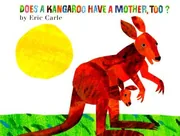
Does a Kangaroo Have a Mother, Too?
by Eric Carle · 1999
Best for toddlers and early readers, ideally shared aloud with a grown-up.
32 pages, about 0.5 to 0.5 hours.
A gentle picture-book lesson in the names of animal families. 51% taste match
About the book
Does a Kangaroo Have a Mother, Too? is a picture book for young children written and illustrated by Eric Carle, first published in 1999. It belongs to the children's nonfiction-meets-fiction tradition of animal books, and it is built around a simple question that the opening line answers right away: a lion has a mother, and so do other creatures. The book runs about 32 pages, a standard length for a picture book, and has appeared in around 32 editions, including Spanish language versions.
The subject is animal families and the words used to describe them. Rather than stopping at "mother" and "baby," the book introduces the specific names given to young animals, their parents, and the groups they live in. The kangaroo is one example: its baby is called a joey, the mother a flyer, the father a boomer, and a gathering of kangaroos can be called a troop, a mob, or a herd. Young readers meeting these terms for the first time will find animals presented through the lens of family and infancy, with pictures carrying much of the explanation. It suits read-aloud sessions at home, in classrooms, and in libraries.
Yes! A LION has a mother.
Themes
AnimalesInfancySpanish language materialsPictorial worksAnimalsInfanciaLiteratura juvenilFamily
- Want to read 169
- Reading now 9
- Read 35
Most people shelving it are saving it for later.
Of 213 readers who put it on a shelf, 79% want to read it, 4% are reading it now, 16% have finished it and 0% stopped before the end.
By the numbers
- The median edition runs 32 pages. Counting about 275 words a page and an adult reading pace of 250 words a minute, that is about 35 minutes of reading.
- Open Library tracks 32 editions from 25 publishers, the earliest dated 1999 and the latest 2013, across 5 languages.
- On reader demand it ranks in the top 6% of the modern books in our catalog (15,152 of them).
- Libraries shelve it under Dewey 591.39 and Library of Congress class QL-0763.00000000.C3718 2002.
 BookWard’s take
A gentle picture-book lesson in the names of animal families
Eric Carle's 1999 picture book turns a simple question into a small vocabulary lesson about animal families. At 32 pages it is tight and short, which suits it perfectly. The opening is direct, since the title question answers itself right away. The book explains outright rather than dramatizing: terms like joey, flyer, boomer, and troop are named plainly, with the pictures carrying the weight. That is a sensible choice for the age group, though I tend to prefer ideas shown in scene. It is also quite careful for a young reader's book, offering specific names rather than vague gestures. The sentiment stays restrained, and familiar story tropes are mostly absent. It is a warm, useful read-aloud rather than a story.
At 32 pages, it is as short as a book gets, which matches BookWard's love of tight books.
Short spreads move quickly, though the picture-book format sets a gentle read-aloud rhythm, a touch slower than BookWard's pick.
Teaching baby, parent, and group names in one book is a fresh angle, though the format is well worn.
The language is plain and simple, chosen for young listeners.
There is no plot to speak of; the focus is on animal families as a subject.
The family theme gives it a warm, reassuring outlook.
It follows a straightforward question-and-example layout, a conventional shape for the form.
The tone is friendly and curious, with no jokes driving it.
Entirely gentle in content.
Feelings stay quiet and warm rather than intense.
See all 50 dialsEvery position, side by side with this book
Where it lines up
- LengthBookWard 1 · book 1
- OpeningBookWard 10 · book 9
- PaceBookWard 8 · book 7
Where it pulls apart
- Character depthBookWard 8 · book 2
- ExpositionBookWard 2 · book 8
- Familiar tropesBookWard 10 · book 7
At 32 pages, it is as short as a book gets, which matches BookWard's love of tight books.
The title question is answered almost at once, so young readers are pulled in immediately, as BookWard likes.
Animal-family books are a familiar genre, but the specific names it teaches keep it from feeling stock.
Short spreads move quickly, though the picture-book format sets a gentle read-aloud rhythm, a touch slower than BookWard's pick.
Teaching baby, parent, and group names in one book is a fresh angle, though the format is well worn.
Animals appear as examples, not individuals, so there is little to draw deeply, which is fine for the form.
Warmth comes from the family theme but the book teaches rather than tugs at feelings.
Nothing here is dark or shocking; it is entirely gentle, which earns top marks on this dial.
It gives specific, checkable names such as joey, flyer, boomer, and troop, solid for a book at this level.
Carle's picture-book style is recognizable, even if the text itself is plain.
The book is built around information about animal families, more than around a story.
Names and terms are stated outright, a sharp contrast with BookWard's preference for showing in scene.
At 32 pages there is no middle to sag; the pattern holds from start to finish.
The language is plain and simple, chosen for young listeners.
There is no plot to speak of; the focus is on animal families as a subject.
The family theme gives it a warm, reassuring outlook.
It follows a straightforward question-and-example layout, a conventional shape for the form.
The tone is friendly and curious, with no jokes driving it.
It is easy to read aloud and easy for small children to follow.
There is no timeline to track; it moves through examples in order.
Animals are presented as real creatures with real names, so it stays grounded.
A run of different animals appears, but each is a quick example, so the cast is modest to middling.
Intimate by design, focused on parents and babies.
It leans toward showing outer things like animals and their groups, with little interior thought.
This is a picture book of labels and statements, with essentially no dialogue.
Romance is not part of this book.
Published in 1999, it reads as contemporary in its approach to teaching young children.
Questions about mothers and babies do not date, so it should last.
A plain guiding voice shares information without any trickery.
There is no moral dilemma here; the message is simple and clear.
Pictures carry the visual detail while the text stays brief.
It reads more as a story-flavored explainer than an analysis.
The tone is warm and close to the child, not distant.
It is a standalone picture book.
There are no plot surprises beyond learning new animal names.
It comforts and teaches without pushing a young reader hard.
Entirely gentle in content.
Feelings stay quiet and warm rather than intense.
Any humor is light and mild, in the sound of names like boomer and flyer.
No violence appears.
No sexual content appears.
Politics is absent.
The language is plain, with only the new animal terms to learn.
The narration is neutral and informative.
It rests on the present moment of learning, with little looking back or ahead.
It takes a warm, trusting view of family life.
Review written by BookWard, dial version 1, November 2026.
Who is Does a Kangaroo Have a Mother, Too? right for?
Best for toddlers and early readers, ideally shared aloud with a grown-up. Nothing in it is frightening or sensitive.
It is easy to read aloud and easy for small children to follow.
Entirely gentle in content.
Feelings stay quiet and warm rather than intense.
No violence appears.
Book CompanionDoes a Kangaroo Have a Mother, Too?: ideas, characters, themes
Animals have mothers, fathers, babies, and groups, and each has its own special name.
- A question to start. The title poses a simple question that draws young readers in right away.
- Names for babies. The book introduces the particular word for a young animal, such as joey for a baby kangaroo.
- Names for parents. Mothers and fathers have their own terms, such as flyer and boomer for kangaroos.
- Names for groups. Animals that gather together have group names, such as troop, mob, or herd for kangaroos.
- Pictures do the teaching. Illustrations carry much of the explanation, so children can learn even before they read.
Characters
The kangaroo
Featured example
A kangaroo family anchors the book's idea: the baby is a joey, the mother a flyer, and the father a boomer.
Themes
Every animal has parents and belongs to a group.
Specific words describe animals at different stages and roles.
A simple question can open up new things to learn.
The book looks closely at young animals and how they are named.
Discussion questions
- Which animal baby name was new to you, and what do you remember about it?
- Why might different animals have different words for their babies?
- What do you think a group of animals does together?
- Which animals in your life have mothers and fathers you can name?
- If you could give an animal family a new name, what would it be?
Personalize your Book Companion
This is the general edition. In BookWard, the Companion is written for you: your reading profile, your notes, and spoiler-safe to the page you are on.
Buy, listen or borrow Does a Kangaroo Have a Mother, Too?
Each link opens a search for this book on that store, in a new tab.
Read on a device
Borrow
Reviews and community
If you liked Does a Kangaroo Have a Mother, Too?
A gentle, tidy picture book about outgrowing your home
MindsetCarol S. DweckOne big idea, two mindsets, applied to work, love and parenting
FrindleAndrew ClementsA small word rebellion that grows into a big idea
Steal Like an ArtistAustin KleonA short, illustrated manifesto on making things by borrowing well
Sources: Open Library.
Track Does a Kangaroo Have a Mother, Too? and find your next favorite
Add it to your shelf, rate what you have read, and BookWard will recommend what fits you.
Free to start. No credit card needed.