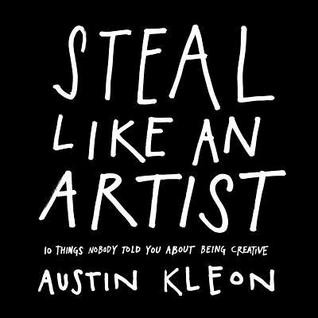
Steal Like an Artist
by Austin Kleon
★ Top 25 book of 2012 · #16 on Best Books of 2012
Austin Kleon turned a list of ten pieces of advice he gave to students into a short illustrated guide to the creative life. It mixes anecdotes and mini-exercises with practical actions for anyone making things in the digital age.
Best for: Writers, artists, designers, and other makers seeking brief, practical creative inspiration
Steal Like an Artist is #16 on BookWard's Best Books of 2012, out of 59 2012 books that cleared our data bar.
What Steal Like an Artist is about
Austin Kleon's guide starts from a simple belief: making things is not reserved for geniuses. His advice is to be yourself and to borrow openly from the work you admire. The ten ideas include using your hands, starting side projects, being nice, being boring, and treating creativity as a matter of cutting away what you do not need.
The book began as a talk to students at a community college in upstate New York in 2011. Kleon posted the text and slides of his talk to his blog, where it quickly went viral, and he then expanded it into this illustrated book, published by Workman Publishing in 2012. It has short anecdotes and small exercises that turn each idea into something you can try that afternoon. Writers, designers, photographers, musicians, and anyone who makes things in the digital age will find a friendly, witty nudge to stop waiting for inspiration and get started.
Steal Like an Artist on the Best Books of 2012
Steal Like an Artist came out in 2012. Of the 59 books first published in 2012 that met BookWard's data bar, it ranks #16 on our Best Books of 2012 list.
Why it made the list: 828 readers have shelved it on Open Library; readers rate it 4.1 out of 5 (48 ratings); 29 are reading it right now. The list ranks each year’s books on how many readers have picked them up, how highly readers rate them, and how many are reading them right now.
Nearby on the 2012 list
- Aristotle and Dante Discover the Secrets of the Universe Benjamin Alire Sáenz, #14
- The Dragonet Prophecy Tui T. Sutherland, #15
- Exile Shannon Messenger, #17
- Shadow and Bone Leigh Bardugo, #18
See all Best Books of 2012 Best books by year
More years: Best Books of 2011 Best Books of 2013.
The numbers behind it
- Readers: 732 want to read it, 29 are reading it now and 67 have read it, according to Open Library.
- Ratings: 4.1 out of 5 from 48 Open Library ratings.
| Signal | This book (0 to 100) | Weight |
|---|---|---|
| Reach | 76 | 55% |
| Reader love | 59 | 25% |
| Being read right now | 68 | 20% |
Questions about Steal Like an Artist
When was Steal Like an Artist published?
Steal Like an Artist by Austin Kleon was first published in 2012.
Was Steal Like an Artist one of the best books of 2012?
Steal Like an Artist is #16 on BookWard's Best Books of 2012, out of 59 2012 books that cleared our data bar. 828 readers have shelved it on Open Library; readers rate it 4.1 out of 5 (48 ratings); 29 are reading it right now.
Why is Steal Like an Artist on the Best Books of 2012 list?
828 readers have shelved it on Open Library; readers rate it 4.1 out of 5 (48 ratings); 29 are reading it right now.
More of the best books of 2012
- Wonder R. J. Palacio, #1
- The Fault in Our Stars John Green, #2
- The Selection (the Selection #1) Kiera Cass, #3
- Drama Raina Telgemeier, #4
- Throne of Glass Sarah J. Maas, #5
- The Power of Habit Charles Duhigg, #6
See the full Best Books of 2012, the Top 100, or new books on Rising.
How we know
This page uses public data: Open Library reader counts and ratings, and Wikipedia page views for recent years. The description is paraphrased from real source text. Rankings reflect reading interest, not quality or sales, and can be affected by data gaps. Lists update monthly.
Suited to teens and adults, especially students and early-career makers, and easy for most readers to follow.
Depends on the edition you pick.
A short, illustrated manifesto on making things by borrowing well. 44% taste match
 BookWard’s take
A short, illustrated manifesto on making things by borrowing well
Kleon turned a list of ten things he wished he'd heard as a student into a brief, illustrated guide to the creative life. It is built for speed: each chapter makes one point, backs it with an anecdote, and often ends with a small exercise. That gives it a strong opening, and the sagging middle that plagues so many advice books never appears, because no section outstays its welcome. It is about as tight as a book can be. The voice is plain, friendly and unmistakably his. Where it loosens is rigor: it runs on personal advice and quotations rather than evidence. The ideas will feel familiar to anyone who has read about creativity, though the packaging is fresh. Hopeful, restrained, and easy to finish in an afternoon.
A short book built from a single talk, it stays brief and never pads, which is just how BookWard likes its reading.
One idea per chapter, short and illustrated, keeps it moving briskly from start to finish.
Its central idea, that nothing is wholly original and influence is the raw material, is old, but the illustrated manifesto format is distinctive.
Plain, conversational sentences with deliberate simplicity, supported by drawings, not ornament.
It insists that creativity is open to everyone and that you can start now, which is firmly encouraging.
A numbered list of ten principles with sketches and exercises is slightly unconventional for a nonfiction guide.
Light and wry in places, but the aim is encouragement, not comedy.
Gentle and upbeat throughout.
Warm and motivating, but measured.
See all 50 dialsEvery position, side by side with this book
Where it lines up
- LengthBookWard 1 · book 1
- PaceBookWard 8 · book 8
- Authorial voiceBookWard 9 · book 8
Where it pulls apart
- Familiar tropesBookWard 10 · book 5
- ExpositionBookWard 2 · book 9
- Internal logicBookWard 10 · book 6
A short book built from a single talk, it stays brief and never pads, which is just how BookWard likes its reading.
The title and first chapter state the central provocation immediately, so you are in the argument from the opening page.
Creative-advice books share a familiar toolkit of pep talk and quotation; Kleon's framing is fresher, but the territory is well worn.
Each of the ten points follows plainly from the last, though it persuades more by assertion than by tight argument.
One idea per chapter, short and illustrated, keeps it moving briskly from start to finish.
Its central idea, that nothing is wholly original and influence is the raw material, is old, but the illustrated manifesto format is distinctive.
It closes by tying the ten ideas together and sending you off to make things, which feels settled rather than open.
Warm and encouraging in tone, yet kept short and practical instead of gooey.
It rests on personal experience and borrowed quotations instead of evidence, which sits below BookWard's appetite for rigor.
Kleon's friendly, direct, slightly wry voice is recognizable on every page.
This is a book of ideas and advice, with anecdotes serving the argument instead of carrying a story.
Kleon states his points outright and explains them, which is the opposite of showing in scene.
Ten short sections leave no room for a slump; the energy stays even.
Plain, conversational sentences with deliberate simplicity, supported by drawings, not ornament.
It insists that creativity is open to everyone and that you can start now, which is firmly encouraging.
A numbered list of ten principles with sketches and exercises is slightly unconventional for a nonfiction guide.
Light and wry in places, but the aim is encouragement, not comedy.
Short chapters and plain language make it about as easy as a book can be.
It is delivered from one author's perspective throughout.
Not a chronological story; it is a straight run through ten ideas in order.
Entirely grounded in real creative work and everyday practice.
It addresses the individual maker at a desk, a small, personal canvas.
Balanced between the habits of mind a creator needs and concrete actions to take.
It is essay and advice, with almost no conversation in scene.
The world is the familiar working life of artists, writers and makers.
Written for the digital age, with online sharing and side projects at its core.
The central advice about influence and practice is durable, even if some tech references will date.
Kleon speaks as himself, openly and without any trickery.
The ethic is clear: copy with care, credit generously, and do the work.
Short illustrations carry much of the visual feel, with little descriptive prose.
More a collection of principles and anecdotes than an extended analysis, though it leans toward the narrative side.
The book is rooted in the author's own experience and tells you what he wished he had known.
Stands alone, though Kleon has written companion volumes.
As a guide, it holds no plot surprises, only ideas turned over.
It reassures and encourages instead of unsettling the reader.
Gentle and upbeat throughout.
Warm and motivating, but measured.
A dry, understated wit, not broad comedy.
None.
None.
Concerned with creative life, not political argument.
Plain, accessible English throughout.
Kleon is openly opinionated, offering firm rules and personal convictions.
It looks ahead to what you might go and make, while drawing on those who came before.
It holds an idealistic view that anyone can be creative and that good work finds its place.
Review written by BookWard, dial version 1, November 2026.
Who is Steal Like an Artist right for?
Suited to teens and adults, especially students and early-career makers, and easy for most readers to follow. It has no sensitive content.
Short chapters and plain language make it about as easy as a book can be.
Gentle and upbeat throughout.
Warm and motivating, but measured.
None.
Book CompanionSteal Like an Artist: ideas, characters, themes
Nothing is wholly original, so build your own work by collecting, remixing and crediting the best influences, and start making now.
- Steal like an artist. All creative work builds on what came before, so study what you love and transform it into something of your own.
- Start before you know who you are. You find your identity by making things, not by waiting until you have worked yourself out.
- Write the book you want to read. Make the work you wish already existed, since that is where your real interest lies.
- Use your hands. Stepping away from the screen to make things physically can unlock ideas the keyboard will not.
- Creativity is subtraction. Limits and choices sharpen your work, so deciding what to leave out matters as much as what you add.
Themes
The idea that all new work grows out of existing work.
Beginning to make things now instead of waiting for confidence or certainty.
Showing up, side projects and being boring enough to get things done.
Putting what you make where other people can see it.
Constraints and subtraction as sources of better work.
Discussion questions
- Where do you draw the line between learning from someone and copying them?
- Which of the ten ideas feels most useful to your own work or hobbies right now?
- Does the claim that nothing is original comfort you or trouble you, and why?
- How does the book's format of short chapters, sketches and exercises change how you read it?
- What is one small thing you could make this week using the book's advice?
Personalize your Book Companion
This is the general edition. In BookWard, the Companion is written for you: your reading profile, your notes, and spoiler-safe to the page you are on.
Buy, listen or borrow Steal Like an Artist
Each link opens a search for this book on that store, in a new tab.
Read on a device
Borrow
Reviews and community
If you liked Steal Like an Artist
Small habits, big results: a short, forceful self-help pitch
ReworkJason FriedA short, punchy business manifesto that rewards doing over planning
Big MagicElizabeth GilbertGilbert's warm, anecdotal pep talk on living a creative life
Why Has Nobody Told Me This Before?Julie SmithShort, practical mental health tools from a clinical psychologist, easy to dip into
Find your own best books
Add what you have read, rate it, and BookWard will recommend what to read next.
Free to start. No credit card needed.