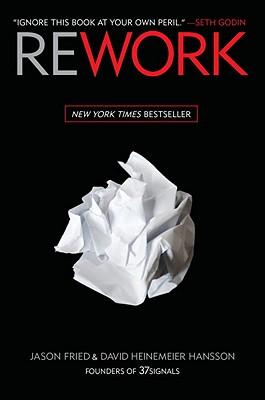
Rework
by Jason Fried
★ Top 25 book of 2010 · #16 on Best Books of 2010
This book tosses out conventional startup wisdom, arguing that business plans do harm, investors are unnecessary, and rivals can be ignored. It promotes doing more with less, staying productive, and getting noticed without a big budget.
Best for: Aspiring entrepreneurs, small-business owners, and anyone stuck in a job they dislike
Rework is #16 on BookWard's Best Books of 2010, out of 43 2010 books that cleared our data bar.
What Rework is about
Jason Fried argues that much of the standard advice for starting a business is wrong. You do not need a business plan, and he says plans can do harm. You can ignore the competition, skip outside investors, and avoid the workaholic habits, meetings and paperwork that many people assume come with the territory. You may not even need an office. His central message is simple: stop talking and start working.
The writing is plain and punchy, with an easy-is-better outlook throughout. It promises practical lessons on getting more done and gaining exposure without spending heavily. Entrepreneurs and small-business owners are the obvious readers, but it also speaks to people stuck in day jobs, those facing downsizing, and artists wondering how to make a living from their work.
Rework on the Best Books of 2010
Rework came out in 2010. Of the 43 books first published in 2010 that met BookWard's data bar, it ranks #16 on our Best Books of 2010 list.
Why it made the list: 610 readers have shelved it on Open Library; readers rate it 3.9 out of 5 (52 ratings); 54 are reading it right now. The list ranks each year’s books on how many readers have picked them up, how highly readers rate them, and how many are reading them right now.
Nearby on the 2010 list
- No Excuses! Brian Tracy, #14
- A Dog's Purpose W. Bruce Cameron, #15
- Death's End (the Three-Body Problem Series Book 3) 刘慈欣, #17
- Clockwork Angel Cassandra Clare, #18
See all Best Books of 2010 Best books by year
More years: Best Books of 2009 Best Books of 2011.
The numbers behind it
- Readers: 496 want to read it, 54 are reading it now and 60 have read it, according to Open Library.
- Ratings: 3.9 out of 5 from 52 Open Library ratings.
| Signal | This book (0 to 100) | Weight |
|---|---|---|
| Reach | 70 | 55% |
| Reader love | 28 | 25% |
| Being read right now | 81 | 20% |
Questions about Rework
When was Rework published?
Rework by Jason Fried was first published in 2010.
Was Rework one of the best books of 2010?
Rework is #16 on BookWard's Best Books of 2010, out of 43 2010 books that cleared our data bar. 610 readers have shelved it on Open Library; readers rate it 3.9 out of 5 (52 ratings); 54 are reading it right now.
Why is Rework on the Best Books of 2010 list?
610 readers have shelved it on Open Library; readers rate it 3.9 out of 5 (52 ratings); 54 are reading it right now.
More of the best books of 2010
- The Lost Hero Rick Riordan, #1
- The Way of Kings Brandon Sanderson, #2
- Divergent Veronica Roth, #3
- The Personal MBA Josh Kaufman, #4
- It's Not Summer Without You Jenny Han, #5
- The Red Pyramid Rick Riordan, #6
See the full Best Books of 2010, the Top 100, or new books on Rising.
How we know
This page uses public data: Open Library reader counts and ratings, and Wikipedia page views for recent years. The description is paraphrased from real source text. Rankings reflect reading interest, not quality or sales, and can be affected by data gaps. Lists update monthly.
Suits adults and older teens interested in work, side projects, or starting a business.
Depends on the edition you pick.
A short, punchy business manifesto that rewards doing over planning. 46% taste match
 BookWard’s take
A short, punchy business manifesto that rewards doing over planning
Rework is built from brief, blunt essays, each making one counterintuitive case about running a business: skip the plan, ignore the competition, stay small. It's tight and it moves fast, and the voice is distinctive, never once sounding like a standard management text. The authors simply tell you what they think, without hedging or building toward a point. Where it loosens is on evidence: this is opinion backed by experience, not research. It also stays on ideas rather than stories, with little in the way of characters or arc. If you want provocation you can finish in a sitting, it delivers. If you want data behind every claim, look elsewhere.
Short essays keep it compact, which suits BookWard's love of tight books.
Chapters run a page or two and never linger, a close match for BookWard's fast taste.
The contrarian stance felt fresh in its field, though the genre has since absorbed much of it.
Plain, direct sentences with no ornament, a little plainer than BookWard prefers.
Its core message is that you can start and succeed with less than you think.
Brief standalone essays rather than a continuous argument, slightly off the conventional path.
A dry, cheeky edge shows up, but this is mainly a serious how-to.
Nothing dark; the subject is ordinary working life.
The tone is energizing and practical, not emotionally heavy.
See all 50 dialsEvery position, side by side with this book
Where it lines up
- SentimentBookWard 8 · book 8
- Authorial voiceBookWard 9 · book 9
- Sagging middleBookWard 8 · book 8
Where it pulls apart
- Internal logicBookWard 10 · book 5
- ExpositionBookWard 2 · book 9
- Familiar tropesBookWard 10 · book 6
Short essays keep it compact, which suits BookWard's love of tight books.
Each chapter opens straight on a bold claim, though there is no story to pull you in.
It argues against standard business advice, yet the startup-gospel genre it belongs to has its own familiar moves.
Claims are argued by assertion and example, so the reasoning holds together without being airtight.
Chapters run a page or two and never linger, a close match for BookWard's fast taste.
The contrarian stance felt fresh in its field, though the genre has since absorbed much of it.
It is brisk and unsentimental, with an encouraging tone but little emotional appeal.
Advice rests on the authors' experience rather than studies, which sits below BookWard's rigorous preference.
The blunt, confident, conversational voice is unmistakable and a real strength.
It is nearly all argument and advice, far more idea-led than BookWard usually likes.
The authors state their points outright instead of dramatizing them, well past BookWard's taste for showing.
Short, self-contained chapters keep energy even from first page to last.
Plain, direct sentences with no ornament, a little plainer than BookWard prefers.
Its core message is that you can start and succeed with less than you think.
Brief standalone essays rather than a continuous argument, slightly off the conventional path.
A dry, cheeky edge shows up, but this is mainly a serious how-to.
Simple language and short chapters make it an easy read.
One authorial perspective carries the whole book.
Entirely grounded in real-world business practice.
It addresses small teams and individual founders, not grand sweeps.
It centers on action and practical moves rather than inner reflection.
There is essentially no dialogue; it is direct address to the reader.
Romance plays no part in it.
The business setting will be familiar to most readers.
Written in 2010, it speaks to a recognizably modern working world.
Some tech and startup references date it, though the core advice travels.
The authors speak plainly in their own voice with nothing hidden.
It argues a clear position and leaves little ambiguity about what to do.
Spare and functional, with description kept to a minimum.
It reads as short advisory essays, tilting a bit toward the narrative end rather than formal analysis.
Drawn from the authors' own experience and addressed directly to you.
A standalone book.
Its surprises are counterintuitive ideas, not plot turns.
It pokes at received business wisdom, mildly unsettling but mostly motivating.
Nothing dark; the subject is ordinary working life.
The tone is energizing and practical, not emotionally heavy.
Wry and understated rather than broad.
No violence at all.
No sexual content.
Workplace culture comes up, but it is not political in a partisan sense.
Plain everyday English throughout.
Heavily opinionated; taking a stand is the whole point.
It pushes you to start something now and build ahead.
An optimistic belief that anyone can do it on their own.
Review written by BookWard, dial version 1, November 2026.
Who is Rework right for?
Suits adults and older teens interested in work, side projects, or starting a business. Nothing in it is sensitive.
Simple language and short chapters make it an easy read.
Nothing dark; the subject is ordinary working life.
The tone is energizing and practical, not emotionally heavy.
No violence at all.
Book CompanionRework: ideas, characters, themes
Most conventional business advice, from detailed plans to outside funding to big staffs, is unnecessary, and success comes from doing more with less and simply starting.
- Plans can hurt. The book argues that rigid business plans are more harmful than helpful.
- You need less than you think. Investors, large teams, and offices are presented as excuses rather than requirements.
- Ignore the competition. Focus on your own work instead of tracking rivals.
- Stop talking, start working. Action beats meetings, paperwork, and endless discussion.
- Productivity and exposure on a budget. It offers ways to get more done and get noticed without spending heavily.
Themes
Doing less, with fewer resources, often works better.
Starting beats preparing endlessly.
You can build a business on your own terms.
Common business wisdom deserves to be questioned.
Freedom from investors, offices, and corporate habits.
Discussion questions
- Which piece of standard business advice does the book challenge that you have believed?
- Is a business plan really harmful, or only sometimes?
- How realistic is it to start with so little in your own field?
- Where does opinion stand in for evidence, and does that matter?
- What is one thing you could start this week instead of planning?
Personalize your Book Companion
This is the general edition. In BookWard, the Companion is written for you: your reading profile, your notes, and spoiler-safe to the page you are on.
Buy, listen or borrow Rework
Each link opens a search for this book on that store, in a new tab.
Read on a device
Borrow
Reviews and community
If you liked Rework
A short, illustrated manifesto on making things by borrowing well
I Will Teach You to Be RichRamit SethiA practical six-week money system with a bossy, friendly voice
DriveDaniel H. PinkA lively case that autonomy, mastery and purpose beat carrots and sticks
UltralearningScott YoungA self-taught learner's practical blueprint for mastering hard skills fast
Find your own best books
Add what you have read, rate it, and BookWard will recommend what to read next.
Free to start. No credit card needed.