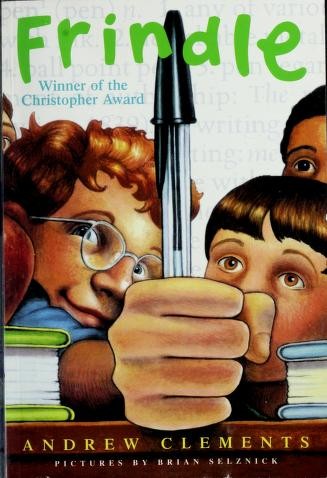
Frindle
by Andrew Clements
★ Top 25 book of 1996 · #20 on Best Books of 1996
Nick Allen, a schoolboy who loves stirring things up, learns how words come to exist and decides to rename the pen as a frindle. His prank catches on across town and beyond, soon slipping out of his control.
Best for: Kids who love wordplay, mischief, and funny stories about school and creative ideas
Frindle is #20 on BookWard's Best Books of 1996, out of 39 1996 books that cleared our data bar.
What Frindle is about
Nick Allen is a fifth-grade class clown with a long history of creative schemes, and he is not happy to land in the class of Mrs. Granger, a no-nonsense English teacher. When she assigns him an essay on where dictionary words come from, Nick discovers that people decide what words mean. So he decides to call a pen a 'frindle'.
His classmates take to the word right away. Mrs. Granger punishes anyone who says it, but the ban only helps the word travel, until it draws attention across the country. Andrew Clements, who had only written picture books before, said the story began with a simple question: what if a kid started using a new word, other kids liked it, but his teacher didn't? Light, funny and encouraging, this 1996 middle-grade novel, illustrated by Brian Selznick, is a good fit for young readers who enjoy mischief and ideas, and for anyone curious about how language really works.
Frindle on the Best Books of 1996
Frindle came out in 1996. Of the 39 books first published in 1996 that met BookWard's data bar, it ranks #20 on our Best Books of 1996 list.
Why it made the list: 267 readers have shelved it on Open Library; readers rate it 3.4 out of 5 (14 ratings). The list ranks each year’s books on how many readers have picked them up, how highly readers rate them, and how many are reading them right now.
Nearby on the 1996 list
- Alias Grace Margaret Atwood, #18
- The Color of Water James McBride, #19
- Exquisite Corpse Poppy Z. Brite, #21
- Hogfather Terry Pratchett, #22
See all Best Books of 1996 Best books by year
More years: Best Books of 1995 Best Books of 1997.
The numbers behind it
- Readers: 223 want to read it, 15 are reading it now and 29 have read it, according to Open Library.
- Ratings: 3.4 out of 5 from 14 Open Library ratings.
| Signal | This book (0 to 100) | Weight |
|---|---|---|
| Reach | 56 | 55% |
| Reader love | 3 | 25% |
| Being read right now | 56 | 20% |
Questions about Frindle
When was Frindle published?
Frindle by Andrew Clements was first published in 1996.
Was Frindle one of the best books of 1996?
Frindle is #20 on BookWard's Best Books of 1996, out of 39 1996 books that cleared our data bar. 267 readers have shelved it on Open Library; readers rate it 3.4 out of 5 (14 ratings).
Why is Frindle on the Best Books of 1996 list?
267 readers have shelved it on Open Library; readers rate it 3.4 out of 5 (14 ratings).
More of the best books of 1996
- A Game of Thrones George R. R. Martin, #1
- The Green Mile Stephen King, #2
- Forbidden Knowledge Roger Shattuck, #3
- Fight Club Chuck Palahniuk, #4
- Push Sapphire, #5
- Neverwhere Neil Gaiman, #6
See the full Best Books of 1996, the Top 100, or new books on Rising.
How we know
This page uses public data: Open Library reader counts and ratings, and Wikipedia page views for recent years. The description is paraphrased from real source text. Rankings reflect reading interest, not quality or sales, and can be affected by data gaps. Lists update monthly.
Suited to middle-grade readers, roughly ages 8 to 12, and a good read-aloud for classrooms.
Depends on the edition you pick.
A small word rebellion that grows into a big idea. 60% taste match
 BookWard’s take
A small word rebellion that grows into a big idea
Frindle takes one clean premise, a fifth grader renames the pen, and lets it snowball without losing its footing. The hook is immediate: Nick Allen is already scheming when we meet him, and the dictionary question that gets him in trouble arrives early. It is short, which suits BookWard, and the logic holds because every escalation follows from the one before. The pace stays quick, and the middle never sags, since each new wrinkle (detention, the principal, the wider world) raises the stakes. Characters are drawn warmly rather than deeply, but the book is more idea-led than most children's novels and treats language as something ordinary people shape. It leans gentle and hopeful, and the ending ties things off with a satisfying, restrained gesture rather than a sentimental flourish.
A short middle-grade novel that wastes no space, which matches BookWard's taste for tight books.
Events escalate briskly and the story rarely lingers, close to BookWard's preferred speed.
A children's book about how words get their meanings is a fresh angle, though less radical than BookWard's top picks.
Plain, clean sentences aimed squarely at young readers, lighter than BookWard's middle ground.
The scheme and its fallout drive the book more than anyone's inner change.
It ends on goodwill and mutual respect, more hopeful than BookWard's already optimistic lean.
A straightforward chronological story with an epilogue, more conventional than BookWard typically seeks.
Light comic energy runs through the schoolroom antics, in line with BookWard's taste for humor.
Very gentle; the worst consequence is staying after school.
Mild warmth and amusement rather than anything intense.
See all 50 dialsEvery position, side by side with this book
Where it lines up
- LengthBookWard 1 · book 1
- PaceBookWard 8 · book 8
- Shock for effectBookWard 9 · book 9
Where it pulls apart
- Familiar tropesBookWard 10 · book 6
- OpeningBookWard 10 · book 8
- Internal logicBookWard 10 · book 8
A short middle-grade novel that wastes no space, which matches BookWard's taste for tight books.
Nick is scheming from the first pages, and the dictionary gambit gets things moving quickly, as BookWard likes.
The class clown versus the stern teacher is a familiar setup, though the word-invention twist keeps it from feeling stock.
Each escalation, from detention to the principal to national attention, follows naturally from the last, and that sits well with BookWard.
Events escalate briskly and the story rarely lingers, close to BookWard's preferred speed.
A children's book about how words get their meanings is a fresh angle, though less radical than BookWard's top picks.
Nick and Mrs. Granger have clear, memorable traits, but the book favors momentum over deep interiority.
The epilogue resolves the conflict fully and reveals the teacher's side, a tidy payoff BookWard appreciates.
Warm and mildly sweet, but the closing gesture stays understated rather than syrupy.
Nothing here is dark for effect; the stakes are classroom-sized and gently earned.
This is a novel, so the dial does not apply.
A friendly, clear storytelling voice with real charm, though not radically distinctive.
The plot carries the reader, but the real draw is the idea that ordinary people decide what words mean.
Ideas about language come through Nick's actions and a school essay assignment, with some plain explaining along the way.
The escalating consequences keep the middle moving, with no stretch where momentum stalls.
Plain, clean sentences aimed squarely at young readers, lighter than BookWard's middle ground.
The scheme and its fallout drive the book more than anyone's inner change.
It ends on goodwill and mutual respect, more hopeful than BookWard's already optimistic lean.
A straightforward chronological story with an epilogue, more conventional than BookWard typically seeks.
Light comic energy runs through the schoolroom antics, in line with BookWard's taste for humor.
Easy to read in a sitting or two, below BookWard's moderate comfort level.
The story stays closely with Nick rather than spreading across many perspectives.
Events unfold in order, with only the epilogue jumping ahead.
Entirely grounded in an ordinary school and town.
A modest circle of classmates, teachers, and family keeps the cast manageable.
It begins in one classroom and grows to national attention, but stays rooted in a small-town feel.
More about what Nick does and how the world reacts than about his private thoughts.
Classroom exchanges and teacher-student standoffs carry a good share of the scenes.
Romance plays no part in this story.
A familiar school and neighborhood that most readers will recognize at once.
Set in the late 1990s, close enough to feel familiar but not strictly present-day.
The theme of language belonging to its users has aged well, and the book won a Phoenix Award twenty years on.
The story is told straightforwardly, with no sign of unreliability.
The book clearly sides with creative thinking and respect between students and teachers.
Settings and people are sketched briefly rather than lavishly drawn.
A standalone novel.
The final revelation about Mrs. Granger lands as a real surprise, though most of the plot is predictable.
A comforting, encouraging read that rarely pushes the reader out of their comfort zone.
Very gentle; the worst consequence is staying after school.
Mild warmth and amusement rather than anything intense.
Playful and slightly broad, built on schoolroom mischief rather than dry wit.
No violence appears in the story.
No sexual content at all.
Not political, beyond a light theme of authority versus individual initiative.
Plain, accessible language throughout.
The narration mostly stays neutral, letting events speak for themselves.
It mostly stays in its moment, with a short glance forward in the epilogue.
It believes in curiosity, creativity, and good faith between people.
Review written by BookWard, dial version 1, November 2026.
Who is Frindle right for?
Suited to middle-grade readers, roughly ages 8 to 12, and a good read-aloud for classrooms. Nothing in it is sensitive beyond mild schoolyard mischief.
Easy to read in a sitting or two, below BookWard's moderate comfort level.
Very gentle; the worst consequence is staying after school.
Mild warmth and amusement rather than anything intense.
No violence appears in the story.
Book CompanionFrindle: ideas, characters, themes
Words mean what people collectively agree they mean, and even a small act of invention can spread beyond anyone's control.
- A simple scheme. Nick Allen, a class clown, decides to rename a pen as a frindle after learning how words come to be.
- The dictionary assignment. His attempt to distract his teacher backfires into an essay that teaches him the idea behind his plan.
- A classroom standoff. Mrs. Granger punishes anyone caught saying frindle, which only makes the word more popular.
- Beyond Nick's control. The word spreads past the school, drawing the principal and eventually national attention.
- An epilogue payoff. Years later, a letter from Mrs. Granger reframes the whole conflict and closes the story on a warm note.
Characters
Nick Allen
Protagonist
A fifth-grade class clown who loves devising clever schemes.
Mrs. Granger
Teacher
Nick's strict, no-nonsense English teacher and his chief opponent in the frindle saga.
Themes
Words belong to the people who use them and can be changed by them.
Playful ideas can carry real power when others take them up.
The friction between a mischievous student and a rule-minded teacher drives the story.
A small scheme grows far beyond what its creator planned.
Opponents can turn out to understand each other better than expected.
Discussion questions
- Who decides what a word means, and how does that change over time?
- Why does punishing students for saying frindle make the word spread faster?
- Is Nick a troublemaker, an inventor, or both?
- How does the ending change the way you see Mrs. Granger?
- Can you think of a word or phrase that caught on because people shared it?
Personalize your Book Companion
This is the general edition. In BookWard, the Companion is written for you: your reading profile, your notes, and spoiler-safe to the page you are on.
Buy, listen or borrow Frindle
Each link opens a search for this book on that store, in a new tab.
Read on a device
Borrow
Reviews and community
If you liked Frindle
A gentle, funny picture book about a name worth keeping
HootCarl HiaasenA funny, fast Florida caper about owls, bullies and one barefoot kid
The GruffaloJulia DonaldsonA tiny mouse outwits the whole forest in rhyme
Roller GirlVictoria JamiesonA graphic novel where friendship strains harder than the skates
Find your own best books
Add what you have read, rate it, and BookWard will recommend what to read next.
Free to start. No credit card needed.