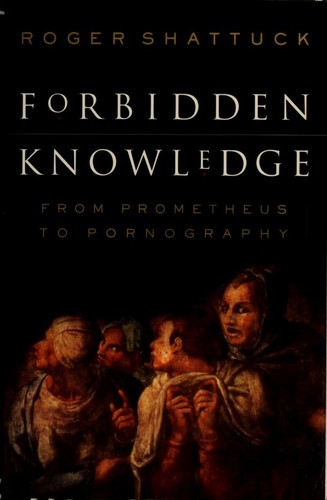
Forbidden Knowledge
by Roger Shattuck
★ Top 5 book of 1996 · #3 on Best Books of 1996
Shattuck follows the idea of knowledge that should perhaps stay off limits, from Adam and Eve to the atomic bomb and genetic engineering. He draws on myth and literature to question a culture that has dropped all restraint in pursuit of discovery.
Best for: Thoughtful readers interested in morality, myth, literature and the limits of discovery
Forbidden Knowledge is #3 on BookWard's Best Books of 1996, out of 39 1996 books that cleared our data bar.
What Forbidden Knowledge is about
Roger Shattuck follows one idea through Western literature and culture: that some knowledge may be better left alone. His journey begins with the sexual innocence of Adam and Eve and ends with the scientists behind the atomic bomb and recombinant DNA. Along the way he draws on the myth of Prometheus, Milton's Paradise Lost, Mary Shelley's Frankenstein, the writings of the Marquis de Sade, Melville's Billy Budd and the poetry of Emily Dickinson.
His argument is blunt. He paints a dire picture of human presumption and of a culture that has dropped its limits in the pursuit of knowledge and experience. He also believes that rereading the great myths and stories of the last two thousand years can help us understand how we lost our innocence. The publisher calls it the first full-scale treatment of the subject and warns that Chapter VII is not suitable for children. A thoughtful, provocative read for anyone curious about literature, science and where ethics should draw a line.
Forbidden Knowledge on the Best Books of 1996
Forbidden Knowledge came out in 1996. Of the 39 books first published in 1996 that met BookWard's data bar, it ranks #3 on our Best Books of 1996 list.
Why it made the list: 1,083 readers have shelved it on Open Library; readers rate it 4.3 out of 5 (55 ratings); 71 are reading it right now. The list ranks each year’s books on how many readers have picked them up, how highly readers rate them, and how many are reading them right now.
It earns Being read right now.
Nearby on the 1996 list
- A Game of Thrones George R. R. Martin, #1
- The Green Mile Stephen King, #2
- Fight Club Chuck Palahniuk, #4
- Push Sapphire, #5
See all Best Books of 1996 Best books by year
More years: Best Books of 1995 Best Books of 1997.
The numbers behind it
- Readers: 953 want to read it, 71 are reading it now and 58 have read it, according to Open Library.
- Ratings: 4.3 out of 5 from 55 Open Library ratings.
| Signal | This book (0 to 100) | Weight |
|---|---|---|
| Reach | 92 | 55% |
| Reader love | 87 | 25% |
| Being read right now | 95 | 20% |
Questions about Forbidden Knowledge
When was Forbidden Knowledge published?
Forbidden Knowledge by Roger Shattuck was first published in 1996.
Was Forbidden Knowledge one of the best books of 1996?
Forbidden Knowledge is #3 on BookWard's Best Books of 1996, out of 39 1996 books that cleared our data bar. 1,083 readers have shelved it on Open Library; readers rate it 4.3 out of 5 (55 ratings); 71 are reading it right now.
Why is Forbidden Knowledge on the Best Books of 1996 list?
1,083 readers have shelved it on Open Library; readers rate it 4.3 out of 5 (55 ratings); 71 are reading it right now.
More of the best books of 1996
- A Game of Thrones George R. R. Martin, #1
- The Green Mile Stephen King, #2
- Fight Club Chuck Palahniuk, #4
- Push Sapphire, #5
- Neverwhere Neil Gaiman, #6
- Infinite Jest David Foster Wallace, #7
See the full Best Books of 1996, the Top 100, or new books on Rising.
How we know
This page uses public data: Open Library reader counts and ratings, and Wikipedia page views for recent years. The description is paraphrased from real source text. Rankings reflect reading interest, not quality or sales, and can be affected by data gaps. Lists update monthly.
Suited to adult readers and advanced students interested in literature, ethics and science.
Depends on the edition you pick.
A literary-cultural inquiry into the limits of knowing, from Eden onward. 44% taste match
 BookWard’s take
A literary-cultural inquiry into the limits of knowing, from Eden onward
Shattuck reads two thousand years of myth and literature, from Prometheus and Paradise Lost to Frankenstein, Billy Budd and Emily Dickinson, to ask whether some knowledge should be left alone. It is driven by ideas rather than plot, and the argument is the engine, which makes it a good match for readers who prefer thinking to narrative. The voice is strongly personal: this is one thinker's opinionated case, and the distinctiveness is much of the appeal. The weak spot is rigor. It reasons through texts and myths rather than data, so the case persuades by reading rather than by proof. Its dire view of modern culture also leaves little room for optimism. Expect to work at it, and note that the publisher itself flags Chapter VII as unsuitable for minors.
A reflective critical study moves at the speed of thought, well below the quick pace BookWard prefers.
Gathering Prometheus, Frankenstein and Sade under one question gives it a distinct angle, which BookWard rewards.
The publisher calls the prose lively and lucid, so it is clear but a little more literary than plain.
The publisher describes a dire portrait of a culture that has abandoned limits, so bleak overall, with a thread of faith.
This is a grave subject treated gravely, so humor barely enters.
Sade, the atomic bomb and a flagged chapter unsuitable for minors make this heavy material.
The tone is grave and measured, more stern reflection than raw feeling.
See all 50 dialsEvery position, side by side with this book
Where it lines up
- SentimentBookWard 8 · book 8
- Shock for effectBookWard 9 · book 8
- Authorial voiceBookWard 9 · book 8
Where it pulls apart
- LengthBookWard 1 · book 6
- OpeningBookWard 10 · book 5
- ExpositionBookWard 2 · book 9
The core myths are familiar, but treating them as one thread of forbidden knowledge is a fresher angle than most surveys.
The argument runs as a connected case from Eden to atomic science, which suits BookWard's liking for tight reasoning.
A reflective critical study moves at the speed of thought, well below the quick pace BookWard prefers.
Gathering Prometheus, Frankenstein and Sade under one question gives it a distinct angle, which BookWard rewards.
An argument like this reaches a considered conclusion about limits, more resolved than open-ended.
Its tone is stern and sober rather than sentimental, matching BookWard's taste for restraint.
Dark material is dealt with to make a point, not for effect, which is how BookWard likes it.
It argues from texts, myths and history rather than data, so rigorous in thought but not empirical.
This is the work of a strongly individual thinker with a clear stance, which BookWard prizes.
The book is built around a single governing idea, far more than any plot, close to BookWard's idea-leaning side.
A critical study explains its case outright instead of dramatizing it, the opposite of BookWard's show-in-scene taste.
A long argument can drag in the middle, though a unifying question keeps it moving.
The publisher calls the prose lively and lucid, so it is clear but a little more literary than plain.
The publisher describes a dire portrait of a culture that has abandoned limits, so bleak overall, with a thread of faith.
This is a grave subject treated gravely, so humor barely enters.
It asks the reader to follow dense literary and moral argument across many works, which takes effort.
It draws on many authors and works, but one critic's lens organizes them all.
It deals with real texts and real science, with myths treated as subjects of study.
It spans two thousand years of Western culture and the fate of humanity, an epic reach.
The book is about ideas and moral reflection, with almost no action on the page.
Romance is not a theme; sexual innocence appears only as part of the forbidden-knowledge story.
The works are mostly the familiar canon of Western literature, so the terrain is well known.
It looks back over millennia of Western culture while writing in the late 1990s.
Its questions about limits to knowledge have lasted and still feel pressing.
A critic speaking openly in his own voice is as reliable as a narrator gets.
The book takes a stand on limits, though weighing them against the pull of knowledge leaves some ambiguity.
It is argument-driven, with moderate quoting and evocation of the works it discusses.
It is a thesis-driven critical analysis rather than a story-told account.
It is a critic's committed argument, with its author's stance felt throughout.
A single capstone work, not part of any series.
Arguments develop rather than surprise, so there are few twists.
It confronts uncomfortable questions about science, morality and loss of innocence rather than comforting the reader.
Sade, the atomic bomb and a flagged chapter unsuitable for minors make this heavy material.
The tone is grave and measured, more stern reflection than raw feeling.
Culture and morality are central, but the focus is ethical rather than party-political.
Literary quotations and abstract argument make the language denser than plain prose.
The author argues a forceful case in his own voice, so it is strongly opinionated.
It looks back to old myths, warning about where modern culture has headed.
Faith in rethinking our myths coexists with a dim view of modern culture, so mixed, tilting cynical.
Review written by BookWard, dial version 1, November 2026.
Who is Forbidden Knowledge right for?
Suited to adult readers and advanced students interested in literature, ethics and science. The publisher warns that Chapter VII is not appropriate for children and minors.
It asks the reader to follow dense literary and moral argument across many works, which takes effort.
Sade, the atomic bomb and a flagged chapter unsuitable for minors make this heavy material.
The tone is grave and measured, more stern reflection than raw feeling.
Book CompanionForbidden Knowledge: ideas, characters, themes
Shattuck argues that Western myths and literature repeatedly warn of knowledge that humans should not pursue, and that modern culture has abandoned those limits.
- Myths as warnings. From Adam and Eve to Prometheus, old stories mark certain knowledge as dangerous to pursue.
- Literature as evidence. Paradise Lost, Frankenstein, Billy Budd and Dickinson's poems are read as a long record of the theme.
- A dark passage. The Marquis de Sade features in the argument, and the publisher flags one chapter as unsuitable for minors.
- From Eden to the bomb. The sweep runs from sexual innocence to the atomic bomb and recombinant DNA.
- A culture without limits. The author sees modern culture as having dropped restraint in its quest for knowledge and experience.
Themes
The idea that some things may be better left unknown or undone.
What humanity gives up as it learns and experiences more.
Whether morality and the sacred can restrain inquiry.
How old stories carry moral warnings across centuries.
The risk of overreach in discoveries like the atomic bomb.
Discussion questions
- Is there knowledge humans should refuse to seek, and who decides?
- Do the old myths still warn us about science today?
- Does the book's gloomy view of modern culture hold up?
- How does reading literature as moral evidence compare with other ways of judging?
- Where would you draw the line between curiosity and presumption?
Personalize your Book Companion
This is the general edition. In BookWard, the Companion is written for you: your reading profile, your notes, and spoiler-safe to the page you are on.
Buy, listen or borrow Forbidden Knowledge
Each link opens a search for this book on that store, in a new tab.
Read on a device
Borrow
Reviews and community
If you liked Forbidden Knowledge
Freud's founding case that every dream carries a hidden meaning
CasteIsabel WilkersonA big idea about American hierarchy, argued through real lives
Vom KriegeCarl von ClausewitzThe foundational theory of war as politics, dense and unhurried
Guns, Germs, and SteelJared DiamondWhy some societies conquered others, argued from geography, not genes
Find your own best books
Add what you have read, rate it, and BookWard will recommend what to read next.
Free to start. No credit card needed.