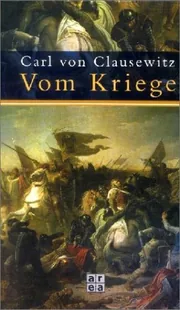
Vom Kriege
by Carl von Clausewitz · 1832
It suits mature readers and students comfortable with abstract, dense argument.
461 pages, about 7.5 to 11 hours.
The foundational theory of war as politics, dense and unhurried. 45% taste match
What it covers
Vom Kriege is a work of military theory and strategy by Carl von Clausewitz, a Prussian general who lived from 1780 to 1831. He wrote it mostly between 1816 and 1830, in the years after the Napoleonic Wars. His wife, Marie von Brühl, saw it into print after his death, and it first appeared in 1832. The book belongs to the history and politics shelf and deals with war as a subject of study, treating strategy and the conduct of campaigns in a systematic way.
The argument starts from the idea that war is politics carried on by other means. A ruler or governing group sets objectives, weighs the options, and turns to force only if it looks like the most efficient route. The text moves from simple elements to the larger whole. Its examples draw on figures such as Napoleon Bonaparte, Frederick II, Charles XII, Henry IV and Archduke Charles of Austria, and on places including Jena, Saalfeld, the Rhine, Champ-Aubert, Montmirail and Paris. It runs to roughly 461 pages in a typical edition, and it has appeared in 194 editions, many of them read in military education.
I PROPOSE to consider first the various elements of the subject, next its various parts or sections, and finally the whole in its internal structure.
Characters
Charles XIIHenry IVNapoleon BonaparteFrederick IIArchduke Charles of Austria
Setting
LuxemburgFranceJenaSaalfeldRhine
Period
18th century1830
Themes
Military art and scienceWarStrategyMilitaryOorlogKriegfu hrungQuelleGuerre
- Want to read 155
- Reading now 10
- Read 17
Most people shelving it are saving it for later.
Of 182 readers who put it on a shelf, 85% want to read it, 5% are reading it now, 9% have finished it and 0% stopped before the end.
By the numbers
- The median edition runs 461 pages. Counting about 275 words a page and an adult reading pace of 250 words a minute, that is about 8.5 hours of reading.
- Open Library tracks 194 editions from 115 publishers, the earliest dated 1835 and the latest 2022, across 7 languages.
- On reader demand it ranks in the top 9% of the classic books in our catalog (8,749 of them).
- Libraries shelve it under Dewey 355.4 and Library of Congress class U--0102.00000000.C65 1989.
 BookWard’s take
The foundational theory of war as politics, dense and unhurried
Vom Kriege is a book you study rather than race through. Clausewitz builds his case from simple elements toward the whole, and that patient structure is the opposite of a book that grabs you on the first page. It runs long and thorough where a tighter book might have made the same point faster. But the rigor is real: the argument is systematic and tested against Napoleon, Frederick II and campaigns like Jena and the Rhine. And the originality is hard to overstate. The idea that war is politics by other means reshaped how strategy gets thought about. The voice is distinctive and driven by ideas rather than story, so expect a cooler, more abstract read. Come for the thinking, not the momentum.
At 461 pages of dense theory it is long and thorough, a good deal more sprawling than BookWard's taste for the tight.
It moves slowly, pausing to define and examine each idea, which is slower than BookWard's brisk preference.
Framing war as politics by other means was a genuinely new way to think about conflict, which BookWard rewards.
The style is formal and measured rather than ornate, a little plainer than ornamental, close to BookWard's middle ground.
It surveys war as a hard fact of politics and offers little consolation, leaning bleak rather than hopeful.
It moves from elements to the whole in a deliberate order, mostly conventional for a treatise but thoughtfully arranged.
It is a serious work of military theory with essentially no humor.
The subject is war, handled analytically, so it feels serious without being gratuitously grim.
The tone is cool and analytical, so emotional intensity stays low.
See all 50 dialsEvery position, side by side with this book
Where it lines up
- OriginalityBookWard 9 · book 9
- Shock for effectBookWard 9 · book 9
- Familiar tropesBookWard 10 · book 9
Where it pulls apart
- OpeningBookWard 10 · book 3
- LengthBookWard 1 · book 7
- Story or ideasBookWard 3 · book 10
At 461 pages of dense theory it is long and thorough, a good deal more sprawling than BookWard's taste for the tight.
It builds from simple elements toward the whole rather than grabbing you at once, which runs against BookWard's love of an immediate hook.
Its central ideas became the standard framework for strategy, so the book itself reads as fresh and avoids borrowed commonplaces.
The argument is built step by step from basic elements to the larger whole, which BookWard admires, though some of it stays deliberately open.
It moves slowly, pausing to define and examine each idea, which is slower than BookWard's brisk preference.
Framing war as politics by other means was a genuinely new way to think about conflict, which BookWard rewards.
As a treatise it closes by finishing its argument rather than resolving a story, sitting between open and fully wrapped up.
It treats war analytically and without sentiment, matching BookWard's taste for restraint.
It examines war coldly and does not lean on shock for effect, in line with BookWard's preference.
It reasons systematically and tests ideas against campaigns of Napoleon and Frederick II, though it is theory more than data.
Clausewitz writes with a distinct, authoritative analytical voice, which BookWard values.
This is entirely about ideas, with no story to lead, so it sits at the far end from BookWard's story-led lean.
Clausewitz explains his reasoning outright instead of dramatizing it, the opposite of BookWard's preference for scene.
Sustained attention is needed, and some stretches of definition can feel uneven, though the argument stays focused overall.
The style is formal and measured rather than ornate, a little plainer than ornamental, close to BookWard's middle ground.
It surveys war as a hard fact of politics and offers little consolation, leaning bleak rather than hopeful.
It moves from elements to the whole in a deliberate order, mostly conventional for a treatise but thoughtfully arranged.
It is a serious work of military theory with essentially no humor.
It asks for sustained concentration and comfort with abstract argument, so it is considerably more demanding than BookWard's norm.
It speaks from a single authorial standpoint, though it surveys many commanders and campaigns.
The argument unfolds in a logical order, with historical examples used as illustration rather than a shifting chronology.
It is wholly grounded in real wars and real commanders.
It draws on a fair number of figures such as Napoleon, Frederick II, Charles XII and Archduke Charles, though none is a character.
It addresses war between states and the fate of nations, a broad and large-scale subject.
It balances outward campaigns and battles with inward reasoning about command, will and judgment.
As a treatise it has no dialogue.
Romance plays no part in this work of strategy.
A reader today meets an unfamiliar world of early nineteenth-century armies and campaigns, though the ideas translate.
Written between 1816 and 1830, it belongs firmly to the past, though it is still studied now.
Still read in military education nearly two centuries on, it has stayed relevant well beyond its moment.
The author argues in his own voice and stays a direct, reliable guide to his reasoning.
It treats war as an instrument of politics and leaves readers to weigh its moral costs, so it is fairly ambiguous on right and wrong.
It describes campaigns and terrain only as needed to support the argument, so description is modest.
It is analytical and theoretical throughout, with only occasional historical illustration rather than storytelling.
Clausewitz argues with some personal conviction but keeps a professional, measured distance from his subject.
It stands alone as a single treatise.
Its pleasures are conceptual, so there are few surprises beyond shifts in argument.
It pushes readers to rethink how war, policy and force relate, which is demanding rather than comforting.
The subject is war, handled analytically, so it feels serious without being gratuitously grim.
The tone is cool and analytical, so emotional intensity stays low.
It offers essentially no humor of any kind.
War is the subject, but it is discussed as strategy rather than depicted graphically.
There is no sexual content.
Its core thesis is that war is politics by other means, so politics sits at the center.
Dense abstract argument and period translation can make the language heavy going.
Clausewitz argues his positions forcefully and does not pretend to neutrality.
It reflects on the Napoleonic wars just past to understand how war works, so it mostly looks back.
Its view of war and state power is hard-headed and realist rather than idealistic.
Review written by BookWard, dial version 1, November 2026.
Who is Vom Kriege right for?
It suits mature readers and students comfortable with abstract, dense argument. It discusses war and violence in analytical terms rather than graphic detail.
It asks for sustained concentration and comfort with abstract argument, so it is considerably more demanding than BookWard's norm.
The subject is war, handled analytically, so it feels serious without being gratuitously grim.
The tone is cool and analytical, so emotional intensity stays low.
War is the subject, but it is discussed as strategy rather than depicted graphically.
Book CompanionVom Kriege: ideas, characters, themes
War is a tool of politics, to be chosen only when force is the most efficient way to reach a political goal.
- War as politics. War serves the objectives of a ruler or governing group rather than being an end in itself.
- Rational choice. Leaders set aims, weigh the options and turn to force only if it is the most cost-effective route.
- Elements to whole. The book builds its theory by moving from simple elements toward the larger picture of war.
- Lessons from campaigns. Examples from Napoleon, Frederick II and battles such as Jena ground the theory in real events.
- Lasting use. It is widely read in military education and has appeared in many editions since 1832.
Characters
Napoleon Bonaparte
Commander cited as example
His campaigns supply many of the cases the argument draws on.
Frederick II
Commander cited as example
His conduct of war is used to illustrate strategic principles.
Charles XII
Commander cited as example
Referenced among the historical figures used to test the theory.
Archduke Charles of Austria
Commander cited as example
Appears among the commanders whose campaigns the book examines.
Themes
Conflict is an extension of political aims, not a separate sphere.
Choosing means that match objectives at the lowest cost.
How abstract ideas about war meet real campaigns.
Massing strength at the enemy's weak point to win.
Discussion questions
- Do you accept that war is politics by other means, and where does that idea strain?
- How well does a rational, cost-benefit model of war match how leaders actually decide?
- What does the book gain and lose by drawing so heavily on Napoleonic examples?
- Why might the work still be taught to officers nearly two centuries later?
- How would you judge a war as won if objectives are met regardless of conditions on the field?
Personalize your Book Companion
This is the general edition. In BookWard, the Companion is written for you: your reading profile, your notes, and spoiler-safe to the page you are on.
Buy, listen or borrow Vom Kriege
Each link opens a search for this book on that store, in a new tab.
Read on a device
Borrow
Reviews and community
If you liked Vom Kriege
A fourteenth-century blueprint for how societies rise, hold together and fall
The Human ConditionHannah ArendtA dense, original map of what humans do and why it matters
De la démocratie en AmériqueAlexis de TocquevilleA French aristocrat's sharp, enduring anatomy of American democracy
The Open Society and Its Enemies (1+2)Karl PopperPopper's long, combative defence of free societies against historicism
Sources: Open Library.
Track Vom Kriege and find your next favorite
Add it to your shelf, rate what you have read, and BookWard will recommend what fits you.
Free to start. No credit card needed.