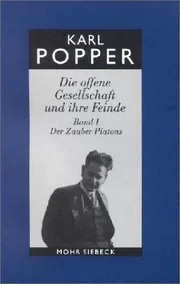
The Open Society and Its Enemies (1+2)
by Karl Popper · 1945
Best suited to mature readers comfortable with sustained philosophical argument, such as advanced students and committed general readers.
713 pages, about 11.5 to 16.5 hours.
Popper's long, combative defence of free societies against historicism. 48% taste match
What it covers
Karl Popper's The Open Society and Its Enemies, first published in 1945, is a work of political philosophy that sets out a defence of the open society. Popper describes such a society as one in which citizens hold a means of changing their government, while a closed society leaves them without it. Throughout, he contrasts forward-looking, empirical reasoning with the backward-looking, utopian outlook he calls historicism, the belief that history moves according to universal laws.
The book takes its examples from three thinkers: Plato, Georg Wilhelm Friedrich Hegel (1770-1831), and Karl Marx (1818-1883). Popper examines how each leaned on historicism to support a political philosophy, and he criticizes those foundations in turn. The argument opens with a question about whether a scientific or philosophical attitude to politics must rest on interpreting human history.
Placed within the study of liberty, political culture, social change, and the philosophy of the social sciences, the work runs to around 713 pages in its typical edition. It has appeared in 76 editions, and the two volumes are often collected under a single cover. It suits readers interested in political theory, the history of ideas, and the debate over how societies govern and change themselves.
It is widely believed that a truly scientific or philosophical attitude towards politics, and a deeper understanding of social life in general, must be based upon a contemplation and interpretation of human history.
Characters
Plato
Themes
PhilosophyPolitical scienceSocial sciencesSociologySociologiaSocial changePolitical science, philosophyPolitical culture
- Want to read 139
- Reading now 9
- Read 9
Most people shelving it are saving it for later.
Of 157 readers who put it on a shelf, 89% want to read it, 6% are reading it now, 6% have finished it and 0% stopped before the end.
By the numbers
- The median edition runs 713 pages. Counting about 275 words a page and an adult reading pace of 250 words a minute, that is about 13 hours of reading.
- Open Library tracks 76 editions from 25 publishers, the earliest dated 1945 and the latest 2023, across 5 languages.
- On reader demand it ranks in the top 14% of the classic books in our catalog (8,749 of them).
- Libraries shelve it under Dewey 301 and Library of Congress class B--0063.00000000.P612.
 BookWard’s take
Popper's long, combative defence of free societies against historicism
Popper builds his case on a single contrast: an open society lets citizens change their government, while a closed one leaves them only revolution. He tests that idea against Plato, Hegel and Marx, arguing each leaned on historicism, the belief that history unfolds by universal laws. The rigor is high, since the argument is built step by step and answered point by point. The voice is distinctive and openly combative, and the narration is strongly opinionated. Length is where it asks most of you: over 700 pages across two volumes. It is driven by ideas rather than story, and it explains its reasoning outright. If you want political philosophy with a clear spine and a sharp temper, it delivers.
Around 713 pages, usually split into two volumes, so it is long and heavy; BookWard prefers tight books, so this is a real commitment.
A dense, argument-by-argument study moves slowly, and the length keeps the pace deliberate rather than brisk.
Setting historicism against an open, forward-looking society was a distinctive framing and remains the book's lasting contribution.
The writing is plain, serious academic prose without ornament.
It defends a society able to change itself, which carries a measured hope even amid sharp criticism.
It follows a conventional scholarly structure, moving through thinkers one after another.
It is a serious work of political philosophy with little levity.
It deals with authoritarian thought, but in analytical terms rather than graphic ones.
The feeling is intellectual intensity and indignation, not emotional drama.
See all 50 dialsEvery position, side by side with this book
Where it lines up
- OriginalityBookWard 9 · book 9
- Authorial voiceBookWard 9 · book 9
- SentimentBookWard 8 · book 9
Where it pulls apart
- LengthBookWard 1 · book 9
- OpeningBookWard 10 · book 4
- Story or ideasBookWard 3 · book 10
Around 713 pages, usually split into two volumes, so it is long and heavy; BookWard prefers tight books, so this is a real commitment.
It opens by saying the book raises issues not apparent from the table of contents, a measured start rather than an immediate grab.
It challenges accepted readings of Plato, Hegel and Marx instead of repeating the standard story, which BookWard rewards.
The case for the open society is built as a structured argument, with each target examined and criticized in turn.
A dense, argument-by-argument study moves slowly, and the length keeps the pace deliberate rather than brisk.
Setting historicism against an open, forward-looking society was a distinctive framing and remains the book's lasting contribution.
This is political philosophy, so there are no invented characters to draw; the dial does not apply.
It closes its argument and defence of the open society rather than leaving the question hanging.
The tone is analytical and combative, not sentimental, which suits BookWard's preference for restraint.
Its sharpness comes from argument and criticism, not from darkness for effect.
It works through the philosophy of each thinker methodically, which fits BookWard's high regard for rigor.
Popper's blunt, partisan style, especially toward Hegel, is unmistakably his own.
The book is entirely about ideas, which is further toward argument than BookWard's story-leaning taste.
It explains its reasoning outright instead of dramatizing it, the opposite of BookWard's preference for showing.
Across two volumes the intensity can dip, though the central argument keeps returning to drive it forward.
The writing is plain, serious academic prose without ornament.
It defends a society able to change itself, which carries a measured hope even amid sharp criticism.
It follows a conventional scholarly structure, moving through thinkers one after another.
It is a serious work of political philosophy with little levity.
Dense philosophical argument across 700-plus pages asks for sustained concentration and background patience.
It is Popper's single argumentative voice, though it engages Plato, Hegel and Marx in detail.
It ranges across history to discuss thinkers from different eras but argues in a broadly orderly way.
It is entirely grounded in history and political thought.
Three central thinkers dominate, with a modest supporting cast of other figures.
It takes on the course of history and the shape of whole societies, a very large canvas.
The focus is on arguments and ideas, with little in the way of action or event.
As a work of argument, it contains almost no dialogue.
Romance has no place in this work.
Ancient Greece and nineteenth-century German thought are likely distant settings for most readers.
Written in 1945 about much older thinkers, it is rooted in the past though still relevant.
Its questions about how societies govern and change themselves keep it relevant decades later.
Popper argues directly in his own voice, with no unreliable narration.
He takes clear positions and says plainly which side he is on.
It deals in argument, not scenery, so description is sparse.
It is analytical throughout, dissecting ideas rather than telling a story.
Popper writes with strong personal conviction, though the argument itself is not autobiographical.
The two volumes are often bound together, but the work stands as one complete argument.
The argument develops steadily, with few surprises beyond Popper's pointed readings.
It challenges admired thinkers and settled assumptions about history and politics.
It deals with authoritarian thought, but in analytical terms rather than graphic ones.
The feeling is intellectual intensity and indignation, not emotional drama.
There is little humor, and what bite exists is dry and polemical.
Violence appears only as an idea within political theory, not on the page.
There is no sexual content.
Political philosophy is its entire subject, from open and closed societies to the thinkers behind them.
Philosophical terminology and dense argument make the language more demanding than plain prose.
Popper is openly and forcefully opinionated, especially about Hegel.
It looks back at history in order to argue for a better way forward.
It defends open, self-correcting society, an optimistic view tempered by sharp critique.
Review written by BookWard, dial version 1, November 2026.
Who is The Open Society and Its Enemies (1+2) right for?
Best suited to mature readers comfortable with sustained philosophical argument, such as advanced students and committed general readers. It discusses authoritarian ideas and political conflict in abstract terms and contains no explicit content.
Dense philosophical argument across 700-plus pages asks for sustained concentration and background patience.
It deals with authoritarian thought, but in analytical terms rather than graphic ones.
The feeling is intellectual intensity and indignation, not emotional drama.
Violence appears only as an idea within political theory, not on the page.
Book CompanionThe Open Society and Its Enemies (1+2): ideas, characters, themes
A society that can change its government without revolution is open, and Popper argues that historicism, belief in fixed laws of history, underpins the thinking of closed societies.
- Open versus closed. An open society gives citizens a way to change government, while a closed one forces them toward extra-legal revolution.
- What historicism is. Historicism is the belief that history unfolds according to universal laws, which Popper treats as a flawed foundation for politics.
- Three targets. Plato, Hegel and Marx serve as the main examples of thinkers who relied on historicism.
- Two outlooks. Popper contrasts backward-looking, utopian motives with forward-looking, empirical ones.
- A defence as well as a critique. Alongside the criticism, the book presents a positive case for the open society.
Characters
Plato
First thinker examined
One of the three figures Popper criticizes for building political philosophy on historicism.
Georg Wilhelm Friedrich Hegel
Second thinker examined
Treated with particular hostility as a leading example of historicist thought.
Karl Marx
Third thinker examined
Examined as a historicist whose political philosophy Popper takes apart.
Themes
Whether citizens can change their government peacefully.
The belief that history follows universal laws.
Freedom as the thing an open society protects.
How societies can reform themselves without upheaval.
Testing ideas against evidence instead of chasing an ideal blueprint.
Discussion questions
- What makes a society open rather than closed, in Popper's terms?
- Is historicism a fair description of how Plato, Hegel and Marx reasoned?
- Does a forward-looking, empirical approach to politics avoid the risks Popper sees in utopian thinking?
- How does the book's 1945 origin shape its tone and urgency?
- Which of Popper's criticisms feels strongest, and which feels overstated?
Personalize your Book Companion
This is the general edition. In BookWard, the Companion is written for you: your reading profile, your notes, and spoiler-safe to the page you are on.
Buy, listen or borrow The Open Society and Its Enemies (1+2)
Each link opens a search for this book on that store, in a new tab.
Read on a device
Borrow
Reviews and community
If you liked The Open Society and Its Enemies (1+2)
A French aristocrat's sharp, enduring anatomy of American democracy
Le Deuxième SexeSimone de BeauvoirBeauvoir's landmark case that woman is made, not born
Vom KriegeCarl von ClausewitzThe foundational theory of war as politics, dense and unhurried
The Human ConditionHannah ArendtA dense, original map of what humans do and why it matters
Sources: Open Library.
Track The Open Society and Its Enemies (1+2) and find your next favorite
Add it to your shelf, rate what you have read, and BookWard will recommend what fits you.
Free to start. No credit card needed.