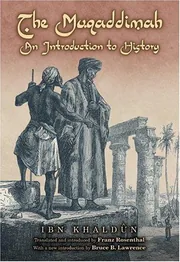
The Muqaddimah, an introduction to history
by Ibn Khaldūn, عبد الرحمن ابن خلدون Abdel Rahman Ibn Khaldun · 1858
This suits mature, patient readers, such as advanced students or adults interested in the history of ideas.
512 pages, about 8 to 12 hours.
A fourteenth-century blueprint for how societies rise, hold together and fall. 43% taste match
What it covers
The Muqaddimah is a fourteenth-century Arabic treatise by Ibn Khaldūn (1332-1406), written as an introduction to the study of history. It is a work of historiography and philosophy of history that treats the writing of history as a subject in its own right, beginning from the idea that history concerns human social organization, which the author identifies with world civilization.
The book ranges across a wide set of topics. It takes up sociology, including urban life, along with economics, political theory, the nature of the state, demography, cultural history and ecology, and it also touches on Islamic theology. Its attention falls on Islamic civilization and the Arab world, with North Africa and Yemen among the regions it draws on. Many modern readers regard it as an early foundation for the social sciences, and it has been described as laying groundwork for ethnography as well.
The text was first published in print in 1858. A translation in three volumes appeared in 1958, and the work has since been issued in many editions, with a typical copy running to about 512 pages. It suits readers interested in the history of ideas, historical method, and the intellectual traditions of the medieval Islamic world.
It should be known that history, in matter of fact, is informan about human social organization, which itself is identical with world civilization.
Setting
Islamic EmpireNorth AfricaYemenYemen (Republic)
Period
المطبعة الادبية بيروت لبنان 1900
Themes
Early works to 1800PhilosophyCivilizationHistoryArab countriesCivilization, IslamicEconomicsHistoriography
- Want to read 138
- Reading now 17
- Read 13
Most people shelving it are saving it for later.
Of 168 readers who put it on a shelf, 82% want to read it, 10% are reading it now, 8% have finished it and 0% stopped before the end.
By the numbers
- The median edition runs 512 pages. Counting about 275 words a page and an adult reading pace of 250 words a minute, that is about 9.4 hours of reading.
- Open Library tracks 54 editions from 44 publishers, the earliest dated 1858 and the latest 2015, across 8 languages.
- On reader demand it ranks in the top 10% of the classic books in our catalog (8,749 of them).
- Libraries shelve it under Dewey 901 and Library of Congress class D--0016.70000000.I2338 1978.
 BookWard’s take
A fourteenth-century blueprint for how societies rise, hold together and fall
Ibn Khaldūn begins by treating the writing of history as a subject worth examining in its own right, then builds outward into sociology, economics, political theory and the nature of the state. That ambition is the draw. This is a book of ideas far more than a book of story, and it explains its arguments outright rather than dramatizing them. It is also big and dense, which asks a lot of the reader, and the effort required is high; anyone who prefers short, tight books will feel the length. What it gives back is originality and staying power. Modern readers see it as an early foundation for the social sciences, and it still reads as a work that mattered long after its moment.
At about 512 pages it is a large, wide-ranging treatise, far from the tight and short that BookWard prefers.
This is a deliberate, dense treatise that moves slowly through its themes, slower than BookWard likes.
Many modern readers credit it with laying groundwork for sociology and other fields, which BookWard values highly.
As a scholarly treatise its prose is functional and measured rather than ornate.
There is no plot or cast to speak of, so neither drive really applies in the usual way.
It analyzes how societies rise and decline with an even, analytical eye, neither bleak nor cheerful.
It follows a systematic, topic-by-topic scholarly arrangement, conventional for a treatise.
A serious scholarly work with little humor, more solemn than BookWard's lightly funny taste.
Its subject is civilization and its decline, treated analytically rather than luridly.
The register is intellectual and measured, not emotionally charged.
See all 50 dialsEvery position, side by side with this book
Where it lines up
- Shock for effectBookWard 9 · book 9
- Familiar tropesBookWard 10 · book 9
- OriginalityBookWard 9 · book 10
Where it pulls apart
- LengthBookWard 1 · book 8
- OpeningBookWard 10 · book 3
- ExpositionBookWard 2 · book 10
At about 512 pages it is a large, wide-ranging treatise, far from the tight and short that BookWard prefers.
It opens by laying out what history is and how it should be studied, a measured start rather than an instant grab.
As an early work founding whole fields, it leans on no stock tropes, which suits BookWard well.
It builds a systematic argument about civilization and social organization, in keeping with BookWard's liking for sound reasoning.
This is a deliberate, dense treatise that moves slowly through its themes, slower than BookWard likes.
Many modern readers credit it with laying groundwork for sociology and other fields, which BookWard values highly.
It is about societies and method rather than individuals, so there are no deeply drawn characters to speak of.
As a treatise that works through its subjects rather than a plot, it does not resolve in the way a story does.
Its tone is analytical and detached, with little room for sentimentality, which fits BookWard's restraint.
It earns its attention through argument, not shock, which BookWard welcomes.
It aims at systematic analysis of how societies work, rigorous in intent and a strong match for BookWard.
A distinctive medieval scholar's mind shapes the whole work, which BookWard enjoys.
Ideas drive everything here, far more than any story, which is a stretch for BookWard's story-led taste.
The argument is explained outright, not shown in scene, the opposite of what BookWard prefers.
A work of this scope has stretches of dense material, though its core argument stays on course.
As a scholarly treatise its prose is functional and measured rather than ornate.
There is no plot or cast to speak of, so neither drive really applies in the usual way.
It analyzes how societies rise and decline with an even, analytical eye, neither bleak nor cheerful.
It follows a systematic, topic-by-topic scholarly arrangement, conventional for a treatise.
A serious scholarly work with little humor, more solemn than BookWard's lightly funny taste.
Dense, abstract and historically distant, it asks real effort from the reader, more than BookWard usually seeks.
A single scholar's analytical perspective runs through the whole work.
It organizes material by theme and argument, not by a shifting sequence of times.
It is a grounded work of history and social analysis.
It deals with peoples and societies rather than a cast of characters.
It takes in civilization and the state across wide regions, an epic canvas.
It balances reflection on method with analysis of social and political forces.
As a treatise it has essentially no dialogue.
Romance plays no role in a work of historical and social analysis.
Its fourteenth-century Islamic world and North African settings will feel unfamiliar to most readers.
Written in the fourteenth century, it is firmly a work of the past.
Still read and discussed centuries on, it clearly outlasted its moment.
A scholar's reasoned voice sets out claims openly and plainly.
It analyzes how societies work instead of delivering simple moral verdicts.
Its focus is on ideas and structures rather than vivid scene-painting.
It is analytical in method, far more argument than narrated story.
The author's own perspective is present, but the work leans toward scholarly analysis.
It stands as a single work, though it was written as an introduction to a larger history.
A work of argument has few surprises in the narrative sense.
It pushes readers to rethink what history is and how societies change.
Its subject is civilization and its decline, treated analytically rather than luridly.
The register is intellectual and measured, not emotionally charged.
What humor exists is dry and rare in a work this serious.
It discusses states and dynasties analytically, with little graphic violence on the page.
Sexual content is not a feature of this work.
Political theory and the nature of the state are central concerns.
Its dense scholarly material and translated medieval concepts can be heavy going.
The author argues a clear position about how history works.
It looks to the past to explain how societies develop and decline.
It takes a clear-eyed, analytical view of how societies rise and fall.
Review written by BookWard, dial version 1, November 2026.
Who is The Muqaddimah, an introduction to history right for?
This suits mature, patient readers, such as advanced students or adults interested in the history of ideas. It is a dense scholarly text rather than anything graphic.
Dense, abstract and historically distant, it asks real effort from the reader, more than BookWard usually seeks.
Its subject is civilization and its decline, treated analytically rather than luridly.
The register is intellectual and measured, not emotionally charged.
It discusses states and dynasties analytically, with little graphic violence on the page.
Book CompanionThe Muqaddimah, an introduction to history: ideas, characters, themes
History should be studied as the story of human social organization, and understanding how societies work is the key to understanding the past.
- History as a subject in itself. The book treats the writing of history as something to be examined critically, not just recorded.
- Society at the center. It begins from the idea that history concerns human social organization, which the author identifies with world civilization.
- A wide range of topics. It covers sociology including urban life, economics, political theory, the state, demography, cultural history and ecology.
- Focus on the Islamic world. Its attention falls on Islamic civilization and the Arab world, drawing on regions such as North Africa and Yemen.
- Foundation for later fields. Many modern readers regard it as an early foundation for the social sciences, with groundwork for ethnography as well.
Themes
How history should be written and judged.
How people form communities, cities and states.
The forces that build up and wear down societies.
How material life and politics shape one another.
The intellectual and cultural world the book speaks from.
Discussion questions
- Why might the author treat history as a field that needs its own method?
- How does focusing on social organization change what counts as history?
- Which of the book's many topics feels most modern to you, and why?
- What does it mean to call this an early work of the social sciences?
- How does knowing the book's setting in the Islamic world change how you read it?
Personalize your Book Companion
This is the general edition. In BookWard, the Companion is written for you: your reading profile, your notes, and spoiler-safe to the page you are on.
Buy, listen or borrow The Muqaddimah, an introduction to history
Each link opens a search for this book on that store, in a new tab.
Read on a device
Borrow
Reviews and community
If you liked The Muqaddimah, an introduction to history
The foundational theory of war as politics, dense and unhurried
De la démocratie en AmériqueAlexis de TocquevilleA French aristocrat's sharp, enduring anatomy of American democracy
The Wealth of NationsAdam SmithThe founding treatise of economics, patient, sprawling and still argued over
The Human ConditionHannah ArendtA dense, original map of what humans do and why it matters
Sources: Open Library.
Track The Muqaddimah, an introduction to history and find your next favorite
Add it to your shelf, rate what you have read, and BookWard will recommend what fits you.
Free to start. No credit card needed.