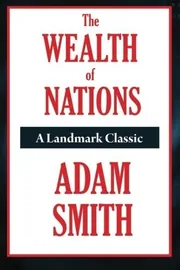
The Wealth of Nations
by Adam Smith · 1776
This suits adult and advanced older readers comfortable with dense argument and period prose.
590 pages, about 9.5 to 14 hours.
The founding treatise of economics, patient, sprawling and still argued over. 44% taste match
What it covers
Adam Smith, a Scottish economist and moral philosopher, published The Wealth of Nations in 1776. It is a nonfiction treatise in the field of political economy, and it belongs to the classical school of economics. The book sets out to explain how commercial and industrial societies produce prosperity, working through questions of labour, capital, growth, finance, business and trade. Its opening argument concerns the division of labour and the skill with which work is directed.
The work also takes up colonies and colonization, and it is counted among the early works in economics written before 1800. In the century and more after it appeared, it became a foundation for later economic thinking. One widely read modern edition reprints Edwin Cannan's 1904 version, with his introduction, notes and a full index, along with a preface by the economist George J. Stigler. The book runs to roughly 590 pages in a typical printing and has appeared in 124 editions.
The greatest improvement in the productive powers of labour, and the greater part of the skill, dexterity, and judgment with which it is any where directed, or applied, seem to have been the effects of the division of labour.
Setting
Germany
Themes
Economische filosofieCommunismFinanceBusinessEconomicsWealthColonizationÉconomie politique
- Want to read 692
- Reading now 53
- Read 32
Most people shelving it are saving it for later.
Of 777 readers who put it on a shelf, 89% want to read it, 7% are reading it now, 4% have finished it and 0% stopped before the end.
By the numbers
- The median edition runs 590 pages. Counting about 275 words a page and an adult reading pace of 250 words a minute, that is about 11 hours of reading.
- Open Library tracks 124 editions from 87 publishers, the earliest dated 1776 and the latest 2010, across 2 languages.
- On reader demand it ranks in the top 2% of the classic books in our catalog (8,749 of them).
- Libraries shelve it under Dewey 330.153 and Library of Congress class HB-0161.00000000.S636.
 BookWard’s take
The founding treatise of economics, patient, sprawling and still argued over
Smith's 1776 treatise tries to explain how commercial societies produce wealth, and it does so with unusual ambition. It opens on the division of labour, one of the great sharp openings in nonfiction, then settles into a long, methodical build through capital, growth, finance, trade and colonies. The tension for a reader is plain. At roughly 590 pages it is long and deliberate, and it asks for patience. But it delivers hard on rigor and originality, since it laid down a system that others spent centuries answering. The voice is distinctive, analytical rather than narrative. This is a book for someone who wants first principles, not a quick tour.
At around 590 pages it is a long, wide-ranging treatise, well beyond BookWard's preference for tight books.
The argument advances steadily and thoroughly, not quickly, which sits against BookWard's taste for speed.
As the first comprehensive system of political economy, it is about as original as nonfiction gets.
Eighteenth-century prose is formal and periodic, somewhat ornate to modern eyes but not florid.
There is no plot or cast, so this dial does not apply.
It argues that commerce can raise prosperity, which gives it a mildly optimistic outlook.
It follows a conventional treatise structure, arranged in books and topics.
It is serious in tone, with only occasional dry asides.
The content is intellectual and gentle, with little disturbing material.
The emotional register is calm and analytical.
See all 50 dialsEvery position, side by side with this book
Where it lines up
- Familiar tropesBookWard 10 · book 9
- OriginalityBookWard 9 · book 10
- SentimentBookWard 8 · book 9
Where it pulls apart
- LengthBookWard 1 · book 9
- Story or ideasBookWard 3 · book 10
- ExpositionBookWard 2 · book 9
At around 590 pages it is a long, wide-ranging treatise, well beyond BookWard's preference for tight books.
The opening on the division of labour gets to a concrete, memorable argument fairly quickly, though gently.
It created much of the framework that later writers repeat, so it reads as foundational, not tired.
Smith builds claims step by step with evidence, though some arguments carry the assumptions of his century.
The argument advances steadily and thoroughly, not quickly, which sits against BookWard's taste for speed.
As the first comprehensive system of political economy, it is about as original as nonfiction gets.
It is a treatise with no characters to draw, so this dial does not apply.
It closes its arguments on a settled note, though a treatise does not resolve like a story.
The reasoning is sober and unsentimental, in line with BookWard's preference for restraint.
It argues rather than shocks, so there is no darkness used for effect.
It marshals extensive examples and reasoning across many topics, rigorous for its era if not by modern standards.
Smith's measured, reasoned, sometimes wry voice is recognisably his own.
This is entirely idea-led, an argument about how societies create wealth, with no narrative.
Ideas are explained outright and at length, the opposite of BookWard's lean toward showing.
Eighteenth-century prose is formal and periodic, somewhat ornate to modern eyes but not florid.
There is no plot or cast, so this dial does not apply.
It argues that commerce can raise prosperity, which gives it a mildly optimistic outlook.
It follows a conventional treatise structure, arranged in books and topics.
It is serious in tone, with only occasional dry asides.
Long sentences, dense argument and period vocabulary make it work to read.
Smith argues from a single authorial perspective throughout.
The argument moves topic by topic, with historical examples, not a shifting timeline.
It deals with real economies, labour and trade, wholly grounded.
It has no cast in the novelistic sense, so this dial does not apply.
It tackles whole national economies and global trade, a large canvas for an argument.
Its attention is on markets, labour and institutions, not inner reflection.
It is exposition with no dialogue.
There is no romantic thread, so this dial does not apply.
The eighteenth-century economic world it describes will feel unfamiliar to most readers.
It was written in 1776, firmly in the past, though its subject still feels current.
Its ideas remain a reference point in modern economics, giving it unusual staying power.
The authorial voice argues openly and can be taken at face value.
Smith takes clear positions, though he weighs competing interests with some nuance.
It describes trades, prices and institutions with moderate detail, not scenic richness.
It is an analytical treatise, not a story-driven account.
The authorial stance is detached and argumentative, with little personal disclosure.
It stands alone as a single, self-contained work.
An argument builds, it does not twist, so surprises are few.
It asks readers to think hard about assumptions on wealth, labour and trade.
The content is intellectual and gentle, with little disturbing material.
The emotional register is calm and analytical.
Where humor appears, it is dry rather than broad.
Violence is barely present, appearing only in passing historical references.
There is no sexual content.
It is a work of political economy, so policy and state action are central to it.
Eighteenth-century syntax and vocabulary make the language dense in places.
Smith argues with conviction and pushes his case, so the narration is openly opinionated.
It aims to shape future policy and growth, so it looks forward.
It believes in the power of commerce and reform, though without naive optimism.
Review written by BookWard, dial version 1, November 2026.
Who is The Wealth of Nations right for?
This suits adult and advanced older readers comfortable with dense argument and period prose. It has no graphic content, though its discussion of colonies and trade reflects the assumptions of its century.
Long sentences, dense argument and period vocabulary make it work to read.
The content is intellectual and gentle, with little disturbing material.
The emotional register is calm and analytical.
Violence is barely present, appearing only in passing historical references.
Book CompanionThe Wealth of Nations: ideas, characters, themes
Smith argues that wealth comes from productive labour and that commercial societies grow richer by organising work and trade well.
- Division of labour. The opening argument holds that dividing work into specialised tasks sharply raises the skill and output of workers.
- Capital and growth. Smith examines how accumulating capital drives economic growth and changes societies over time.
- Trade and commerce. The book works through how trade, business and finance shape the prosperity of nations.
- Colonies. Smith takes up colonies and colonization as part of his wider account of commerce and national wealth.
- A system of political economy. The work is described as the first comprehensive formulation of political economy, and it founded classical economics.
Themes
What a nation's prosperity consists of and how it grows.
Work as the source of value and the focus of specialisation.
Accumulated resources that enable growth and production.
Exchange between people and nations as an engine of prosperity.
The study of how politics and economics shape each other.
Discussion questions
- Which of Smith's arguments still feel current, and which feel tied to 1776?
- Why might Smith begin with the division of labour?
- How does Smith's treatment of colonies fit with his wider account of wealth?
- Does the book's length and detail strengthen its argument or weaken it?
- What would you want to ask Smith about modern economies?
Personalize your Book Companion
This is the general edition. In BookWard, the Companion is written for you: your reading profile, your notes, and spoiler-safe to the page you are on.
Buy, listen or borrow The Wealth of Nations
Each link opens a search for this book on that store, in a new tab.
Read on a device
Borrow
Reviews and community
If you liked The Wealth of Nations
Rigorous, argument-led case for the Constitution, demanding but still essential
De la démocratie en AmériqueAlexis de TocquevilleA French aristocrat's sharp, enduring anatomy of American democracy
The Muqaddimah, an introduction to historyIbn KhaldūnA fourteenth-century blueprint for how societies rise, hold together and fall
Le capital au XXIe siècleThomas PikettyA data-heavy, 816-page case that capital outgrows growth
Sources: Open Library.
Track The Wealth of Nations and find your next favorite
Add it to your shelf, rate what you have read, and BookWard will recommend what fits you.
Free to start. No credit card needed.