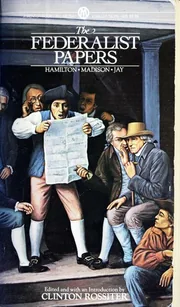
The Federalist, or, The New Constitution
by Alexander Hamilton, James Madison · 1788
This suits mature teens and adults ready for formal eighteenth-century argument, and it is a common text in courses on American history and politics.
477 pages, about 7.5 to 11 hours.
Rigorous, argument-led case for the Constitution, demanding but still essential. 46% taste match
What it covers
This is a collection of political essays addressed to the people of the State of New York during the debate over the proposed Constitution of the United States. The pieces were written by Alexander Hamilton, James Madison, and John Jay, and they first appeared in 1788 after running as a run of letters in New York newspapers. They were put out without the authors' names attached. The opening essay speaks directly to New Yorkers, pointing to the shortcomings of the existing federal government and asking them to weigh a new framework for the nation.
The book sits within American constitutional history and political science, and it belongs to the period between 1783 and 1789, when the young republic was deciding how it would be governed. It works as a set of arguments for ratification and as a commentary on the questions a democracy has to face. The edition described here also prints the complete text of the Constitution alongside the essays. With around 350 editions in circulation and a typical length of about 477 pages, it remains a standard source for readers of United States politics, law, and history.
To the People of the State of New York: AFTER an unequivocal experience of the inefficiency of the subsisting federal government, you are called upon to deliberate on a new Constitution for the United States of America.
Setting
United StatesÉtats-UnisEstados Unidos
Period
1783-1789
Themes
Classic LiteratureAmerican historyUnited States - GeneralHistoryHistory - General HistoryUSAConstitutional law, united statesUnited states, constitution
- Want to read 84
- Reading now 7
- Read 8
Most people shelving it are saving it for later.
Of 99 readers who put it on a shelf, 85% want to read it, 7% are reading it now, 8% have finished it and 0% stopped before the end.
By the numbers
- The median edition runs 477 pages. Counting about 275 words a page and an adult reading pace of 250 words a minute, that is about 8.7 hours of reading.
- Open Library tracks 350 editions from 115 publishers, the earliest dated 1788 and the latest 2024, across 2 languages.
- On reader demand it ranks in the top 16% of the classic books in our catalog (8,749 of them).
- Libraries shelve it under Dewey 342.73024 and Library of Congress class KF-4515.00000000.F4 2009a.
 BookWard’s take
Rigorous, argument-led case for the Constitution, demanding but still essential
The Federalist is a run of newspaper essays by Hamilton, Madison and Jay, written to persuade New Yorkers to ratify the new Constitution. It is idea-led from the first page, and it opens by addressing its readers directly, so the hook is clear even if it is not dramatic. On rigor it sits near the top: each essay builds a reasoned case about how a republic should be structured, and the internal logic is tight. Prose is formal and period-bound, so the reading effort is real, and the cast is essentially three authors rather than characters. BookWard prefers story-led books and shown scenes, so this is a respectful fit rather than a natural one. Its staying power, though, is hard to dispute.
At 477 pages in the described edition, it is a substantial collection rather than a short read, which sits against BookWard's taste for tight books.
Dense argument takes time to absorb, so it moves at a deliberate, measured pace compared with BookWard's preference for momentum.
It worked out how a large republic could be governed at a moment when the question was open, which was new thinking then.
The language is formal and period-bound, elaborate in construction but not decorative.
It makes a confident case that a well-designed government can serve a free people, which is a broadly hopeful premise.
It is a sequence of essays rather than a single narrative, a conventional form for political writing.
It is a serious work of political argument with essentially no comic tone.
The content is political and legal, not dark or disturbing.
It appeals to reason and the public good, with little emotional intensity.
See all 50 dialsEvery position, side by side with this book
Where it lines up
- OriginalityBookWard 9 · book 9
- Rigor (nonfiction)BookWard 9 · book 9
- Internal logicBookWard 10 · book 9
Where it pulls apart
- ExpositionBookWard 2 · book 10
- LengthBookWard 1 · book 6
- Story or ideasBookWard 3 · book 10
At 477 pages in the described edition, it is a substantial collection rather than a short read, which sits against BookWard's taste for tight books.
It opens by addressing New Yorkers directly about the flaws of the existing government, which is purposeful but not a gripping start.
These essays helped define the American constitutional argument, so they read as foundational rather than as a retread of familiar moves.
Each essay builds a reasoned case for ratification, and that disciplined argument is exactly what BookWard rewards.
Dense argument takes time to absorb, so it moves at a deliberate, measured pace compared with BookWard's preference for momentum.
It worked out how a large republic could be governed at a moment when the question was open, which was new thinking then.
The collection closes its case for the framework it defends, though its debates over government were never fully settled.
It argues from reasoning about institutions rather than appeals to feeling, which fits BookWard's liking for restraint.
There is no shock for effect; the essays persuade through argument, which BookWard values.
These are structured arguments about governance and the problems facing a democracy, close to the rigorous end BookWard prefers.
Three authors wrote anonymously under a shared purpose, so the voice is formal and collective more than individually distinctive.
This is an argument from start to finish with no narrative, far toward ideas where BookWard leans toward story.
The authors state their reasoning outright rather than dramatizing it, the opposite of BookWard's preference for showing in scene.
A long run of essays can feel uneven, though the shared purpose keeps the collection pointed at one goal.
The language is formal and period-bound, elaborate in construction but not decorative.
It makes a confident case that a well-designed government can serve a free people, which is a broadly hopeful premise.
It is a sequence of essays rather than a single narrative, a conventional form for political writing.
It is a serious work of political argument with essentially no comic tone.
Formal eighteenth-century argument takes sustained attention, so it asks more of the reader than most nonfiction.
Three authors contribute, but they argue for one position, so the outlook stays unified.
The essays run in sequence within the ratification debate, with no time shifts.
It deals entirely with real government and law.
The only figures are the authors and the public they address.
It concerns the structure of a whole nation and the case for a new framework of government, a large canvas.
The focus is on institutions and public arguments rather than private reflection.
There is no dialogue, only argument addressed to the public.
Romance plays no part in a work of constitutional argument.
The setting is the world of the founding era, unfamiliar in its details to most modern readers.
It dates from 1787 and 1788, in the debate over the new Constitution.
The questions it raises about democracy are still debated today, which gives it lasting standing.
The authors argue openly under a shared pen, with no concealed or untrustworthy narrator.
The essays take clear positions on how government should be built and argue for them directly.
These are arguments about structures and principles, with little scene-setting or sensory detail.
It is analytical and argumentative, not a narrative account of events.
The authors write as advocates making a case, not as personal witnesses to their own lives.
It is a self-contained collection, though its essays form one connected campaign.
It follows an argument it announces, with little to surprise the reader.
It asks readers to weigh serious claims about power and government rather than offering comfort.
The content is political and legal, not dark or disturbing.
It appeals to reason and the public good, with little emotional intensity.
There is no humor to speak of.
Violence is not depicted.
There is no sexual content.
Political argument is its entire subject, as it urges ratification of the Constitution.
Eighteenth-century phrasing and long sentences make the language denser than modern prose.
The essays are openly persuasive, pressing a case for ratification.
It looks ahead, proposing how a new nation should be governed.
It argues in earnest that a well-built republic can protect a free people.
Review written by BookWard, dial version 1, November 2026.
Who is The Federalist, or, The New Constitution right for?
This suits mature teens and adults ready for formal eighteenth-century argument, and it is a common text in courses on American history and politics. It contains nothing graphic, though the density can be a barrier to casual readers.
Formal eighteenth-century argument takes sustained attention, so it asks more of the reader than most nonfiction.
The content is political and legal, not dark or disturbing.
It appeals to reason and the public good, with little emotional intensity.
Violence is not depicted.
Book CompanionThe Federalist, or, The New Constitution: ideas, characters, themes
Hamilton, Madison and Jay argue to New Yorkers that the existing federal government is inadequate and that the proposed Constitution offers a sounder framework for a lasting republic.
- A public argument. The essays first ran as letters in New York newspapers, addressed to ordinary voters deciding whether to ratify.
- Three authors, one cause. Alexander Hamilton, James Madison and John Jay wrote the pieces, which appeared without their names.
- Diagnosing the old order. The opening essay points to the shortcomings of the existing federal government as the reason to consider a new one.
- A commentary on democracy. Beyond the immediate campaign, the essays comment on crucial issues facing a democracy.
- The text alongside. The edition described prints the complete Constitution, so the essays can be read against the document they defend.
Characters
Alexander Hamilton
Co-author
One of the three founders who wrote the essays urging ratification.
James Madison
Co-author
A second author of the essays, writing in support of the new framework.
John Jay
Co-author
The third author, who joined the others in addressing the people of New York.
Themes
How power should be organized across a nation, and what the old arrangement lacked.
The problems a republic must solve to endure.
Using reasoned public argument to win a decision.
The moment when a young republic chose how it would be governed.
Discussion questions
- Why might the authors have addressed ordinary New Yorkers rather than politicians alone?
- How does reading the essays beside the text of the Constitution change your understanding of each?
- Which weaknesses of the existing federal government does the opening essay emphasize, and are they convincing?
- What does it mean that the essays were published without the authors' names?
- Which of the questions facing democracy in these essays still feel live today?
Personalize your Book Companion
This is the general edition. In BookWard, the Companion is written for you: your reading profile, your notes, and spoiler-safe to the page you are on.
Buy, listen or borrow The Federalist, or, The New Constitution
Each link opens a search for this book on that store, in a new tab.
Read on a device
Borrow
Reviews and community
If you liked The Federalist, or, The New Constitution
The founding treatise of economics, patient, sprawling and still argued over
De la démocratie en AmériqueAlexis de TocquevilleA French aristocrat's sharp, enduring anatomy of American democracy
Die Entwicklung des Sozialismus von der Utopie zur WissenschaftFriedrich EngelsEngels's short, argumentative primer on how socialism claimed to become a science
On LibertyJohn Stuart MillA short, rigorous case for the freedom to differ
Sources: Open Library.
Track The Federalist, or, The New Constitution and find your next favorite
Add it to your shelf, rate what you have read, and BookWard will recommend what fits you.
Free to start. No credit card needed.