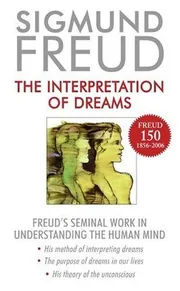
Die Traumdeutung
by Sigmund Freud · 1899
Best suited to adult readers and students with patience for dense, historical, theoretical writing.
512 pages, about 8 to 12 hours.
Freud's founding case that every dream carries a hidden meaning. 43% taste match
What it covers
Die Traumdeutung, first published in 1899, is a work of nonfiction by Sigmund Freud, the founder of psychoanalysis. It sits within psychology and psychoanalytic theory, and its subject is the interpretation of dreams. Freud sets out to present a psychological technique for reading dreams, arguing that each one has a meaning and can be placed within the mental activity of waking life.
The book introduces his theory of the unconscious as it relates to dreams, and it touches on ideas that later developed into the theory of the Oedipus complex. Freud revised the work at least eight times over the years. In the third edition he added a long section that treated dream symbolism in a very literal way, a change influenced by Wilhelm Stekel. The topics it draws on include dream interpretation, psychoanalytic interpretation and neurasthenia. A typical edition runs to around 512 pages, and the title has appeared in 141 editions.
Themes
PsychoanalysisDreamsDream interpretationNeurastheniaPsychologyPsychoanalytic TheoryPsychoanalytic InterpretationInterprétation
- Want to read 450
- Reading now 24
- Read 20
Most people shelving it are saving it for later.
Of 494 readers who put it on a shelf, 91% want to read it, 5% are reading it now, 4% have finished it and 0% stopped before the end.
By the numbers
- The median edition runs 512 pages. Counting about 275 words a page and an adult reading pace of 250 words a minute, that is about 9.4 hours of reading.
- Open Library tracks 141 editions from 73 publishers, the earliest dated 1899 and the latest 2023, across 6 languages.
- On reader demand it ranks in the top 4% of the classic books in our catalog (8,749 of them).
- Libraries shelve it under Dewey 154.63 and Library of Congress class BF-1078.00000000.F748 1999.
 BookWard’s take
Freud's founding case that every dream carries a hidden meaning
This is the book where psychoanalysis plants its flag, arguing that dreams are meaningful and can be read as part of waking mental life. It is driven by ideas rather than story, and it leans on Freud's own dreams and his patients' as material. Expect a dense, long, demanding read, one that asks a lot of you, with Freud arguing every step outright instead of leaving anything for the reader to infer. His voice is unmistakable, confident and opinionated, and that carries the length better than most theory does. As for rigor, the case-by-case method is closer to persuasive argument than controlled evidence, so read it as a landmark of ideas and a historical document, not settled science. Few books have shaped how people talk about the mind.
About 512 pages of sustained argument and example, well past short; BookWard prefers tight, so this sits on the wrong side of its taste.
Dense, cumulative argument moves slowly and rewards patience; BookWard leans faster.
It introduced the theory of the unconscious in relation to dreams, a genuinely new way of thinking, squarely in BookWard's taste.
Formal, scholarly nineteenth-century prose with long sentences, more ornate than plain.
Neutral in outlook; it is analysis of the mind rather than a statement about hope.
A conventional scholarly layout of survey, method, theory and conclusion.
Serious throughout, with only occasional dry asides.
Its subject includes repressed and uncomfortable wishes, treated analytically rather than luridly.
Cool and clinical in tone, with emotion present only as material under analysis.
See all 50 dialsEvery position, side by side with this book
Where it lines up
- Authorial voiceBookWard 9 · book 9
- OriginalityBookWard 9 · book 10
- SentimentBookWard 8 · book 9
Where it pulls apart
- LengthBookWard 1 · book 7
- OpeningBookWard 10 · book 4
- Story or ideasBookWard 3 · book 10
About 512 pages of sustained argument and example, well past short; BookWard prefers tight, so this sits on the wrong side of its taste.
It opens with a survey of earlier dream literature, which is scholarly groundwork, not a grab; BookWard likes an immediate hook.
Freud builds his own framework instead of leaning on genre conventions, which BookWard values.
The argument is carefully chained from step to step, though some of its central claims are asserted more than proven.
Dense, cumulative argument moves slowly and rewards patience; BookWard leans faster.
It introduced the theory of the unconscious in relation to dreams, a genuinely new way of thinking, squarely in BookWard's taste.
The people in it are Freud and his patients, sketched through dreams and associations rather than fully drawn.
It closes by tying dreams back to the wider psychology of the mind, a reasonably resolved argument.
Freud writes clinically and analytically, with little sentimentality, which BookWard prefers.
Sexual and aggressive wishes are put forward as argument, not as provocation for its own sake.
Case-based reasoning from self-analysis and patients falls short of controlled evidence, which sits below BookWard's rigor bar.
Freud's confident, argumentative, self-revealing voice is unmistakably his own, which BookWard loves.
It is a work of theory with no narrative drive; the ideas are the whole point.
Freud explains his method and conclusions outright at nearly every step, far from BookWard's show-in-scene taste.
The long middle chapters on dream-work grow repetitive in places, though the argument keeps building.
Formal, scholarly nineteenth-century prose with long sentences, more ornate than plain.
Neutral in outlook; it is analysis of the mind rather than a statement about hope.
A conventional scholarly layout of survey, method, theory and conclusion.
Serious throughout, with only occasional dry asides.
Dense, technical and historically distant; it asks real effort from the reader.
A single authorial perspective argues the case from start to finish.
The argument unfolds in a straight line, though examples jump between dreams.
The subject is dreams, but the treatment is a grounded psychological analysis.
A modest set of recurring dreamers and patients, mostly Freud himself.
The ambition is large, a theory of the unconscious, though the material is intimate dream detail.
Almost entirely about inner mental life: wishes, memories, dream images.
Essentially none; it is exposition and recounted dream content.
Not a theme in the usual sense; desire appears only as psychological theory.
Fin-de-siècle Vienna and the unfamiliar territory of the unconscious feel distant to a modern reader.
Published in 1899 and firmly of its time in its assumptions and examples.
Its ideas on dreams and the unconscious have shaped culture ever since, though many claims have aged.
Freud is open about his methods and his own dreams, a mostly reliable if self-interested guide.
Interpretation is open to debate, and Freud leaves much to the reader's judgment.
Dreams are recounted in detail, but the prose is analytic rather than vivid.
Argument and analysis dominate, with case anecdotes as support.
Freud analyzes his own dreams freely, so it is quite personal for a theory book.
A standalone work, though the ideas run through his wider output.
Little surprise by design; the argument builds steadily to its thesis.
It pushes against assumptions about the mind and asks readers to take dreams seriously.
Its subject includes repressed and uncomfortable wishes, treated analytically rather than luridly.
Cool and clinical in tone, with emotion present only as material under analysis.
Aggression appears in dream content but is discussed, not depicted.
Sexual wishes are central to the theory, discussed analytically rather than explicitly.
Largely absent; this is a work of psychology.
Dense German academic prose, with technical terms that can slow translation and reading.
Freud argues his case forcefully and says outright what he thinks.
It looks back to dreams and childhood for explanation, though it opened a new field.
A faith in rational inquiry runs through it, tempered by Freud's darker view of human drives.
Review written by BookWard, dial version 1, November 2026.
Who is Die Traumdeutung right for?
Best suited to adult readers and students with patience for dense, historical, theoretical writing. It discusses sexual and aggressive wishes analytically, which some readers may find sensitive.
Dense, technical and historically distant; it asks real effort from the reader.
Its subject includes repressed and uncomfortable wishes, treated analytically rather than luridly.
Cool and clinical in tone, with emotion present only as material under analysis.
Aggression appears in dream content but is discussed, not depicted.
Book CompanionDie Traumdeutung: ideas, characters, themes
Freud argues that dreams are meaningful psychological events that can be interpreted and traced into the unconscious mental activity of waking life.
- Dreams have meaning. Freud rejects the view that dreams are random noise and argues each one can be interpreted.
- A technique for reading them. He lays out a psychological method for working back from a dream to what it expresses.
- The unconscious enters. The book introduces his theory of the unconscious as it applies to dream interpretation.
- Seeds of the Oedipus complex. It touches on ideas that later grew into the theory of the Oedipus complex.
- A book revised for years. Freud revised it at least eight times, adding a long section on dream symbolism in the third edition under Wilhelm Stekel's influence.
Characters
Sigmund Freud
Author and chief subject
Freud draws on his own dreams and his analysis of them as central material for the theory.
Wilhelm Stekel
Influence on later editions
His influence led Freud to add an extensive, very literal section on dream symbolism in the third edition.
Themes
Mental activity beyond awareness that shapes dreams and behavior.
The idea that dreams are texts to be read, not noise to be dismissed.
Wishes pushed out of awareness that return in disguised form.
How a new science of the mind claims to know what it knows.
Discussion questions
- Does Freud's claim that every dream has a meaning hold up, or is it too sweeping?
- How does the book's use of Freud's own dreams strengthen or weaken the argument?
- Which ideas here still shape how we talk about the mind, and which feel dated?
- Why might Freud have revised the book so many times, and what does that say about the theory?
- How should a modern reader weigh a landmark of ideas against its limits as evidence?
Personalize your Book Companion
This is the general edition. In BookWard, the Companion is written for you: your reading profile, your notes, and spoiler-safe to the page you are on.
Buy, listen or borrow Die Traumdeutung
Each link opens a search for this book on that store, in a new tab.
Read on a device
Borrow
Reviews and community
If you liked Die Traumdeutung
A literary-cultural inquiry into the limits of knowing, from Eden onward
Motivation and personalityAbraham H. MaslowMaslow's landmark portrait of what human beings need and become
WaldenHenry David ThoreauTwo years by a pond, and a case against busyness
MoraliaPlutarchPlutarch's 78 essays: ancient ethics with surprising bite
Sources: Open Library.
Track Die Traumdeutung and find your next favorite
Add it to your shelf, rate what you have read, and BookWard will recommend what fits you.
Free to start. No credit card needed.