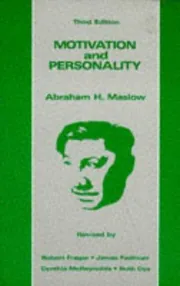
Motivation and personality
by Abraham H. Maslow · 1954
Best suited to adult and older teen readers comfortable with an academic text.
400 pages, about 6.5 to 9.5 hours.
Maslow's landmark portrait of what human beings need and become. 40% taste match
What it covers
Motivation and Personality is a work of psychology by Abraham H. Maslow, first published in 1954. It belongs to the self-help and psychology shelf and runs to roughly 400 pages. The book looks at what drives human beings and how personality takes shape around those drives, with particular attention to human fulfillment and the part that personal relationships play in it.
At its centre is the idea of self-actualization, the stage at which a person develops their potential and does the best they are capable of. Maslow sets this against the earlier needs in his hierarchy, including the need for social love and affection. A person who has had those needs met is free to follow an individual path toward self-actualization, while someone whose needs remain unmet stays occupied with them. To describe the self-actualized person, Maslow looked at figures he considered to fit that description, among them Abraham Lincoln, Thomas Jefferson and Albert Einstein, and drew out the traits they shared. The book sits within humanistic psychology and has been issued in 18 editions.
Themes
MotivatieMotivationDavid SzePersoonlijkheidMotivation (Psychology)Motivation (Psychologie)Self-actualization (Psychology)Réalisation de soi
- Want to read 257
- Reading now 25
- Read 9
Most people shelving it are saving it for later.
Of 291 readers who put it on a shelf, 88% want to read it, 9% are reading it now, 3% have finished it and 0% stopped before the end.
By the numbers
- The median edition runs 400 pages. Counting about 275 words a page and an adult reading pace of 250 words a minute, that is about 7.3 hours of reading.
- Open Library tracks 18 editions from 10 publishers, the earliest dated 1954 and the latest 1998, across 2 languages.
- On reader demand it ranks in the top 7% of the classic books in our catalog (8,749 of them).
- Libraries shelve it under Dewey 153.8 and Library of Congress class BF-0199.00000000.M3.
 BookWard’s take
Maslow's landmark portrait of what human beings need and become
This is the book where Maslow lays out his hierarchy of needs and then goes further, describing the self-actualized person in detail. It is led by ideas rather than story, and the exposition tells you outright what it means instead of dramatizing it in scene, which is not my favorite way to read. Where it earns its place is in its originality and its voice: the ideas were distinctive for 1954, and the author's humanistic stance is unmistakable on every page. On rigor, it draws on figures like Lincoln, Jefferson and Einstein as case studies, which is thoughtful but closer to portraiture than controlled experiment. The outlook is hopeful and the tone restrained, with little sentiment. It is demanding in places, a 400-page academic text rather than a quick read, so the going is slow.
At roughly 400 pages it is a substantial academic read, longer than BookWard's taste for tight books.
Dense theoretical argument moves at a measured, slow pace, below BookWard's preference for speed.
Placing fulfillment, not pathology, at the centre of psychology was distinctive in 1954, which BookWard values.
The writing is plain and academic, closer to clear than ornate.
There is no narrative drive, so plot versus character does not apply here.
Maslow focuses on human potential and growth, an optimistic outlook that fits BookWard's hopeful side.
It follows a conventional treatise structure, with no formal experiments.
A serious scholarly work with little humor.
The tone is humane and gentle rather than dark.
The register is intellectual and measured rather than emotionally intense.
See all 50 dialsEvery position, side by side with this book
Where it lines up
- SentimentBookWard 8 · book 8
- OriginalityBookWard 9 · book 8
- Authorial voiceBookWard 9 · book 8
Where it pulls apart
- OpeningBookWard 10 · book 4
- LengthBookWard 1 · book 6
- Story or ideasBookWard 3 · book 10
At roughly 400 pages it is a substantial academic read, longer than BookWard's taste for tight books.
It opens as a scholarly treatise rather than a grabber, which is slower than BookWard likes.
The hierarchy of needs became famous, but the argument itself avoids stock self-help formulas, which suits BookWard.
Maslow builds the case step by step from needs to self-actualization, a reasonably coherent chain, though not airtight.
Dense theoretical argument moves at a measured, slow pace, below BookWard's preference for speed.
Placing fulfillment, not pathology, at the centre of psychology was distinctive in 1954, which BookWard values.
This is a work of psychology, not fiction, so there are no characters to place.
As a theoretical work it has no plot ending to resolve, so this dial does not apply.
The prose is analytical and restrained rather than sentimental, which matches BookWard's taste.
It does not use shock for effect, so this dial does not apply.
Maslow studied figures he judged self-actualized, a careful but selective method, short of BookWard's high bar for rigor.
Maslow's humanistic voice and unusual portrait of the healthy personality are distinctive, which BookWard favors.
This is entirely an argument about ideas, far from BookWard's story-led leaning.
Concepts are explained outright rather than dramatized, the opposite of what BookWard prefers.
A long theoretical text can drift in places, though the core argument holds up across the whole.
The writing is plain and academic, closer to clear than ornate.
There is no narrative drive, so plot versus character does not apply here.
Maslow focuses on human potential and growth, an optimistic outlook that fits BookWard's hopeful side.
It follows a conventional treatise structure, with no formal experiments.
A serious scholarly work with little humor.
Dense academic argument takes real effort, more demanding than BookWard's usual comfort level.
The book is built on a single authorial viewpoint.
The argument is laid out in a linear, topic-by-topic way.
Entirely grounded in human psychology and observation.
As an academic work, it has no cast to size.
It makes claims about human nature at large, giving it a broad reach despite its small-scale case studies.
The subject is inner life: motivation, needs, personality and fulfillment.
As an academic treatise, there is essentially no dialogue.
Love and belonging appear as a need in the hierarchy, but romance is not a theme of the book.
The setting is human psychology, which is familiar territory for most readers.
Written in 1954, the book comes from the past, though its ideas remain widely used.
The hierarchy of needs is still widely recognized decades on, which BookWard rates highly.
As nonfiction with no storyteller, the narrator dial does not apply.
Maslow argues for a clear ideal of human fulfillment, though the self-actualized figures are portrayed with nuance.
The text relies on explanation and argument rather than rich scene-setting.
The book is analytical in form, built around theory and traits rather than a narrative arc.
Maslow writes as a theorist while drawing on his own studies, a balanced mix of detached and personal.
It stands alone as a single, self-contained work.
There are few surprises in a theoretical argument, beyond how the ideas develop.
It invites readers to rethink motivation and fulfillment, which is moderately challenging.
The tone is humane and gentle rather than dark.
The register is intellectual and measured rather than emotionally intense.
Humor is largely absent, so this dial does not apply.
There is no violence on the page.
Sexual content is not a feature of the book.
It is a work of psychology, not politics, though its views on culture and conformity carry some social weight.
The language is plain academic English, with some specialist terms.
Maslow argues a clear position and states his judgments openly.
The book looks forward, toward human growth and what people can become.
It is built around an idealistic vision of human potential, from the title concept to the portraits of self-actualized people.
Review written by BookWard, dial version 1, November 2026.
Who is Motivation and personality right for?
Best suited to adult and older teen readers comfortable with an academic text. It contains no graphic or sensitive material, though the abstract, theoretical style can be heavy going.
Dense academic argument takes real effort, more demanding than BookWard's usual comfort level.
The tone is humane and gentle rather than dark.
The register is intellectual and measured rather than emotionally intense.
There is no violence on the page.
Book CompanionMotivation and personality: ideas, characters, themes
Human beings are driven by a hierarchy of needs, and once the lower ones are met, they can pursue self-actualization, developing their potential in their own way.
- Needs come in layers. Maslow organizes human motivation as a hierarchy, with earlier needs shaping what a person is free to pursue next.
- Love and belonging matter. The need for social love and affection sits in the hierarchy, and people whose needs go unmet stay occupied with them.
- Self-actualization is the peak. It means maximizing your potential and doing the best you are capable of doing.
- Study the healthy, not just the troubled. Maslow looked at figures such as Lincoln, Jefferson and Einstein to draw out shared traits of a fulfilled person.
- Growth over striving. Self-actualized people are described as developing in their own style, rather than chasing the satisfaction of missing needs.
Themes
What drives people to act, and how those drives are ordered.
Developing your full potential and doing the best you are capable of.
The role of love and affection in a person's development.
A focus on human fulfillment and health rather than only on illness.
How character takes shape around what a person needs and wants.
Discussion questions
- Do you agree that needs are best understood as a hierarchy, or do they overlap in your experience?
- Why might Maslow have chosen to study people he considered healthy rather than people in distress?
- What does it mean to you to 'do the best that you are capable of doing'?
- How does the need for love and affection shape a person's ability to grow?
- Is it fair to judge figures like Lincoln, Jefferson and Einstein as examples of self-actualization?
Personalize your Book Companion
This is the general edition. In BookWard, the Companion is written for you: your reading profile, your notes, and spoiler-safe to the page you are on.
Buy, listen or borrow Motivation and personality
Each link opens a search for this book on that store, in a new tab.
Read on a device
Borrow
Reviews and community
If you liked Motivation and personality
A method for reading seriously, taught step by step
Emotional IntelligenceDaniel GolemanGoleman's case that emotional skill can outweigh IQ, and can be taught
The 7 Habits of Highly Effective PeopleStephen R. CoveySeven habits, laid out plainly, with ideas ahead of story
CodeCharles PetzoldFlashlights to microprocessors: how computers actually work, built from nothing
Sources: Open Library.
Track Motivation and personality and find your next favorite
Add it to your shelf, rate what you have read, and BookWard will recommend what fits you.
Free to start. No credit card needed.