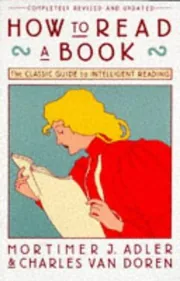
How to Read a Book
by Mortimer J. Adler · 1940
Best suited to adult and older teenage readers who are willing to work at their reading.
398 pages, about 6.5 to 9.5 hours.
A method for reading seriously, taught step by step. 36% taste match
What it covers
How to Read a Book is a nonfiction guide by Mortimer J. Adler, first published in 1940. It belongs to the self-help and psychology shelf and deals with the practice of reading itself, treating the subject through the lens of the psychology of reading and the education of adults. The text is addressed to people who already read and to those who hope to become readers, and it approaches books as something to be studied with deliberate method rather than merely passed over.
The material draws on the idea of reading as a skill that can be learned and improved, which places it alongside other works on adult education and on how people engage with the printed page. Its subject matter spans reading in general and books in general, with attention to what a reader brings to a text and how that effort shapes understanding. The book has a lecture-like quality in its approach, speaking to readers in the manner of instruction.
In the median edition the book runs to about 398 pages. It has appeared in 23 editions since its first publication, and it has been featured among the Open Library Staff Picks. Readers interested in how reading works as a discipline, and in the habits that go with it, will find the subject laid out in a single extended volume.
This is a book for readers and for those who wish to become readers.
Themes
Reading, Psychology ofPsychology of ReadingBooks and readingLectureReadingLong Now Manual for CivilizationBooksReading (Adult education)
- Want to read 728
- Reading now 95
- Read 23
Most people shelving it are saving it for later.
Of 846 readers who put it on a shelf, 86% want to read it, 11% are reading it now, 3% have finished it and 0% stopped before the end.
By the numbers
- The median edition runs 398 pages. Counting about 275 words a page and an adult reading pace of 250 words a minute, that is about 7.3 hours of reading.
- Open Library tracks 23 editions from 15 publishers, the earliest dated 1940 and the latest 2022, across 4 languages.
- On reader demand it ranks in the top 2% of the classic books in our catalog (8,749 of them).
- Libraries shelve it under Dewey 028 and Library of Congress class PN-0083.00000000.A43 1992.
 BookWard’s take
A method for reading seriously, taught step by step
Adler treats reading as a skill with levels, and he walks you up them on purpose. It is an idea-led book through and through, more interested in the argument than in any story, though a reader who likes narrative might wish otherwise. It also explains outright rather than showing things in scene, which is a matter of taste, since some readers prefer to watch an idea at work. Where it earns its keep is rigor: the method is laid out as a system rather than a pile of anecdotes. Expect a measured pace and a sustained middle, with practical instruction in place of surprise. At 398 pages it is long for anyone who likes tight books, but the structure makes it easy to dip into by part. Useful if you want a framework, less so if you want a hook.
At 398 pages it runs long for a how-to, well past BookWard's preference for tight, short books.
Instruction moves at a steady, deliberate pace, slower than BookWard's taste for momentum.
Teaching a structured approach to reading was fresher in 1940 than it feels now.
The prose is plain and functional, built to teach rather than to ornament.
With no plot and no characters, this dial does not apply.
It assumes readers can improve with effort, a quietly hopeful stance.
The book is organized in conventional parts that build a method in order.
It is earnest and instructional, with little humor.
The content is gentle throughout.
It is calm and rational, with little emotional intensity.
See all 50 dialsEvery position, side by side with this book
Where it lines up
- EndingBookWard 8 · book 7
- SentimentBookWard 8 · book 9
- Shock for effectBookWard 9 · book 10
Where it pulls apart
- OpeningBookWard 10 · book 4
- ExpositionBookWard 2 · book 10
- LengthBookWard 1 · book 6
At 398 pages it runs long for a how-to, well past BookWard's preference for tight, short books.
It opens on its subject and its method rather than a gripping scene, a slower start than BookWard likes.
The advice follows familiar self-improvement lines, though the systematic framing sets it apart somewhat.
The method is built as a stepwise system where each level of reading rests on the one before.
Instruction moves at a steady, deliberate pace, slower than BookWard's taste for momentum.
Teaching a structured approach to reading was fresher in 1940 than it feels now.
There is no cast to draw, so this dial does not apply.
It closes by bringing the method together and pointing you toward practice.
The tone is practical and instructive, with almost no sentimentality, which suits BookWard well.
Nothing here is dark or shocking; it earns its seriousness through argument alone.
It builds a method with defined levels and procedures, though it leans on assertion more than evidence.
Adler speaks as a confident teacher, clear and recognizable without being flashy.
This is an idea-led book from start to finish, the opposite of BookWard's story-first lean.
It explains its points outright, the reverse of BookWard's preference for showing in scene.
Instruction in parts keeps it fairly steady, though some stretches of method can feel repetitive.
The prose is plain and functional, built to teach rather than to ornament.
With no plot and no characters, this dial does not apply.
It assumes readers can improve with effort, a quietly hopeful stance.
The book is organized in conventional parts that build a method in order.
It is earnest and instructional, with little humor.
It asks for real attention and practice, more effort than a casual read.
A single teacher's voice carries the whole book.
The material moves in a straight line from basic to advanced reading.
It is entirely grounded in the real practice of reading.
There is no cast, so this dial does not apply.
It stays focused on the individual reader and the page in front of them.
The book is about the mental work of reading, an inward activity.
It is exposition with no conversation on the page.
Romance plays no part in a book about reading method.
The setting is the familiar world of readers, books and study.
Written in 1940, it sits closer to the past than the present day.
Its core idea, that reading is a skill to be trained, outlasts its era.
The author addresses you directly and plainly, with nothing hidden.
Its view of what counts as good reading is stated with clear confidence.
There is little scene-setting; the focus is on method and argument.
It is analytical and systematic rather than a story told in sequence.
Adler writes as an engaged teacher, personal in tone rather than detached.
It stands as a single volume that needs no companions.
A teaching book offers no plot twists.
It nudges you to change habits, a moderate challenge rather than a comfort.
The content is gentle throughout.
It is calm and rational, with little emotional intensity.
There is not enough humor here to place a style.
There is no violence on the page.
There is no sexual content.
Its concern is reading, not politics, though education carries some civic weight.
The language is standard and clear, with no dense dialect.
Adler states firm views on how reading should be done, and says so openly.
It looks to the reader's future improvement while drawing on a tradition of great books.
It holds an idealistic faith in what disciplined reading can do for a person.
Review written by BookWard, dial version 1, November 2026.
Who is How to Read a Book right for?
Best suited to adult and older teenage readers who are willing to work at their reading. Nothing in it is sensitive or mature in content.
It asks for real attention and practice, more effort than a casual read.
The content is gentle throughout.
It is calm and rational, with little emotional intensity.
There is no violence on the page.
Book CompanionHow to Read a Book: ideas, characters, themes
Reading is a learnable skill with levels, and deliberate method turns passive page-turning into real understanding.
- Reading is a skill. Adler treats reading as something that can be trained and improved through deliberate practice.
- Levels of reading. The method moves the reader up through stages of increasing depth and engagement.
- Active engagement. Understanding comes from what the reader brings to the text, not from passively taking it in.
- Method over speed. Careful, structured effort matters more than getting through pages quickly.
- Meant for any reader. The advice speaks both to those who read already and to those hoping to become readers.
Themes
Treating reading as a practice that rewards method and effort.
The idea that learning continues beyond school through self-directed study.
Comprehension as something the reader builds, not simply receives.
Growth through deliberate habits and training.
Discussion questions
- Do you read differently for pleasure than for study, and should you?
- Which part of Adler's method would you actually adopt?
- Does treating reading as a skill help or take some joy out of it?
- How might this advice change for a novel versus a work of ideas?
- What makes a book worth reading more than once?
Personalize your Book Companion
This is the general edition. In BookWard, the Companion is written for you: your reading profile, your notes, and spoiler-safe to the page you are on.
Buy, listen or borrow How to Read a Book
Each link opens a search for this book on that store, in a new tab.
Read on a device
Borrow
Reviews and community
If you liked How to Read a Book
Maslow's landmark portrait of what human beings need and become
Getting Things DoneDavid AllenA practical system for getting your head clear and your work moving
Trading in the zoneMark DouglasA trader's psychology manual about thinking in probabilities, not predictions
Emotional IntelligenceDaniel GolemanGoleman's case that emotional skill can outweigh IQ, and can be taught
Sources: Open Library.
Track How to Read a Book and find your next favorite
Add it to your shelf, rate what you have read, and BookWard will recommend what fits you.
Free to start. No credit card needed.