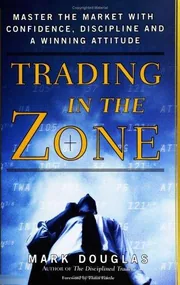
Trading in the zone
by Mark Douglas · 2001
It suits adult readers with an interest in trading or investing, and it needs no special background beyond that.
121 pages, about 2 to 3 hours.
A trader's psychology manual about thinking in probabilities, not predictions. 45% taste match
What it covers
Trading in the Zone is a nonfiction guide for people who buy and sell in financial markets, written by Mark Douglas and first published in 2001. It belongs to the business and money category and deals with stocks, speculation, investments, stock exchanges and the securities industry.
Rather than offering a system for picking securities, the book looks at the psychology of the person placing the trades. Douglas has worked as a trader, a personal trading coach and an industry consultant since 1982, and he draws on that experience to argue that a trader's habits of thought shape how consistently they perform. The book works through five specific issues meant to help readers understand their own attitudes, including the beliefs they hold about markets. Simple exercises teach readers to reason in terms of probabilities and to build the mindset the author associates with steady results. Examples are used throughout to illustrate the points. The edition most often found runs to about 121 pages, and the book has appeared in four editions.
Themes
BusinessSpeculationStocksStock exchangesSecurities industryInvestments
- Want to read 2,022
- Reading now 243
- Read 73
Most people shelving it are saving it for later.
Of 2338 readers who put it on a shelf, 86% want to read it, 10% are reading it now, 3% have finished it and 0% stopped before the end.
By the numbers
- The median edition runs 121 pages. Counting about 275 words a page and an adult reading pace of 250 words a minute, that is about 2.2 hours of reading.
- Open Library tracks 4 editions from 4 publishers, the earliest dated 2001 and the latest 2025.
- On reader demand it ranks in the top 1% of the modern books in our catalog (15,152 of them).
- Libraries shelve it under Dewey 332.64 and Library of Congress class HG-6041.00000000.D59 2000.
 BookWard’s take
A trader's psychology manual about thinking in probabilities, not predictions
Trading in the Zone is a short, focused book that skips stock tips and goes after the trader's own head. Douglas, who has coached traders since 1982, argues that consistency comes from how you think, and he builds the case through exercises that retrain readers to reason in probabilities. It is tight, and at about 121 pages it never overstays its welcome. The evidence is the weak spot: it leans on a coach's experience and examples rather than formal research, so readers hoping for rigorous proof will come away wanting more. Douglas is direct and sure of his argument, and that confidence carries the book. He also explains his ideas outright rather than letting them emerge from scenes or stories, which isn't my preference, though the plainness serves a subject like this one.
At about 121 pages it stays compact and does not pad its argument, which matches BookWard's taste for short books.
It moves briskly through ideas, though the exercises ask the reader to slow down and practice.
Putting the trader's mindset ahead of strategy was a distinctive stance in 2001, though it has been echoed often since.
The writing is plain and instructional, chosen to make ideas clear rather than ornate.
With no plot or cast, it is driven by its argument, though it is aimed squarely at the reader's own character.
It promises that a changed mindset can lead to consistent results, which gives it an encouraging outlook.
It follows the conventional self-help format of an argument broken into issues plus exercises.
It is a serious, work-focused book with little room for humor.
The subject is gentle, though it deals with the pain of losing trades.
The tone is measured and practical, with little emotional intensity.
See all 50 dialsEvery position, side by side with this book
Where it lines up
- SentimentBookWard 8 · book 8
- Shock for effectBookWard 9 · book 9
- LengthBookWard 1 · book 2
Where it pulls apart
- Familiar tropesBookWard 10 · book 4
- ExpositionBookWard 2 · book 9
- OpeningBookWard 10 · book 6
At about 121 pages it stays compact and does not pad its argument, which matches BookWard's taste for short books.
Market psychology advice is a crowded shelf, so some of its claims will feel familiar even where the angle is sharp.
Its five issues follow one another in a clear chain, so the argument holds together from one step to the next.
It moves briskly through ideas, though the exercises ask the reader to slow down and practice.
Putting the trader's mindset ahead of strategy was a distinctive stance in 2001, though it has been echoed often since.
This is a guide, not a story, so there are no characters to draw deeply.
It closes on the mindset it has been building toward, giving the reader a clear takeaway to act on.
The tone is practical and coach-like, not weepy, which BookWard appreciates.
It makes its case through reasoning and examples, not through dark or sensational material.
It rests on a practitioner's experience and illustrative examples rather than formal research, so it falls short of BookWard's rigor.
Douglas writes in the confident, personal register of a coach, which gives the book a recognisable character.
The whole book is organised around a central idea about mindset, not around a plot.
Concepts are explained outright and then reinforced with exercises, the opposite of showing them in scene.
With so few pages, the argument has little room to sag and keeps returning to its central point.
The writing is plain and instructional, chosen to make ideas clear rather than ornate.
With no plot or cast, it is driven by its argument, though it is aimed squarely at the reader's own character.
It promises that a changed mindset can lead to consistent results, which gives it an encouraging outlook.
It follows the conventional self-help format of an argument broken into issues plus exercises.
It is a serious, work-focused book with little room for humor.
The prose is easy, but applying its ideas about belief and probability takes real self-reflection.
It speaks from a single authorial perspective, that of the trader and coach.
It proceeds in a linear order, building each idea on the previous one.
It deals entirely with real markets and real traders.
There is essentially no cast beyond the author and the reader.
It focuses on the individual trader's mind, which keeps it intimate.
Its subject is the trader's inner beliefs and habits of thought, more than outward market action.
As an instructional nonfiction book, it has no real dialogue.
Romance has no place in a book about trading psychology.
The world of trading will be unfamiliar to many readers, though the book explains its terms.
First published in 2001, it predates current markets but speaks to a present-day audience of traders.
Its focus on human psychology gives it lasting relevance, even as specific markets change.
The author speaks plainly in his own voice, with no unreliable narration.
Description is sparse and functional, serving the argument rather than painting scenes.
It leans toward analysis and instruction more than storytelling, though examples are used throughout.
Douglas draws on his own experience as a coach, but the focus stays on the reader's own mindset.
It stands alone as a single guide.
A self-help argument has little room for surprises beyond the occasional reframing of an idea.
It asks readers to question deeply held beliefs about markets and themselves, which can be uncomfortable.
The subject is gentle, though it deals with the pain of losing trades.
The tone is measured and practical, with little emotional intensity.
It carries no real humor to place on this dial.
There is no violence in a book about trading psychology.
There is no sexual content.
It stays focused on the trader's mind and avoids political argument.
The language is plain and accessible to a general reader.
Douglas states his views firmly and argues for a specific way of thinking.
It looks ahead, teaching habits meant to improve a trader's future results.
It holds out an optimistic view that discipline of mind can lead to consistent success.
Review written by BookWard, dial version 1, November 2026.
Who is Trading in the zone right for?
It suits adult readers with an interest in trading or investing, and it needs no special background beyond that. Nothing in it is sensitive, though it does discuss the stress of financial loss.
The prose is easy, but applying its ideas about belief and probability takes real self-reflection.
The subject is gentle, though it deals with the pain of losing trades.
The tone is measured and practical, with little emotional intensity.
There is no violence in a book about trading psychology.
Book CompanionTrading in the zone: ideas, characters, themes
Consistent trading success depends less on strategy than on adopting a probability-based mindset and examining the beliefs you hold about markets.
- Mindset over strategy. The book argues that how a trader thinks shapes results more than any particular method of picking securities.
- Thinking in probabilities. Readers are taught to treat each trade as one outcome in a larger set of probabilities rather than a prediction to be proven right.
- Examining your beliefs. Douglas encourages traders to look at their entrenched misconceptions about the market and where they come from.
- Five specific issues. The book is organised around five issues meant to give traders insight and understanding about themselves.
- Learning through exercises. Simple exercises help readers put the ideas into practice and adopt the beliefs that support steady performance.
Themes
The inner habits and beliefs of the trader are treated as the main factor in outcomes.
Trading is framed as a series of uncertain outcomes rather than predictable calls.
Understanding your own misconceptions is presented as the first step to improvement.
Steady, repeatable results matter more than occasional big wins.
Success comes from adopting specific beliefs and acting on them reliably.
Discussion questions
- Which of your own beliefs about the market might be getting in the way of consistent results?
- How does thinking in probabilities change the way you would judge a single winning or losing trade?
- Does the book convince you that mindset matters more than strategy, and why or why not?
- Which of the exercises seems most useful, and how would you apply it?
- How well do the book's ideas travel beyond trading to other decisions made under uncertainty?
Personalize your Book Companion
This is the general edition. In BookWard, the Companion is written for you: your reading profile, your notes, and spoiler-safe to the page you are on.
Buy, listen or borrow Trading in the zone
Each link opens a search for this book on that store, in a new tab.
Read on a device
Borrow
Reviews and community
If you liked Trading in the zone
A former FBI agent's field guide to reading body language
DriveDaniel H. PinkA lively case that autonomy, mastery and purpose beat carrots and sticks
Slow ProductivityCal NewportA calm, idea-led case against busyness as proof of work
Emotional IntelligenceDaniel GolemanGoleman's case that emotional skill can outweigh IQ, and can be taught
Sources: Open Library.
Track Trading in the zone and find your next favorite
Add it to your shelf, rate what you have read, and BookWard will recommend what fits you.
Free to start. No credit card needed.