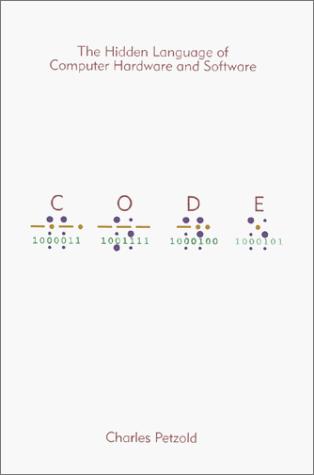
Code
by Charles Petzold
★ Top 25 book of 1999 · #22 on Best Books of 1999
Using everyday things like Braille, Morse code and flashlights, this book unpacks how computers really work and why people have always invented new ways to communicate. It is illustrated, approachable, and aimed at any reader curious about the hidden life of smart machines.
Best for: Curious readers of any technical level who want to understand how computers work
Code is #22 on BookWard's Best Books of 1999, out of 52 1999 books that cleared our data bar.
What Code is about
Computers can feel like sealed boxes, but Charles Petzold argues that they grew out of something very human: our ingenuity and our urge to communicate. Over the past two centuries, that drive led people to invent new ways of sending messages and manipulating language, and those inventions eventually became the technology around us.
The book builds its case from everyday things, such as flashlights, seesaws, Braille, and Morse code, and moves patiently toward an understanding of how machines really work inside. The explanations are cleverly illustrated and easy to follow, and they are meant for readers of any technical level. It will suit anyone curious about the hidden life of computers and smart machines, and anyone who wants some context for PCs, digital media, and the Internet without needing a degree to get through it.
Code on the Best Books of 1999
Code came out in 1999. Of the 52 books first published in 1999 that met BookWard's data bar, it ranks #22 on our Best Books of 1999 list.
Why it made the list: 255 readers have shelved it on Open Library; readers rate it 4.2 out of 5 (22 ratings). The list ranks each year’s books on how many readers have picked them up, how highly readers rate them, and how many are reading them right now.
Nearby on the 1999 list
- Scattered Gabor Maté, #20
- Hannibal Thomas Harris, #21
- The Amber Spyglass Philip Pullman, #23
- The Birchbark House Louise Erdrich, #24
See all Best Books of 1999 Best books by year
More years: Best Books of 1998 Best Books of 2000.
The numbers behind it
- Readers: 213 want to read it, 11 are reading it now and 31 have read it, according to Open Library.
- Ratings: 4.2 out of 5 from 22 Open Library ratings.
| Signal | This book (0 to 100) | Weight |
|---|---|---|
| Reach | 42 | 55% |
| Reader love | 77 | 25% |
| Being read right now | 40 | 20% |
Questions about Code
When was Code published?
Code by Charles Petzold was first published in 1999.
Was Code one of the best books of 1999?
Code is #22 on BookWard's Best Books of 1999, out of 52 1999 books that cleared our data bar. 255 readers have shelved it on Open Library; readers rate it 4.2 out of 5 (22 ratings).
Why is Code on the Best Books of 1999 list?
255 readers have shelved it on Open Library; readers rate it 4.2 out of 5 (22 ratings).
More of the best books of 1999
- Harry Potter and the Prisoner of Azkaban J. K. Rowling, #1
- Wings of Fire A. P. J. Abdul Kalam, #2
- The Perks of Being a Wallflower Stephen Chbosky, #3
- On Writing Stephen King, #4
- The Bad Beginning Lemony Snicket, #5
- The Coldest Winter Ever Sister Souljah, #6
See the full Best Books of 1999, the Top 100, or new books on Rising.
How we know
This page uses public data: Open Library reader counts and ratings, and Wikipedia page views for recent years. The description is paraphrased from real source text. Rankings reflect reading interest, not quality or sales, and can be affected by data gaps. Lists update monthly.
Best suited to curious teens and adults willing to work through technical ideas step by step; no prior expertise is needed.
Depends on the edition you pick.
Flashlights to microprocessors: how computers actually work, built from nothing. 53% taste match
 BookWard’s take
Flashlights to microprocessors: how computers actually work, built from nothing
Petzold opens with two kids signaling to each other by flashlight and builds, one clear step at a time, toward the inner workings of a computer. It's an unusual kind of hook: a patient promise that the machine will stop being magic. The rigor is high, because each layer rests firmly on the one before it, and the internal logic is close to airtight. Exposition is the whole point here, so the book explains outright rather than dramatizing, and it is driven by ideas from start to finish. The prose stays plain and friendly. The reading gets harder as the circuits stack up, so the pace is deliberate, but the climb never sags; it stays rewarding all the way through. It repays a reader willing to slow down and think.
A full, layered build from signals to circuits runs longer than a tight read; BookWard favors short, so this asks for patience.
It moves at the speed of understanding, steady and deliberate rather than quick, a little slower than BookWard's taste.
Teaching computing through Braille, Morse code and seesaws is a fresh route into a well-worn subject.
The writing is plain and clear, built for understanding rather than ornament, a bit plainer than BookWard's middle ground.
There is no plot or character arc to be driven by, so the dial does not apply.
It treats human ingenuity and the urge to communicate as a source of wonder, an upbeat outlook that suits BookWard.
The structure is a deliberate staircase of concepts, mostly conventional but with a careful design.
Light, friendly touches appear now and then, but the tone stays mostly earnest and instructive.
Nothing in it is dark; it is an upbeat exploration of invention.
It engages curiosity and wonder more than strong emotion.
See all 50 dialsEvery position, side by side with this book
Where it lines up
- Internal logicBookWard 10 · book 10
- Rigor (nonfiction)BookWard 9 · book 9
- Sagging middleBookWard 8 · book 8
Where it pulls apart
- ExpositionBookWard 2 · book 10
- LengthBookWard 1 · book 6
- Story or ideasBookWard 3 · book 10
A full, layered build from signals to circuits runs longer than a tight read; BookWard favors short, so this asks for patience.
The flashlight and Morse code opening is a gentle, concrete invitation rather than a jolt, though curiosity pulls you in quickly.
It avoids the usual popular-tech clichés by teaching from first principles with everyday objects, which BookWard likes.
Each concept is built directly on the one before, so the chain of reasoning holds together tightly, just as BookWard wants.
It moves at the speed of understanding, steady and deliberate rather than quick, a little slower than BookWard's taste.
Teaching computing through Braille, Morse code and seesaws is a fresh route into a well-worn subject.
This is an explanatory book with no characters to draw, so the dial does not apply.
The build arrives at a working picture of the computer, a satisfying resolution that matches BookWard's liking for closure.
The tone is warm but not sappy, keeping to restraint and clarity, in line with BookWard.
Nothing here is dark or shocking for effect, so the dial does not apply.
It builds the machine step by step from first principles, which is the kind of rigor BookWard prizes.
Petzold's friendly, patient teaching voice is recognizable without ever calling attention to itself.
Ideas drive the whole book; there is no plot beyond the progression of concepts, far more idea-led than BookWard's usual lean.
Explaining outright is the entire method, well beyond BookWard's preference for showing in scene, though it is the right tool here.
Every chapter adds a new layer, so momentum holds rather than flagging, which BookWard appreciates.
The writing is plain and clear, built for understanding rather than ornament, a bit plainer than BookWard's middle ground.
There is no plot or character arc to be driven by, so the dial does not apply.
It treats human ingenuity and the urge to communicate as a source of wonder, an upbeat outlook that suits BookWard.
The structure is a deliberate staircase of concepts, mostly conventional but with a careful design.
Light, friendly touches appear now and then, but the tone stays mostly earnest and instructive.
The later layers of circuitry reward slow, focused reading, so it asks more effort than BookWard's typical comfort zone.
One teacher speaks throughout, a single steady viewpoint.
It moves forward in a clean progression from simple signals to complex machines.
Everything is grounded in real objects and real physics, with nothing fantastical at all.
There is essentially no cast beyond the author guiding the reader.
It spans two centuries of communication and technology, yet stays at the human, bench-top level of explanation.
It leans toward thinking through how systems work rather than action, closer to the inner-thought pole.
This is an explanatory text with almost no dialogue.
No romance appears in a book about how machines work.
The world of switches, relays and logic gates is new to many readers, though built from familiar objects.
Written in 1999 and tracing history, it sits between past and present in feel.
Because it teaches fundamentals that do not change, it holds up well as technology moves on.
The author explains plainly and directly, a fully reliable guide.
This is a how-it-works book without moral questions, so the dial does not apply.
Diagrams and concrete everyday imagery carry much of the explaining, giving a moderate richness.
It tells a story of invention and builds toward understanding, more narrative than a dry analytical text.
The author stays in the background as a guide, though the tone is approachable rather than clinical.
It is a standalone book.
The surprises are insights as concepts click into place, rather than plot reversals.
It stretches your thinking more than it comforts, though it never feels hostile.
Nothing in it is dark; it is an upbeat exploration of invention.
It engages curiosity and wonder more than strong emotion.
Any humor is mild and gentle rather than broad.
There is no violence in this book.
There is no sexual content in this book.
The book stays out of politics entirely.
The language is plain, with technical terms introduced carefully and defined as they appear.
It mostly explains neutrally, with a light touch of the author's enthusiasm.
It traces history to explain the present, and gestures at where computing has led.
It celebrates human ingenuity and curiosity with a quietly idealistic warmth.
Review written by BookWard, dial version 1, November 2026.
Who is Code right for?
Best suited to curious teens and adults willing to work through technical ideas step by step; no prior expertise is needed. It contains no sensitive content.
The later layers of circuitry reward slow, focused reading, so it asks more effort than BookWard's typical comfort zone.
Nothing in it is dark; it is an upbeat exploration of invention.
It engages curiosity and wonder more than strong emotion.
There is no violence in this book.
Book CompanionCode: ideas, characters, themes
Complex machines are built from simple ideas stacked patiently on one another, and you can understand them all the way down.
- Signals and codes. The book begins with simple ways of encoding messages, like flashlight signals, Morse code and Braille, to show how information can be represented.
- Everyday objects as teachers. Familiar things such as seesaws and black cats are used to make abstract ideas concrete and easy to hold.
- Building up layer by layer. Each new concept rests on the previous one, so the path from basic switches to a working computer feels earned.
- Communication drives invention. The urge to send messages to one another is presented as the force behind two centuries of technological change.
- Demystifying the machine. The goal is to remove the sense of magic around computers and show the logic hidden inside smart machines.
Themes
How people invent ways of sending information to one another, and how that shapes technology.
Building complex systems from simple parts and ideas layered together.
Making something that seems magical understandable by explaining its inner workings.
The inventive drive that links early signaling to modern digital machines.
Discussion questions
- Which layer of the build-up was hardest for you to follow, and what finally made it click?
- How does starting with simple codes change the way you think about modern computers?
- Why might the author choose everyday objects over technical diagrams to introduce ideas?
- How has your sense of what happens inside a smart device changed after reading?
- What other complicated systems could be explained by building up from first principles?
Personalize your Book Companion
This is the general edition. In BookWard, the Companion is written for you: your reading profile, your notes, and spoiler-safe to the page you are on.
Buy, listen or borrow Code
Each link opens a search for this book on that store, in a new tab.
Read on a device
Borrow
Reviews and community
If you liked Code
Cosmology for the general reader, short and clear-eyed
InfluenceRobert B. CialdiniSix levers of persuasion, laid out with evidence and field work
The Elegant UniverseBrian GreeneString theory for general readers, built on clear analogies and real ideas
Motivation and personalityAbraham H. MaslowMaslow's landmark portrait of what human beings need and become
Find your own best books
Add what you have read, rate it, and BookWard will recommend what to read next.
Free to start. No credit card needed.