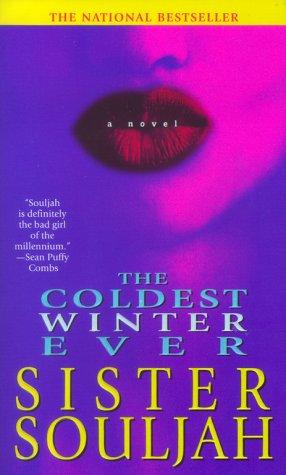
The Coldest Winter Ever
by Sister Souljah
★ Top 10 book of 1999 · #6 on Best Books of 1999
Winter, the quick-witted, business-minded daughter of a prominent Brooklyn drug-dealing family, knows the streets of New York intimately. When her life turns in an unwanted direction, her street smarts and seductive skills are tested, and she refuses to lose.
Best for: Readers who want a gritty New York street story with a determined heroine
The Coldest Winter Ever is #6 on BookWard's Best Books of 1999, out of 52 1999 books that cleared our data bar.
What The Coldest Winter Ever is about
Winter Santiaga is a teenager in Brooklyn and the daughter of a drug kingpin. She is brash, sure of her own importance, and convinced she deserves the best of everything. Her father's reputation makes her well known in the neighborhood, and she is happy to use it. Then her father is arrested for drug trafficking, and Winter lands in a girls' home, where she draws on what he taught her to keep her lifestyle going. Sister Souljah's first novel is narrated by Winter herself in slang shaped by hip-hop culture, so the voice carries much of the story. It looks at street life, status and money, and what a family's choices cost the people in it. It has a prequel and a sequel for readers who want more.
The Coldest Winter Ever on the Best Books of 1999
The Coldest Winter Ever came out in 1999. Of the 52 books first published in 1999 that met BookWard's data bar, it ranks #6 on our Best Books of 1999 list.
Why it made the list: 1,029 readers have shelved it on Open Library; readers rate it 4.2 out of 5 (26 ratings); 42 are reading it right now. The list ranks each year’s books on how many readers have picked them up, how highly readers rate them, and how many are reading them right now.
Nearby on the 1999 list
- On Writing Stephen King, #4
- The Bad Beginning Lemony Snicket, #5
- The Monk Who Sold His Ferrari Robin S. Sharma, #7
- Speak Laurie Halse Anderson, #8
See all Best Books of 1999 Best books by year
More years: Best Books of 1998 Best Books of 2000.
The numbers behind it
- Readers: 941 want to read it, 42 are reading it now and 46 have read it, according to Open Library.
- Ratings: 4.2 out of 5 from 26 Open Library ratings.
| Signal | This book (0 to 100) | Weight |
|---|---|---|
| Reach | 90 | 55% |
| Reader love | 81 | 25% |
| Being read right now | 87 | 20% |
Questions about The Coldest Winter Ever
When was The Coldest Winter Ever published?
The Coldest Winter Ever by Sister Souljah was first published in 1999.
Was The Coldest Winter Ever one of the best books of 1999?
The Coldest Winter Ever is #6 on BookWard's Best Books of 1999, out of 52 1999 books that cleared our data bar. 1,029 readers have shelved it on Open Library; readers rate it 4.2 out of 5 (26 ratings); 42 are reading it right now.
Why is The Coldest Winter Ever on the Best Books of 1999 list?
1,029 readers have shelved it on Open Library; readers rate it 4.2 out of 5 (26 ratings); 42 are reading it right now.
More of the best books of 1999
- Harry Potter and the Prisoner of Azkaban J. K. Rowling, #1
- Wings of Fire A. P. J. Abdul Kalam, #2
- The Perks of Being a Wallflower Stephen Chbosky, #3
- On Writing Stephen King, #4
- The Bad Beginning Lemony Snicket, #5
- The Monk Who Sold His Ferrari Robin S. Sharma, #7
See the full Best Books of 1999, the Top 100, or new books on Rising.
How we know
This page uses public data: Open Library reader counts and ratings, and Wikipedia page views for recent years. The description is paraphrased from real source text. Rankings reflect reading interest, not quality or sales, and can be affected by data gaps. Lists update monthly.
Best suited to mature teens and adults.
Depends on the edition you pick.
A Brooklyn drug kingpin's daughter narrates her own fall in hip-hop slang. 65% taste match
 BookWard’s take
A Brooklyn drug kingpin's daughter narrates her own fall in hip-hop slang
Winter Santiaga tells her own story, in slang shaped by hip-hop, and that voice is the whole engine of the book. She is brash, self-assured and certain she deserves the best, which makes her magnetic and maddening in equal measure. Nobody else sounds like her. The opening grabs at once because she does, and the story keeps moving after her father's arrest sends her into a girls' home. The question of how far to trust her is where it gets interesting, since Winter's view of herself is not the whole picture. The setting is a specific Brooklyn, drawn with a confidence that never stops to explain itself. This is a character-led novel with real political edge and genuine moral ambiguity, and readers who love a distinctive voice and darkness that feels earned will find plenty here.
A full-length novel that follows Winter from privilege into the girls' home, though its voice keeps the pages moving; BookWard prefers tighter.
Her father's arrest sends her life moving quickly, and her hustle in the girls' home keeps momentum up.
The hip-hop-inflected first-person voice was a distinctive way into this world, even if the premise is a known one.
The language is conversational and colloquial rather than ornate, built for voice instead of polish.
What happens flows from who Winter is: her vanity, appetites and instincts drive the story.
This is a story of loss and consequence, and it offers little comfort along the way.
A straightforward first-person account told in sequence, with no formal tricks.
Winter's sass brings sharp humor, but it sits inside a serious story about survival.
Drug dealing, a girls' home and a life built on hustle make this a hard-edged read.
Winter's pride and pressure give the story real heat, even as she keeps feelings at arm's length.
See all 50 dialsEvery position, side by side with this book
Where it lines up
- PaceBookWard 8 · book 8
- Character depthBookWard 8 · book 8
- Story or ideasBookWard 3 · book 3
Where it pulls apart
- LengthBookWard 1 · book 6
- Familiar tropesBookWard 10 · book 5
- Internal logicBookWard 10 · book 7
A full-length novel that follows Winter from privilege into the girls' home, though its voice keeps the pages moving; BookWard prefers tighter.
Winter's first-person voice is brash and commanding from the opening lines, which is exactly the kind of start BookWard rewards.
The drug-family setting is well-trodden territory, but Winter's perspective gives familiar material a sharper edge.
Winter's choices follow her upbringing and the skills her father's world taught her, so events feel consistent and earned.
Her father's arrest sends her life moving quickly, and her hustle in the girls' home keeps momentum up.
The hip-hop-inflected first-person voice was a distinctive way into this world, even if the premise is a known one.
Winter is vain, quick-witted and self-serving in ways that feel fully human rather than typed.
The story drives toward a definite reckoning for Winter rather than leaving her fate hanging.
Winter's bravado keeps the book from softening, though it is not as cool-eyed as BookWard's own taste.
The darkness grows out of Winter's world and choices rather than appearing only to provoke.
This is a novel, so rigor does not apply.
Winter's slang-rich, self-regarding narration is the book's signature and unmistakable on any page.
Story leads here; the themes of class, status and survival come through Winter's experience, not argument.
Winter's world is shown through her attitude and actions, not lectured, which suits BookWard well.
Winter's constant scheming keeps each stage of her fall moving, so the middle holds up.
The language is conversational and colloquial rather than ornate, built for voice instead of polish.
What happens flows from who Winter is: her vanity, appetites and instincts drive the story.
This is a story of loss and consequence, and it offers little comfort along the way.
A straightforward first-person account told in sequence, with no formal tricks.
Winter's sass brings sharp humor, but it sits inside a serious story about survival.
Easy to follow and fast to read, with the main challenge being the slang for readers new to it.
Everything is filtered through Winter alone, and the book is defined by that single lens.
The story moves forward in order from Winter's life at the height of her power to its collapse.
Entirely grounded in the real streets of Brooklyn.
Winter's family and the people around her form a moderate circle, with Winter always at the center.
The stakes are personal and local, centered on one teenager and her family, not a sweeping canvas.
Winter narrates her own thoughts, yet what she does drives the story as much as how she feels.
Talk carries a great deal of the book, with voice and attitude coming through in exchanges.
Relationships and desire matter in Winter's world, but the book is not mainly a love story.
The Brooklyn drug-dealing milieu will be unfamiliar territory for many readers, rendered with insider confidence.
Published in 1999 and set in its own late-century moment, so it reads as past rather than present.
Its portrait of status, power and consequence has kept it in circulation well beyond its release.
Winter's confidence in her own story invites readers to question how fairly she sees herself.
Winter is neither villain nor hero, and the book leaves her choices open to judgment.
Style and surroundings are conveyed with some texture, though voice does the heavy lifting.
It has a prequel and a sequel, so it belongs to a larger story.
Winter's fortunes shift sharply after her father's arrest, with several turns along the way.
It asks readers to spend time inside a difficult, self-serving mind and reckon with her choices.
Drug dealing, a girls' home and a life built on hustle make this a hard-edged read.
Winter's pride and pressure give the story real heat, even as she keeps feelings at arm's length.
Winter's wit is cutting and bold, leaning toward the brash.
The drug trade brings harsh consequences, though the story centers on Winter's choices more than spectacle.
Winter is described as seductive and uses it as leverage, so sexuality is a notable part of the book.
Class, race and survival in a hard neighborhood run through Winter's life without being delivered as lectures.
Hip-hop-influenced slang saturates the narration, which can take adjusting to for unfamiliar readers.
Winter has strong views on herself and everyone else, and the narration is steeped in them.
The story looks at what Winter's upbringing built and what it costs her, more than at any future.
Winter's worldview is hard-nosed and transactional, with little room for idealism.
Review written by BookWard, dial version 1, November 2026.
Who is The Coldest Winter Ever right for?
Best suited to mature teens and adults. It deals with the drug trade, sexuality and a hard life on the streets.
Easy to follow and fast to read, with the main challenge being the slang for readers new to it.
Drug dealing, a girls' home and a life built on hustle make this a hard-edged read.
Winter's pride and pressure give the story real heat, even as she keeps feelings at arm's length.
The drug trade brings harsh consequences, though the story centers on Winter's choices more than spectacle.
Book CompanionThe Coldest Winter Ever: ideas, characters, themes
A pampered drug kingpin's daughter must rely on the skills her father taught her when his arrest strips away the life she assumed she deserved.
- Winter's birth. She is named for the snowstorm she was born into, a name that fits the cold turn her life takes.
- A life of privilege. Winter lives well as the daughter of Ricky Santiaga, a Brooklyn drug kingpin, and expects the best of everything.
- Her father's arrest. His arrest for drug trafficking ends her comfort and sends her into a girls' home.
- Using what she knows. In the girls' home she turns to the skills she learned from her father, selling illicit items to keep her lifestyle going.
- The voice. The story is told by Winter in slang shaped by hip-hop culture, which gives it its distinct attitude.
Characters
Winter Santiaga
Narrator and protagonist
A brash, self-important teenager who knows what she wants and believes she deserves the best.
Ricky Santiaga
Winter's father
A local Brooklyn drug kingpin whose power shapes his daughter's status and whose arrest changes her life.
Themes
How much Winter's sense of self depends on having the best, with no knock-offs.
What Winter takes from her father's world and how it shapes her choices.
What a person will do to stay on top once their protection is gone.
How Brooklyn's streets define opportunity and risk for Winter.
How telling the story in her own slang is part of who Winter is.
Discussion questions
- Does Winter's confidence make her more sympathetic or less?
- How much of what Winter does comes from her father's example?
- What does the slang add to the story that standard narration would lose?
- Is Winter a reliable guide to her own life?
- What does the girls' home reveal about who Winter is once her father's power is gone?
Personalize your Book Companion
This is the general edition. In BookWard, the Companion is written for you: your reading profile, your notes, and spoiler-safe to the page you are on.
Buy, listen or borrow The Coldest Winter Ever
Each link opens a search for this book on that store, in a new tab.
Read on a device
Borrow
Reviews and community
If you liked The Coldest Winter Ever
A Saxon boy raised by Danes, caught between two loyalties
Presumed InnocentScott TurowA prosecutor investigates a murder, then stands accused of it
Novels (Adventures of Huckleberry Finn / Adventures of Tom Sawyer)Mark TwainTwo Twain classics: a boy's summer, then a river escape
Angela's AshesFrank McCourtA Limerick childhood told with a child's eyes and no self-pity
Find your own best books
Add what you have read, rate it, and BookWard will recommend what to read next.
Free to start. No credit card needed.