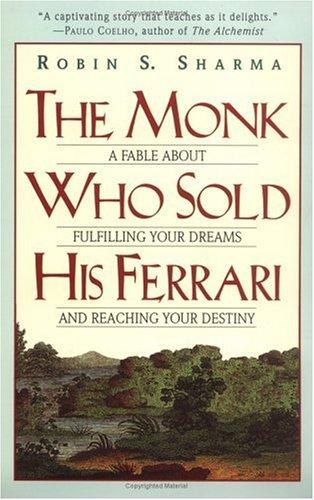
The Monk Who Sold His Ferrari
by Robin S. Sharma
★ Top 10 book of 1999 · #7 on Best Books of 1999
A successful lawyer named Julian Mantle suffers a physical and emotional breakdown that forces him to rethink how he lives. His journey offers lessons for releasing your potential and finding passion, purpose and peace.
Best for: Readers seeking a fable-style guide to balance, fulfillment and personal growth
The Monk Who Sold His Ferrari is #7 on BookWard's Best Books of 1999, out of 52 1999 books that cleared our data bar.
What The Monk Who Sold His Ferrari is about
Julian Mantle is a successful lawyer who has lost his way. A physical and emotional collapse forces him to face his life, and he sells his holiday home and his red Ferrari to travel to the Himalayas. The story unfolds as a conversation between Julian and his best friend John, as Julian describes the spiritual lessons he gathered on the journey. Written by Robin Sharma, who left his own career as a litigation lawyer at 25, it is a business fable with a self-help purpose: to show readers how to release their potential and live with passion, purpose and peace. First published in 1997, it has sold more than four million copies in fifty-one languages. Inspirational and teaching in tone, it suits anyone feeling stretched by work and wondering what a simpler, more meaningful life might look like.
The Monk Who Sold His Ferrari on the Best Books of 1999
The Monk Who Sold His Ferrari came out in 1999. Of the 52 books first published in 1999 that met BookWard's data bar, it ranks #7 on our Best Books of 1999 list.
Why it made the list: 1,960 readers have shelved it on Open Library; readers rate it 4 out of 5 (66 ratings); 163 are reading it right now. The list ranks each year’s books on how many readers have picked them up, how highly readers rate them, and how many are reading them right now.
It earns Being read right now.
Nearby on the 1999 list
- The Bad Beginning Lemony Snicket, #5
- The Coldest Winter Ever Sister Souljah, #6
- Speak Laurie Halse Anderson, #8
- Nonviolent Communication Marshall B. Rosenberg, #9
See all Best Books of 1999 Best books by year
More years: Best Books of 1998 Best Books of 2000.
The numbers behind it
- Readers: 1,733 want to read it, 163 are reading it now and 64 have read it, according to Open Library.
- Ratings: 4 out of 5 from 66 Open Library ratings.
| Signal | This book (0 to 100) | Weight |
|---|---|---|
| Reach | 94 | 55% |
| Reader love | 56 | 25% |
| Being read right now | 96 | 20% |
Questions about The Monk Who Sold His Ferrari
When was The Monk Who Sold His Ferrari published?
The Monk Who Sold His Ferrari by Robin S. Sharma was first published in 1999.
Was The Monk Who Sold His Ferrari one of the best books of 1999?
The Monk Who Sold His Ferrari is #7 on BookWard's Best Books of 1999, out of 52 1999 books that cleared our data bar. 1,960 readers have shelved it on Open Library; readers rate it 4 out of 5 (66 ratings); 163 are reading it right now.
Why is The Monk Who Sold His Ferrari on the Best Books of 1999 list?
1,960 readers have shelved it on Open Library; readers rate it 4 out of 5 (66 ratings); 163 are reading it right now.
More of the best books of 1999
- Harry Potter and the Prisoner of Azkaban J. K. Rowling, #1
- Wings of Fire A. P. J. Abdul Kalam, #2
- The Perks of Being a Wallflower Stephen Chbosky, #3
- On Writing Stephen King, #4
- The Bad Beginning Lemony Snicket, #5
- The Coldest Winter Ever Sister Souljah, #6
See the full Best Books of 1999, the Top 100, or new books on Rising.
How we know
This page uses public data: Open Library reader counts and ratings, and Wikipedia page views for recent years. The description is paraphrased from real source text. Rankings reflect reading interest, not quality or sales, and can be affected by data gaps. Lists update monthly.
It suits adult and older teen readers looking for an easy introduction to self-improvement ideas.
Depends on the edition you pick.
A short motivational fable that trades story for sermon. 37% taste match
 BookWard’s take
A short motivational fable that trades story for sermon
This is a business fable: a litigation lawyer's collapse sends him to the Himalayas, and the book is built from conversation between Julian Mantle and his friend John. The story is a frame for the lessons, and that shows in how the pages are spent. The ideas matter more than the plot, and the book explains outright rather than showing anything in scene. Its tropes are the genre's own: the burned-out high achiever, the mountain sage, the neat principles. The characters stay thin because they exist to carry the advice. If you want a quick, upbeat push to rethink your days, it delivers that plainly. If you want rigor, surprise or restraint, you will find little of it here.
It is a compact fable built around conversation, which suits BookWard's taste for tight books.
Short chapters and steady lesson-by-lesson movement keep it brisk, close to BookWard's preference.
The business-fable format was familiar well before this book, and the advice is widely shared wisdom, which sits low against BookWard's love of the original.
The writing is plain and direct, close to BookWard's mid-low comfort with ornament.
Events are thin and the people are thin too; the lessons drive it more than either, landing near the middle.
It is relentlessly upbeat about change, more hopeful than even BookWard's hopeful lean.
A frame conversation around a recounted journey is a conventional structure, in line with BookWard's modest taste.
The tone is earnest and sincere, with little humor, more serious than BookWard's lean toward funny.
Apart from the opening collapse the tone is gentle and encouraging.
Feeling is present but kept mild and uplifting, more modest than BookWard's moderate-to-intense taste.
See all 50 dialsEvery position, side by side with this book
Where it lines up
- EndingBookWard 8 · book 8
- LengthBookWard 1 · book 2
- PaceBookWard 8 · book 6
Where it pulls apart
- Familiar tropesBookWard 10 · book 2
- Internal logicBookWard 10 · book 4
- Rigor (nonfiction)BookWard 9 · book 2
It is a compact fable built around conversation, which suits BookWard's taste for tight books.
A collapsed lawyer who sells his Ferrari and vanishes into the Himalayas is an arresting premise, though the telling after that is gentler than BookWard's pull.
The burned-out achiever and wise mountain mentors are stock figures of the self-help fable, well short of BookWard's appetite for fresh ground.
Its lessons follow a clean sequence, but the transformation is asserted rather than tested, which falls short of BookWard's airtight standard.
Short chapters and steady lesson-by-lesson movement keep it brisk, close to BookWard's preference.
The business-fable format was familiar well before this book, and the advice is widely shared wisdom, which sits low against BookWard's love of the original.
Julian and John exist mainly to deliver and receive advice, so they stay types rather than deeply drawn people.
The journey closes on a clear, resolved note, which matches BookWard's liking for complete endings.
It is openly earnest and uplifting, leaning sentimental where BookWard prefers restraint.
Nothing here relies on darkness; the collapse that starts the story is a device, so shock is not a concern.
Principles come as maxims and parable rather than evidence, which is far from BookWard's wish for rigor.
Its motivational tone is recognizable but sits within a well-worn genre voice, so it is moderately distinct.
The fable is a vehicle for lessons on living well, so ideas lead and story follows, further toward ideas than BookWard likes.
Lessons are spoken and explained outright in dialogue, the opposite of BookWard's preference for showing in scene.
The book is short enough to stay even, though the lesson-after-lesson rhythm can feel repetitive.
The writing is plain and direct, close to BookWard's mid-low comfort with ornament.
Events are thin and the people are thin too; the lessons drive it more than either, landing near the middle.
It is relentlessly upbeat about change, more hopeful than even BookWard's hopeful lean.
A frame conversation around a recounted journey is a conventional structure, in line with BookWard's modest taste.
The tone is earnest and sincere, with little humor, more serious than BookWard's lean toward funny.
The language and ideas are easy to follow, a lighter read than BookWard usually seeks.
Julian's account is told through one friend's listening ear, so the viewpoint stays essentially single.
A recounted journey told in conversation is mostly linear, matching BookWard's mild tolerance for shifts.
The mountain sages and rapid transformation lean toward fable, a little more fantastical than BookWard's middle ground.
The story hinges on two main speakers, a smaller cast than BookWard usually likes.
The book stays within a personal transformation, an intimate frame for BookWard's middling taste.
Most of the action is reflection and instruction rather than events, favoring inner life as BookWard slightly prefers.
The whole book rests on conversation between two friends, heavy on dialogue as BookWard likes.
Romance does not feature in this story of self-reinvention.
A Himalayan retreat and sages are somewhat unfamiliar, which fits BookWard's appetite for new settings.
It speaks to the pressures of modern working life, which keeps it close to the present day.
Its self-improvement themes keep finding readers, but the corporate-burnout framing is partly of its era.
The story is told straightforwardly with no reason to doubt the narrator, far from BookWard's unreliable taste.
The book states what is right and wrong with total clarity, leaving no ambiguity, unlike BookWard's taste for gray.
Settings are sketched briefly in service of the lessons, sparser than BookWard's mid-rich preference.
As a fable it is narrative-driven rather than analytical, a story form with an advice goal.
The book builds on the author's own turn from litigation, giving it a personal, intimate cast.
It launched a bestselling series, so it is part of a larger run, a bit above BookWard's middle.
The path is predictable from the premise onward, offering few surprises.
It aims to reassure and inspire, so it is comforting more than challenging.
Apart from the opening collapse the tone is gentle and encouraging.
Feeling is present but kept mild and uplifting, more modest than BookWard's moderate-to-intense taste.
There is little comedy at all, and what appears is mild and dry in nature.
There is no meaningful violence on the page.
The book has no sexual content to speak of.
Politics are absent; the focus stays on personal habits and purpose.
The language is plain and simple, easy at a glance.
It pushes a clear point of view about how to live, strongly opinionated narration.
It urges readers to change their future by adopting new daily habits, looking forward.
It believes anyone can transform life with the right principles, deeply idealistic against BookWard's mildly idealistic stance.
Review written by BookWard, dial version 1, November 2026.
Who is The Monk Who Sold His Ferrari right for?
It suits adult and older teen readers looking for an easy introduction to self-improvement ideas. It deals with burnout and physical collapse, but handles them gently.
The language and ideas are easy to follow, a lighter read than BookWard usually seeks.
Apart from the opening collapse the tone is gentle and encouraging.
Feeling is present but kept mild and uplifting, more modest than BookWard's moderate-to-intense taste.
There is no meaningful violence on the page.
Book CompanionThe Monk Who Sold His Ferrari: ideas, characters, themes
A burned-out lawyer walks away from status and wealth, and the wisdom he brings back is that purpose and daily discipline matter more than success.
- The collapse that starts it. Julian Mantle, a successful but misguided lawyer, suffers a physical and emotional breakdown that forces him to face his life.
- Selling the symbols. He sells his holiday home and red Ferrari, trading outward status for a different kind of life.
- The Himalayan journey. His search takes him to the Himalayas, where he gathers the spiritual lessons the book retells.
- A story told as conversation. Julian passes those lessons to his best friend John in dialogue, which gives the book its fable shape.
- Life in balance. The book promotes a life where family, work and personal fulfillment sit in harmony.
Characters
Julian Mantle
The lawyer turned seeker
A successful but misguided litigator whose collapse sends him to the Himalayas and into a new life.
John
Julian's best friend
The listener in the conversations, who receives Julian's account and its lessons.
Themes
Meaning and passion count for more than the trappings of success.
A person can walk away from a life that no longer fits and start again.
Family, work and personal fulfillment can be held together.
Insight from a distant, quiet place can improve ordinary working life.
Discussion questions
- What does selling the Ferrari represent, and could you make a similar gesture in your own life?
- Do you find the fable format a help or a hindrance in taking the advice seriously?
- Which of Julian's lessons feels most useful, and which feels too simple?
- Why might a lawyer's collapse make a stronger starting point than a gentler one?
- How would the book change if the friend John pushed back harder on Julian's claims?
Personalize your Book Companion
This is the general edition. In BookWard, the Companion is written for you: your reading profile, your notes, and spoiler-safe to the page you are on.
Buy, listen or borrow The Monk Who Sold His Ferrari
Each link opens a search for this book on that store, in a new tab.
Read on a device
Borrow
Reviews and community
If you liked The Monk Who Sold His Ferrari
A short fable about following a dream, fully resolved and openly didactic
The Greatest Salesman in the WorldOg MandinoA short parable that turns selling into a philosophy of living
Rich Dad, Poor Dad for TeensRobert T. KiyosakiKiyosaki's money lessons, trimmed and tuned for teenage readers
Who Moved My Cheese?Spencer JohnsonA cheese-in-a-maze parable that makes its point and gets out
Find your own best books
Add what you have read, rate it, and BookWard will recommend what to read next.
Free to start. No credit card needed.