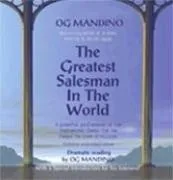
The Greatest Salesman in the World
by Og Mandino · 1968
Short, plain, and gentle, it suits teens and adults, especially anyone curious about motivation or sales.
111 pages, about 2 to 2.5 hours.
A short parable that turns selling into a philosophy of living. 43% taste match
What it covers
Og Mandino's The Greatest Salesman in the World, first published in 1968, is a work of inspirational fiction that doubles as a guide to success and the art of selling. It sits in the self-help category while telling its lessons through a story, drawing on religious and Christmas themes, with Jesus Christ appearing among its figures.
The story follows Hafid, a poor camel boy who goes on to build a life of abundance. His path is used to present a philosophy of salesmanship and personal achievement, with attention to the psychological side of success. The tale opens with Hafid studying his own reflection in a polished bronze mirror.
At about 111 pages, it is a short read, and it has appeared in roughly two dozen editions. Bantam reissued it in 1983, and Buccaneer Books brought out a hardcover in 1993. An audio recording was also produced after the Success Motivation Institute acquired the rights in 1970.
Hafid lingered before the bronze mirror and studied his reflected image in the polished metal.
Themes
SuccessNativitySellingVentaPsychological aspects of SuccessPsychological aspectsExitoChristmas stories
- Want to read 226
- Reading now 16
- Read 20
Most people shelving it are saving it for later.
Of 262 readers who put it on a shelf, 86% want to read it, 6% are reading it now, 8% have finished it and 0% stopped before the end.
By the numbers
- The median edition runs 111 pages. Counting about 275 words a page and an adult reading pace of 250 words a minute, that is about 2.0 hours of reading.
- Open Library tracks 24 editions from 15 publishers, the earliest dated 1968 and the latest 2007, across 3 languages.
- On reader demand it ranks in the top 6% of the classic books in our catalog (8,749 of them).
- Libraries shelve it under Dewey 174 and Library of Congress class PS-3563.00000000.A464 G7 2001.
 BookWard’s take
A short parable that turns selling into a philosophy of living
Og Mandino's 1968 parable follows Hafid, a poor camel boy who goes on to a life of abundance, and uses his path to teach a philosophy of selling and success. At 111 pages it is short and tight, which is a real virtue. It is also firmly built around its ideas: the lessons come first and the story exists to serve them. Instead of letting scenes carry the meaning, the book explains things outright. The tone is warm and earnest, with little restraint. Its religious and Christmas framing, with Jesus among its figures, gives it a distinct flavor. Read it for the message, not the plot.
At 111 pages it is a very short read, which matches BookWard's love of tight books.
The short length keeps it moving, though the reflective teaching passages slow the momentum.
Wrapping a sales philosophy inside a nativity-era parable is a distinctive angle, though the genre itself is familiar.
The language leans toward the elevated, scriptural register, with a formal ring.
Hafid's journey gives it a loose personal arc, but the teaching matters more than either plot or character.
It is about as hopeful as books get, promising abundance to anyone who applies its principles.
It follows a conventional parable shape with a clear lesson-by-lesson progression.
It is solemn and sincere, with no real comic streak.
The content is gentle and uplifting throughout.
It aims to inspire and move the reader, but at a steady, earnest pitch rather than an intense one.
See all 50 dialsEvery position, side by side with this book
Where it lines up
- LengthBookWard 1 · book 1
- EndingBookWard 8 · book 8
- Shock for effectBookWard 9 · book 9
Where it pulls apart
- Familiar tropesBookWard 10 · book 3
- Rigor (nonfiction)BookWard 9 · book 2
- ExpositionBookWard 2 · book 9
At 111 pages it is a very short read, which matches BookWard's love of tight books.
It opens on Hafid studying his reflection in a bronze mirror, a quiet image rather than an immediate grab.
It works in the familiar mold of the inspirational parable and success guide, so it leans on well-worn tropes.
Its lessons follow a clear chain from one principle to the next, though it asks for faith more than proof.
The short length keeps it moving, though the reflective teaching passages slow the momentum.
Wrapping a sales philosophy inside a nativity-era parable is a distinctive angle, though the genre itself is familiar.
Hafid serves as a vehicle for the lessons, so he is drawn as a type rather than a deep individual.
A parable of this kind closes by delivering its lesson cleanly, giving a satisfying, resolved finish.
It is openly earnest and uplifting, far from the restraint BookWard prefers.
It is gentle and inspirational, with no shock for effect, so nothing here feels cheap.
Its claims about success rest on inspiration and parable, not evidence or analysis.
Mandino's earnest, exhortative tone is recognizable, with a preacher's cadence.
The story exists to carry a philosophy of selling and success, so ideas clearly lead.
The lessons are stated outright and explained directly rather than dramatized in scene.
Its brevity leaves little room for a sag, so the teaching stays steady throughout.
The language leans toward the elevated, scriptural register, with a formal ring.
Hafid's journey gives it a loose personal arc, but the teaching matters more than either plot or character.
It is about as hopeful as books get, promising abundance to anyone who applies its principles.
It follows a conventional parable shape with a clear lesson-by-lesson progression.
It is solemn and sincere, with no real comic streak.
Short, plain, and direct, it asks very little effort from the reader.
The story stays tied to Hafid, so the viewpoint is essentially single.
It moves forward through one man's rise, a straightforward linear progression.
The parable setting and religious figures give it a mythic, stylized feel more than strict realism.
Few figures matter, with Hafid at the center, so the cast stays small.
It centers on one person's path, though the framing carries a larger moral weight.
The focus is on mindset, resolve, and habit, so the book dwells on inner discipline.
Teaching speech and exhortation carry real weight, but it is not built around back-and-forth conversation.
Romance plays no part in this success parable.
The ancient, biblical-era setting is unfamiliar ground for most modern readers.
Its setting reaches back to antiquity, far from the present day.
Its basic message about persistence and attitude has stayed in print across decades and many editions.
The narration is straightforward and trustworthy, with no games played on the reader.
The book is plain about what it wants you to believe and do, leaving no moral ambiguity.
Imagery appears now and then, but the book favors direct teaching over lush scene-setting.
It teaches through a story, so it reads as narrative rather than analysis.
It speaks warmly and directly to the reader, so the perspective is personal, not detached.
It stands alone as a single complete work.
The structure is a steady teaching progression with few surprises.
It mostly reassures and encourages, offering comfort more than provocation.
The content is gentle and uplifting throughout.
It aims to inspire and move the reader, but at a steady, earnest pitch rather than an intense one.
Humor is almost absent, so it falls toward the dry end by default.
Violence has no place in this inspirational parable.
There is no sexual content in this book.
It concerns personal success and faith, not political argument.
The language is plain and accessible, with a formal, slightly archaic tone.
It argues its case with conviction and tells the reader plainly what to do.
It urges readers to act now and build a better future for themselves.
It holds an unshaken belief that anyone can succeed through discipline and attitude.
Review written by BookWard, dial version 1, November 2026.
Who is The Greatest Salesman in the World right for?
Short, plain, and gentle, it suits teens and adults, especially anyone curious about motivation or sales. It carries a religious frame, with Jesus among its figures, which some readers may welcome and others may find heavy-handed.
Short, plain, and direct, it asks very little effort from the reader.
The content is gentle and uplifting throughout.
It aims to inspire and move the reader, but at a steady, earnest pitch rather than an intense one.
Violence has no place in this inspirational parable.
Book CompanionThe Greatest Salesman in the World: ideas, characters, themes
Success in selling and in life comes from daily habits, persistence, and a settled sense of purpose, taught here through the story of a poor camel boy named Hafid.
- Story as a teaching tool. Hafid's rise from poverty to abundance carries the book's lessons, so the narrative exists to illustrate a philosophy.
- Selling as a way of life. The book treats the art of selling as a broader philosophy of personal achievement, not just a trade.
- Psychological side of success. It gives real attention to mindset and inner habits as the foundation of achievement.
- Religious and Christmas framing. Its nativity-era setting and the presence of Jesus Christ among its figures give the lessons a spiritual weight.
- Short and re-readable. At about 111 pages it is built to be read quickly and returned to, which helps explain its many editions.
Characters
Hafid
Central figure
A poor camel boy who goes on to build a life of abundance, and through whom the book's philosophy is presented.
Jesus Christ
Figure in the story
Appears among the book's figures within its religious and Christmas-themed framing.
Themes
Keeping at the work day after day, even when results are slow to arrive.
The idea that a full, prosperous life is open to anyone willing to follow the principles.
Selling treated as a philosophy of serving others and presenting yourself well.
A spiritual grounding that gives the pursuit of success its meaning.
Confidence in your own worth as the starting point for achievement.
Discussion questions
- Does framing a sales philosophy as a parable make its lessons more convincing or less?
- Which of the book's principles could you actually practice every day, and which feel out of reach?
- How does the religious and Christmas setting change the way you read a book about success?
- Is Hafid a character you connect with, or mainly a vehicle for the message?
- Where does inspiration end and oversimplification begin in a book like this?
Personalize your Book Companion
This is the general edition. In BookWard, the Companion is written for you: your reading profile, your notes, and spoiler-safe to the page you are on.
Buy, listen or borrow The Greatest Salesman in the World
Each link opens a search for this book on that store, in a new tab.
Read on a device
Borrow
Reviews and community
If you liked The Greatest Salesman in the World
A short fable about following a dream, fully resolved and openly didactic
The ProphetKahlil GibranTwenty-six short sermons on living, for a quiet afternoon
The Four AgreementsDon Miguel RuizFour short rules for living, delivered plainly and without padding
The Monk Who Sold His FerrariRobin S. SharmaA short motivational fable that trades story for sermon
Sources: Open Library.
Track The Greatest Salesman in the World and find your next favorite
Add it to your shelf, rate what you have read, and BookWard will recommend what fits you.
Free to start. No credit card needed.