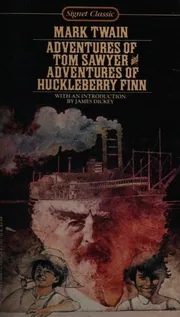
Novels (Adventures of Huckleberry Finn / Adventures of Tom Sawyer)
by Mark Twain · 1922
Suits older children and teens through adult readers, and works well read aloud or discussed.
448 pages, about 7 to 10.5 hours.
Two Twain classics: a boy's summer, then a river escape. 61% taste match
The story
This volume gathers two novels by Mark Twain, The Adventures of Tom Sawyer and Adventures of Huckleberry Finn, in a single book of about 448 pages. It belongs to the young adult category and has appeared in 68 editions since it was first published in 1922.
The stories follow two boys in Missouri and along the Mississippi River in the Southern States. Tom Sawyer is the central figure of the first novel, which takes in schoolboy mischief, punishment, adventure, and a first romance, with characters such as Judge Thatcher and the Widow Douglas in the surrounding cast. Huckleberry Finn, an orphan with a harsh father, is the focus of the second. He leaves his circumstances behind and travels downriver by raft with Jim, a runaway slave. Their journey brings together themes of friendship, slavery, and a young person's growth in character, set against American river country in the nineteenth century.
"TOM!" No answer.
Characters
Tom SawyerHuckleberry FinnJimJudge ThatcherThe Widow DouglasFinn
Setting
MissouriMississippi RiverSouthern States
Themes
literaturechild witnessesyoung menMale friendshipRunaway childrenvoyages and travelsraftingadventure and adventurers
- Want to read 189
- Reading now 5
- Read 63
Most people shelving it are saving it for later.
Of 257 readers who put it on a shelf, 74% want to read it, 2% are reading it now, 25% have finished it and 0% stopped before the end.
By the numbers
- The median edition runs 448 pages. Counting about 275 words a page and an adult reading pace of 250 words a minute, that is about 8.2 hours of reading.
- Open Library tracks 68 editions from 57 publishers, the earliest dated 1922 and the latest 2020, across 5 languages.
- On reader demand it ranks in the top 4% of the classic books in our catalog (8,749 of them).
- Libraries shelve it under Dewey 813.4 and Library of Congress class PS-1306.00000000.A1 1995.
 BookWard’s take
Two Twain classics: a boy's summer, then a river escape
Twain's two Missouri novels sit side by side here, and they pull in different directions. Tom Sawyer is the lighter of the pair, a run of pranks, punishments and a first romance, while Huckleberry Finn sends an orphan down the Mississippi on a raft with Jim, a runaway slave. The voice is unmistakable in both; Twain's narration is the real draw. The episodic river travel keeps the story moving, and the opening hooks fast with a boy nobody wanted. Huck grows from rebel into someone with real conviction. The dialect is dense, though, and harder going than modern readers may expect. The moral picture also gets murkier as Huck's conscience wrestles with what he has been taught. Two books for the price of one.
At 448 pages for two novels, it is substantial but each story moves briskly, which suits BookWard's taste for tight reading only partly.
The river journey and schoolboy schemes keep things moving, a little slower than BookWard likes in places.
A vernacular boy narrator and a raft journey down the Mississippi were fresh in their day and still stand out.
Plain, spoken-sounding language with flashes of lyrical river description, close to BookWard's middle ground.
Adventure drives the events, but Huck's changing conscience gives the second novel its weight.
Friendship and courage win out, though the world around the boys is often cruel.
Twain's wit runs through the pranks, tall tales and Huck's deadpan observations.
See all 50 dialsEvery position, side by side with this book
Where it lines up
- Character depthBookWard 8 · book 8
- PaceBookWard 8 · book 7
- OriginalityBookWard 9 · book 8
Where it pulls apart
- Familiar tropesBookWard 10 · book 5
- Internal logicBookWard 10 · book 6
- LengthBookWard 1 · book 4
At 448 pages for two novels, it is substantial but each story moves briskly, which suits BookWard's taste for tight reading only partly.
Both stories open on an immediately vivid boy and his trouble, which BookWard rewards.
Boyhood adventure and runaway tales were Twain's ground to shape, though the form has been copied so often it now feels familiar.
The episodic adventures hold together on their own terms, though coincidence drives some of the plotting.
The river journey and schoolboy schemes keep things moving, a little slower than BookWard likes in places.
A vernacular boy narrator and a raft journey down the Mississippi were fresh in their day and still stand out.
Huck in particular is drawn with real inner conflict, which matches what BookWard values.
Each novel closes its main thread, though the endings are debated and not perfectly tidy.
Tom Sawyer leans nostalgic and warm, while Huck's story cuts against easy sentiment, landing near the middle.
The darker elements, like Huck's brutal father and slavery, serve the story, not the effect.
Twain's narration is among the most distinctive in American fiction, squarely what BookWard prizes.
These are story-led adventures first, with ideas carried inside the incidents, which fits BookWard's preference.
Events and conversation carry the telling, with little explaining, which BookWard likes.
Episodes vary in strength, so energy dips in a few stretches but the river keeps pulling forward.
Plain, spoken-sounding language with flashes of lyrical river description, close to BookWard's middle ground.
Adventure drives the events, but Huck's changing conscience gives the second novel its weight.
Friendship and courage win out, though the world around the boys is often cruel.
Twain's wit runs through the pranks, tall tales and Huck's deadpan observations.
The story is easy to follow, but the dialect and period attitudes ask for some effort.
The action runs forward in order along the river and through a summer.
These are grounded tales of Missouri and the Mississippi, with no fantasy.
A sizable cast of townsfolk and river characters surrounds the two boys, though the focus stays tight.
The scope is a boy's life and a river trip, personal more than epic.
Plenty of adventure and incident, balanced by Huck's reflections.
Talk in dialect fills much of the pages and carries the humor and character.
Tom's first love is a small thread, and Huck's story has almost none.
Nineteenth-century river country is distant from most readers, though Twain makes it easy to enter.
Set well in the past, in the antebellum South.
Both novels are still read widely long after their era, a mark of lasting power.
Huck narrates sincerely, though his naive view lets the reader see more than he does.
Huck's struggle over Jim and what he was taught makes right and wrong anything but simple.
The river and the small-town world are vividly drawn without being overloaded.
Review written by BookWard, dial version 1, November 2026.
Who is Novels (Adventures of Huckleberry Finn / Adventures of Tom Sawyer) right for?
Suits older children and teens through adult readers, and works well read aloud or discussed. It contains period racial language and depictions of slavery that call for context and conversation.
The story is easy to follow, but the dialect and period attitudes ask for some effort.
Book CompanionNovels (Adventures of Huckleberry Finn / Adventures of Tom Sawyer): ideas, characters, themes
Two boys in Missouri show the same river world, one through carefree play and one through a flight that tests his conscience.
- Tom's world. The first novel covers schoolboy mischief, punishment, adventure and first love in a dreamlike summer.
- Huck's escape. An orphan with a brutal father leaves his circumstances behind and strikes out on his own.
- The raft journey. Huck and Jim travel the Mississippi together, which drives the second novel.
- Friendship across lines. The bond between Huck and Jim, a runaway slave, changes Huck for good.
- Growing up. The boy nobody wanted matures into someone of courage and conviction.
Characters
Tom Sawyer
Central figure of the first novel
A mischievous boy whose pranks, punishments and adventures fill a summer.
Huckleberry Finn
Narrator and hero of the second novel
An orphan and rebel against respectability who flees by raft.
Jim
Huck's companion
A runaway slave who travels downriver with Huck.
Judge Thatcher
Member of the surrounding cast
A figure from the respectable world around the boys.
The Widow Douglas
Member of the surrounding cast
Part of the respectable society Huck pushes against.
Themes
The bond between boys, and between Huck and Jim, shapes both stories.
The institution looms over the river journey and tests Huck's choices.
Both boys change, Huck most deeply, from play toward conviction.
Huck rebels against polite society and finds his own sense of right.
Tom Sawyer looks back on a summertime boyhood with warmth.
Discussion questions
- How do Tom's and Huck's views of adventure differ?
- Why does Huck's friendship with Jim change him?
- What does the river represent in the second novel?
- How does Twain use dialect to build character?
- Do the two novels feel like one world or two different books?
Personalize your Book Companion
This is the general edition. In BookWard, the Companion is written for you: your reading profile, your notes, and spoiler-safe to the page you are on.
Buy, listen or borrow Novels (Adventures of Huckleberry Finn / Adventures of Tom Sawyer)
Each link opens a search for this book on that store, in a new tab.
Read on a device
Borrow
Reviews and community
If you liked Novels (Adventures of Huckleberry Finn / Adventures of Tom Sawyer)
A Limerick childhood told with a child's eyes and no self-pity
Tom Sawyer, DetectiveMark TwainTwain sends Huck and Tom after a murder, comically
Tortilla FlatJohn SteinbeckA mock-Arthurian comedy of poverty on a Monterey hillside
The Coldest Winter EverSister SouljahA Brooklyn drug kingpin's daughter narrates her own fall in hip-hop slang
Sources: Open Library.
Track Novels (Adventures of Huckleberry Finn / Adventures of Tom Sawyer) and find your next favorite
Add it to your shelf, rate what you have read, and BookWard will recommend what fits you.
Free to start. No credit card needed.