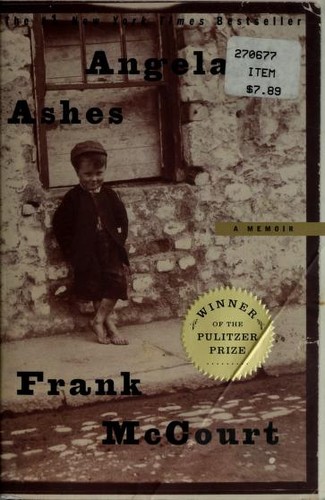
Angela's Ashes
by Frank McCourt
★ Top 10 book of 1996 · #8 on Best Books of 1996
Frank McCourt recalls growing up in Depression-era Brooklyn and then the slums of Limerick, where his father's drinking left the family hungry. His father's stories helped him endure poverty, and he tells it all with humor and forgiveness.
Best for: Memoir lovers who appreciate eloquent, funny and moving accounts of hardship in Ireland
Angela's Ashes is #8 on BookWard's Best Books of 1996, out of 39 1996 books that cleared our data bar.
What Angela's Ashes is about
Frank McCourt was born in Brooklyn in 1930 to Irish immigrants, Malachy and Angela. After the death of his baby sister, the family returns to Ireland and settles in Limerick, Angela's hometown. There they live on the dole and on charity from the Society of Saint Vincent de Paul, in slum housing that floods. Malachy drinks away his wages, and the family endures more losses, including the deaths of twin brothers Oliver and Eugene.
The memoir centers on Frank's Limerick childhood in the 1930s and 40s, and it is told with a wry humor that keeps the bleakness from becoming unbearable. Malachy, flawed as he is, nurtures his son's love of stories, including tales of Cuchulain and the Angel on the Seventh Step. Readers who enjoy memoir, Irish history, or stories of resilience will find a lot here, and two sequels, 'Tis and Teacher Man, follow.
Angela's Ashes on the Best Books of 1996
Angela's Ashes came out in 1996. Of the 39 books first published in 1996 that met BookWard's data bar, it ranks #8 on our Best Books of 1996 list.
Why it made the list: 477 readers have shelved it on Open Library; readers rate it 3.8 out of 5 (54 ratings); 26 are reading it right now. The list ranks each year’s books on how many readers have picked them up, how highly readers rate them, and how many are reading them right now.
Nearby on the 1996 list
- Neverwhere Neil Gaiman, #6
- Infinite Jest David Foster Wallace, #7
- Desperation Stephen King, #9
- Airframe Michael Crichton, #10
See all Best Books of 1996 Best books by year
More years: Best Books of 1995 Best Books of 1997.
The numbers behind it
- Readers: 353 want to read it, 26 are reading it now and 98 have read it, according to Open Library.
- Ratings: 3.8 out of 5 from 54 Open Library ratings.
| Signal | This book (0 to 100) | Weight |
|---|---|---|
| Reach | 79 | 55% |
| Reader love | 28 | 25% |
| Being read right now | 85 | 20% |
Questions about Angela's Ashes
When was Angela's Ashes published?
Angela's Ashes by Frank McCourt was first published in 1996.
Was Angela's Ashes one of the best books of 1996?
Angela's Ashes is #8 on BookWard's Best Books of 1996, out of 39 1996 books that cleared our data bar. 477 readers have shelved it on Open Library; readers rate it 3.8 out of 5 (54 ratings); 26 are reading it right now.
Why is Angela's Ashes on the Best Books of 1996 list?
477 readers have shelved it on Open Library; readers rate it 3.8 out of 5 (54 ratings); 26 are reading it right now.
More of the best books of 1996
- A Game of Thrones George R. R. Martin, #1
- The Green Mile Stephen King, #2
- Forbidden Knowledge Roger Shattuck, #3
- Fight Club Chuck Palahniuk, #4
- Push Sapphire, #5
- Neverwhere Neil Gaiman, #6
See the full Best Books of 1996, the Top 100, or new books on Rising.
How we know
This page uses public data: Open Library reader counts and ratings, and Wikipedia page views for recent years. The description is paraphrased from real source text. Rankings reflect reading interest, not quality or sales, and can be affected by data gaps. Lists update monthly.
Best suited to mature teens and adults.
Depends on the edition you pick.
A Limerick childhood told with a child's eyes and no self-pity. 64% taste match
 BookWard’s take
A Limerick childhood told with a child's eyes and no self-pity
Frank McCourt's memoir opens with a famous line about the miserable Irish Catholic childhood, and the hook lands at once. The book is told from a child's point of view, which keeps the voice distinctive and the narration free of bitterness. Poverty, hunger and a father's drinking are all on the page, yet the darkness is earned through scenes rather than shock for its own sake. It is also funny in places, which sets it apart from most grim memoirs. Dialogue carries much of the telling, and the background is dramatized rather than explained. The characters have real depth, especially Malachy Sr, who is both exasperating and beguiling. The Pulitzer win in 1997 was earned by sustained, controlled storytelling, and the book holds up through its long middle.
A full-length memoir that takes its time across years of childhood, longer than BookWard likes but never padded.
It moves through episodes at a steady clip, a little more leisurely than BookWard's preference.
A familiar kind of story told in a voice so particular that it feels new.
Plain, rhythmic sentences close to speech, not ornate, which is part of the charm.
What drives the book is who Frank and his parents are, more than any engineered plot.
The tone is bleak in circumstance but carries a thread of survival and forgiveness.
A straightforward chronological memoir with no formal tricks.
Dark comedy surfaces throughout even in the worst circumstances, a quality BookWard values.
Poverty, illness and death are central, but treated with restraint.
Deeply affecting, with grief and tenderness running through it.
See all 50 dialsEvery position, side by side with this book
Where it lines up
- OpeningBookWard 10 · book 10
- ExpositionBookWard 2 · book 2
- OriginalityBookWard 9 · book 8
Where it pulls apart
- LengthBookWard 1 · book 6
- Rigor (nonfiction)BookWard 9 · book 3
- Familiar tropesBookWard 10 · book 8
A full-length memoir that takes its time across years of childhood, longer than BookWard likes but never padded.
The opening paragraph announces the miserable Irish Catholic childhood and pulls you in immediately, exactly what BookWard wants.
Hardship memoirs can be formulaic, but the child's-eye telling and specific detail keep this one fresh.
Events follow cleanly from one another, and the family's cause and effect holds together tightly.
It moves through episodes at a steady clip, a little more leisurely than BookWard's preference.
A familiar kind of story told in a voice so particular that it feels new.
Malachy, Angela and young Frank are drawn with warmth and flaws, which fits BookWard well.
The memoir closes on a clear turning point, though it leaves room for the sequels.
It invites tears yet mostly avoids mush, though some moments lean toward the sentimental.
Hunger, illness and loss are shown plainly and serve the story rather than shocking for effect.
It is a memoir built on memory and anecdote rather than documentation, so rigor is not its aim.
The child narrator's tone, rhythm and humor are unmistakable and are the book's greatest strength.
This is story all the way, built from scenes and incidents rather than argument.
Almost everything is shown through scene and a child's perception, rarely explained outright.
The long middle holds up because each episode brings fresh incident and feeling.
Plain, rhythmic sentences close to speech, not ornate, which is part of the charm.
What drives the book is who Frank and his parents are, more than any engineered plot.
The tone is bleak in circumstance but carries a thread of survival and forgiveness.
A straightforward chronological memoir with no formal tricks.
Dark comedy surfaces throughout even in the worst circumstances, a quality BookWard values.
Easy to read in the sense of clarity, though emotionally heavy at times.
One narrator, a child's perspective, throughout.
It moves forward in order through childhood.
Grounded in real places and real hardship, with only the father's tales of heroes as myth.
The family is central but relatives, neighbors and teachers fill out a moderately sized cast.
A family's daily survival, intimate rather than epic.
Balanced between what Frank sees happening and what he feels about it.
Conversation drives many scenes and carries the book's humor and pain.
Romance is minor, appearing only in the margins of a childhood story.
Depression-era Brooklyn and Limerick slums will be unfamiliar to most readers.
Set in the 1930s and 40s, firmly in the past.
Its portrait of poverty, family and storytelling has lasted well beyond its 1996 publication.
Frank tells it honestly as he remembers it, a largely reliable narrator.
Judgments about the father and the church are shaded rather than simple.
Rich in physical detail of damp rooms, hunger and street life, without lingering.
A personal narrative memoir with no analytical apparatus.
Entirely first-person, intimate and subjective.
It has sequels in 'Tis and Teacher Man, though it stands on its own.
Events unfold as life does, with few engineered surprises.
It asks the reader to sit with suffering and offers humor as relief.
Poverty, illness and death are central, but treated with restraint.
Deeply affecting, with grief and tenderness running through it.
Mostly dry and wry, arising from the child's observations.
Some cruelty and harsh punishment appear, but nothing gratuitous.
Adolescence brings some frankness, though it is not a focus.
Colonial history and class touch the story but are not front and center.
Irish speech rhythms and idiom add some density without blocking understanding.
The narration is more observational than argumentative, though Frank's views come through.
It looks back on childhood from an adult vantage.
Despite everything, the book leans toward resilience over cynicism.
Review written by BookWard, dial version 1, November 2026.
Who is Angela's Ashes right for?
Best suited to mature teens and adults. It includes child death, hunger, alcoholism and some frank talk about the body and sex.
Easy to read in the sense of clarity, though emotionally heavy at times.
Poverty, illness and death are central, but treated with restraint.
Deeply affecting, with grief and tenderness running through it.
Some cruelty and harsh punishment appear, but nothing gratuitous.
Book CompanionAngela's Ashes: ideas, characters, themes
A child survives a poor and painful Irish upbringing, and storytelling is part of what carries him through.
- A child's point of view. The story is told as Frank experienced it, which shapes both its humor and its heartbreak.
- Poverty and alcohol. The family's struggles are tied to Malachy Sr's drinking and the lack of steady work.
- Two cities. The book begins in Brooklyn and settles mostly in Limerick.
- Stories as survival. Malachy's tales of Irish heroes give Frank something to hold on to.
- Recognition. The book won the 1997 Pulitzer Prize for Biography or Autobiography.
Characters
Frank McCourt
Narrator and eldest son
The child through whose eyes the whole story is told.
Malachy McCourt Sr
Father
An alcoholic known for his odd manner and for telling stories of Irish heroes.
Angela Sheehan McCourt
Mother
Fond of music, singing and dancing, she struggles to keep the family fed.
Margaret
Infant sister
Her short life briefly lifts the family before her death.
Themes
The daily pressure of not having enough food, money or shelter.
The bonds and failures between parents and children.
Narrative as comfort, identity and a way to endure.
The role of the Catholic church in daily life and guilt.
Looking back on hardship without bitterness.
Discussion questions
- How does telling the story from a child's perspective change how hardship feels on the page?
- Why does the author include so much humor alongside suffering?
- How should we judge Malachy Sr, given both his failings and his gifts?
- What role do stories play in Frank's survival?
- Why do you think this memoir resonated so widely?
Personalize your Book Companion
This is the general edition. In BookWard, the Companion is written for you: your reading profile, your notes, and spoiler-safe to the page you are on.
Buy, listen or borrow Angela's Ashes
Each link opens a search for this book on that store, in a new tab.
Read on a device
Borrow
Reviews and community
If you liked Angela's Ashes
A Puerto Rican girlhood, and the move that rewrote it
The War That Saved My LifeKimberly Brubaker BradleyA child's wartime escape from cruelty, told with quiet force
Different SeasonsStephen KingFour King novellas, one for each season, with horror held back
Novels (Adventures of Huckleberry Finn / Adventures of Tom Sawyer)Mark TwainTwo Twain classics: a boy's summer, then a river escape
Find your own best books
Add what you have read, rate it, and BookWard will recommend what to read next.
Free to start. No credit card needed.