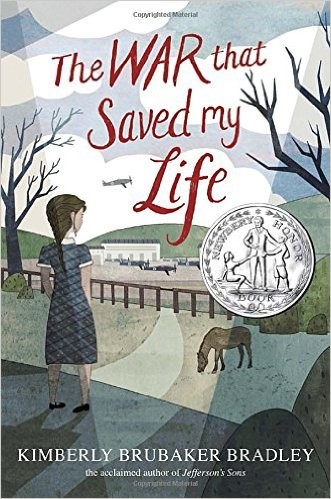
The War That Saved My Life
by Kimberly Brubaker Bradley
★ Top 25 book of 2015 · #19 on Best Books of 2015
Ada, a girl kept shut inside because of her twisted foot, slips away to follow her brother as children are evacuated from London. With a reluctant guardian, she learns to read and ride, and starts to trust again.
Best for: Young readers who like wartime stories about family, courage and growing trust
The War That Saved My Life is #19 on BookWard's Best Books of 2015, out of 55 2015 books that cleared our data bar.
What The War That Saved My Life is about
Ada has a clubfoot and has never been outside her family's one-room apartment in London. Her mother is ashamed of the foot, keeps her hidden and punishes her cruelly. When children are evacuated from the city in 1939, Ada slips away to join her little brother Jamie, and the two are sent to Kent, where Susan Smith is forced to take them in. Ada learns to ride a pony, teaches herself to read and keeps watch for German spies, while Susan slowly lets go of her reluctance to care for children. The question running underneath is whether the bond they build can last. A moving, hopeful and sometimes gritty Newbery Honor novel for middle-grade readers and up.
The War That Saved My Life on the Best Books of 2015
The War That Saved My Life came out in 2015. Of the 55 books first published in 2015 that met BookWard's data bar, it ranks #19 on our Best Books of 2015 list.
Why it made the list: 291 readers have shelved it on Open Library; readers rate it 4.6 out of 5 (24 ratings); 20 are reading it right now. The list ranks each year’s books on how many readers have picked them up, how highly readers rate them, and how many are reading them right now.
Nearby on the 2015 list
- The Mistake Elle Kennedy, #17
- Between the World and Me Ta-Nehisi Coates, #18
- Cantik Itu Luka Eka Kurniawan, #20
- Every Last Word Tamara Ireland Stone, #21
See all Best Books of 2015 Best books by year
More years: Best Books of 2014 Best Books of 2016.
The numbers behind it
- Readers: 233 want to read it, 20 are reading it now and 38 have read it, according to Open Library.
- Ratings: 4.6 out of 5 from 24 Open Library ratings.
| Signal | This book (0 to 100) | Weight |
|---|---|---|
| Reach | 47 | 55% |
| Reader love | 95 | 25% |
| Being read right now | 65 | 20% |
Questions about The War That Saved My Life
When was The War That Saved My Life published?
The War That Saved My Life by Kimberly Brubaker Bradley was first published in 2015.
Was The War That Saved My Life one of the best books of 2015?
The War That Saved My Life is #19 on BookWard's Best Books of 2015, out of 55 2015 books that cleared our data bar. 291 readers have shelved it on Open Library; readers rate it 4.6 out of 5 (24 ratings); 20 are reading it right now.
Why is The War That Saved My Life on the Best Books of 2015 list?
291 readers have shelved it on Open Library; readers rate it 4.6 out of 5 (24 ratings); 20 are reading it right now.
More of the best books of 2015
- Six of Crows Leigh Bardugo, #1
- The Hired Girl Laura Amy Schlitz, #2
- Queen of Shadows Sarah J. Maas, #3
- November 9 Colleen Hoover, #4
- Red Queen Victoria Aveyard, #5
- The Sword of Summer Rick Riordan, #6
See the full Best Books of 2015, the Top 100, or new books on Rising.
How we know
This page uses public data: Open Library reader counts and ratings, and Wikipedia page views for recent years. The description is paraphrased from real source text. Rankings reflect reading interest, not quality or sales, and can be affected by data gaps. Lists update monthly.
Suited to readers around nine and up, and a good family read-aloud.
Depends on the edition you pick.
A child's wartime escape from cruelty, told with quiet force. 63% taste match
 BookWard’s take
A child's wartime escape from cruelty, told with quiet force
This Newbery Honor novel opens on Ada, a girl who has never been outside her London apartment, and it hooks at once: her mother hides her clubfoot, and Ada slips away with her brother Jamie when the evacuation begins. That instinct for forward motion carries through the whole book, so the pace stays brisk and the middle never sags. Character depth is the real strength. Ada and Susan are drawn through small, concrete changes rather than speeches, and the book's restraint with sentiment suits that approach well. The ending resolves its central questions, though the book favors warmth over bleakness, so the outlook leans hopeful. It is a children's book, so the familiar pieces (evacuees, a reluctant guardian) are present, but the specificity of Ada's voice keeps them fresh.
A middle-grade novel of moderate length, compact enough to stay focused on one girl's year of change.
Ada's escape, her new skills and the war's approach keep events moving at a steady, readable clip.
The premise is familiar territory for wartime fiction, though Ada's disability and abuse give it its own angle.
The writing is plain and clean, built for clarity and emotional directness over ornament.
The plot is driven by Ada's growth and her bond with Susan more than by wartime events alone.
Despite cruelty and war, the book leans toward healing, trust and found family.
A straightforward chronological telling with no formal tricks.
The tone is mostly serious, with only light touches of warmth and humor.
Abuse and wartime danger are real, though softened for a young audience.
Ada's fear, longing and slow trust make the emotional stakes strong and sustained.
See all 50 dialsEvery position, side by side with this book
Where it lines up
- EndingBookWard 8 · book 8
- Sagging middleBookWard 8 · book 8
- OpeningBookWard 10 · book 9
Where it pulls apart
- Familiar tropesBookWard 10 · book 5
- LengthBookWard 1 · book 4
- Internal logicBookWard 10 · book 8
A middle-grade novel of moderate length, compact enough to stay focused on one girl's year of change.
It opens on Ada's locked-in life and her escape to join Jamie, so the stakes land immediately.
Evacuee stories and the reluctant guardian are well-worn, but Ada's particular circumstances give them fresh edges.
Events follow cleanly from Ada's situation and choices, and the wartime setting holds together without strain.
Ada's escape, her new skills and the war's approach keep events moving at a steady, readable clip.
The premise is familiar territory for wartime fiction, though Ada's disability and abuse give it its own angle.
Ada and Susan change through concrete, believable steps, which is exactly the kind of drawing BookWard rewards.
The central question of whether Ada and Jamie can stay safe is answered, giving the story a firm close.
It is warm and moving, but it earns that feeling through small gestures rather than leaning on easy tears.
Ada's abuse is shown to build empathy and explain her fear, never for gratuitous effect.
Ada's guarded, observant narration gives the book a clear and individual sound.
This is a story-led book; its ideas about trust and belonging come through events and relationships.
Backstory and feelings surface through scenes and Ada's reactions rather than long explanations.
Learning to ride, read and sew keeps the middle stretch alive with new discoveries and rising tension.
The writing is plain and clean, built for clarity and emotional directness over ornament.
The plot is driven by Ada's growth and her bond with Susan more than by wartime events alone.
Despite cruelty and war, the book leans toward healing, trust and found family.
A straightforward chronological telling with no formal tricks.
The tone is mostly serious, with only light touches of warmth and humor.
Accessible to young readers, with simple sentences and a clear throughline.
Everything is seen through Ada's eyes alone.
Events unfold in order across the war's early period.
A fully grounded historical story with no fantastical elements.
A small circle of Ada, Jamie, Susan and a handful of villagers keeps the focus tight.
The war looms, but the story stays on one household and one child's inner journey.
Ada's fears, hopes and slow trust drive the book more than the outward events do.
Conversation carries a fair share of the relationships, without dominating the page.
There is no romance; the central bonds are family and found family.
Wartime Kent and the evacuation will feel unfamiliar to many young readers.
The story is set in 1939 England, firmly in the past.
Its themes of safety, belonging and being seen travel well across generations.
Ada narrates honestly, though her limited experience colors how she reads people.
Cruelty and kindness are drawn clearly, with little ambiguity about who does harm.
Setting is rendered with sensory touches but never lingers or overwhelms the story.
The close, intimate narration keeps Ada's experience personal throughout.
It is the first of a series, with a sequel continuing Ada's story.
A few turns arrive, but the book is more about unfolding than surprise.
It handles abuse and war honestly yet offers enough warmth to stay approachable.
Abuse and wartime danger are real, though softened for a young audience.
Ada's fear, longing and slow trust make the emotional stakes strong and sustained.
Humor, when it appears, is gentle and understated.
Abuse and wartime peril are present but handled with restraint for young readers.
No sexual content appears.
The war is the backdrop rather than a political argument.
The language is plain and easy to follow.
Ada's point of view colors events, though the book rarely lectures.
It reflects on a past era while carrying a hopeful sense of what comes next.
It believes kindness and patience can change a life, which gives it a hopeful tilt.
Review written by BookWard, dial version 1, November 2026.
Who is The War That Saved My Life right for?
Suited to readers around nine and up, and a good family read-aloud. It deals with physical and emotional abuse and with wartime danger, so younger or sensitive children may want company while reading.
Accessible to young readers, with simple sentences and a clear throughline.
Abuse and wartime danger are real, though softened for a young audience.
Ada's fear, longing and slow trust make the emotional stakes strong and sustained.
Abuse and wartime peril are present but handled with restraint for young readers.
Book CompanionThe War That Saved My Life: ideas, characters, themes
A girl kept hidden and shamed finds that safety, skill and love can be learned once someone lets her step outside.
- Escape and evacuation. Ada seizes the evacuation as her chance to leave a cruel home and follow her brother.
- A reluctant guardian. Susan takes the children in against her own wishes and slowly grows into the role.
- Learning to live. Riding, reading and sewing give Ada new ways to see herself and the world.
- The war closes in. The wider conflict reaches the village, testing the new bonds the children have formed.
- Fear versus trust. Ada must unlearn the rules of her mother's flat before she can believe in Susan's kindness.
Characters
Ada
Narrator and protagonist
A ten-year-old with a clubfoot who has never been outside and fiercely protects her brother.
Jamie
Ada's younger brother
A six-year-old whom Ada cooks for and shields.
Susan Smith
The guardian
A reluctant woman who takes in the children and gradually learns to care for them.
Ada's mother
The source of cruelty
A physically abusive widow who hides Ada away out of shame.
Themes
Love and care can come from people who chose to give it, not only from blood relatives.
Being told you are lesser can be unlearned when others treat you as capable.
Safety has to be believed in slowly after someone has been hurt.
Gaining physical and mental freedom changes how Ada sees herself.
Conflict disrupts lives but also reshapes who people turn out to be.
Discussion questions
- Why does Ada find it so hard to trust Susan at first?
- How do the new skills Ada learns change the way she sees herself?
- What makes Susan change from a reluctant guardian into a caring one?
- How does the wartime setting shape the story beyond being a backdrop?
- What does the book suggest about how shame is passed on and how it can be undone?
Personalize your Book Companion
This is the general edition. In BookWard, the Companion is written for you: your reading profile, your notes, and spoiler-safe to the page you are on.
Buy, listen or borrow The War That Saved My Life
Each link opens a search for this book on that store, in a new tab.
Read on a device
Borrow
Reviews and community
If you liked The War That Saved My Life
A ten-year-old runs a motel desk and holds her family together
When I Was Puerto RicanEsmeralda SantiagoA Puerto Rican girlhood, and the move that rewrote it
Orbiting JupiterGary D. SchmidtA short, quiet farm novel with a terrible, tender weight
Roll of Thunder, Hear My CryMildred D. TaylorA Newbery-winning Depression-era story of one Black family's pride
Find your own best books
Add what you have read, rate it, and BookWard will recommend what to read next.
Free to start. No credit card needed.