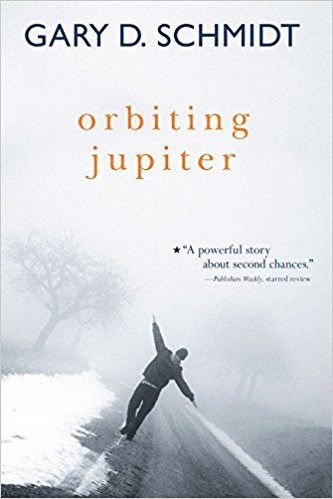
Orbiting Jupiter
by Gary D. Schmidt
★ Top 25 book of 2015 · #24 on Best Books of 2015
Told through Jack's eyes, this novel follows his bond with his foster brother Joseph, a troubled boy shadowed by an abusive father. Joseph's young daughter Jupiter, kept from him, becomes central to a deeply emotional story.
Best for: Young readers ready for a moving, tearjerking story about foster family bonds
Orbiting Jupiter is #24 on BookWard's Best Books of 2015, out of 55 2015 books that cleared our data bar.
What Orbiting Jupiter is about
Twelve-year-old Jack Hurd lives with his parents on an organic farm in Maine, and his quiet routines change when the family agrees to foster Joseph Brook. Joseph is fourteen, wary, and carrying a history that follows him into every room: a recent stay at Stone Mountain and a three-month-old daughter named Jupiter whom he has never met. Jack tells the story, and through his eyes we watch a boy who has been given very little learn to be part of a household, even as school and old threats keep pressing in.
The Hurds promise to help Joseph see his daughter, but the path to her is blocked by people with power over him and by hurt that has no easy name. Schmidt writes in a spare, tender voice about fatherhood, belonging, love and loss. It suits readers who like short, emotional novels about families made and unmade.
Orbiting Jupiter on the Best Books of 2015
Orbiting Jupiter came out in 2015. Of the 55 books first published in 2015 that met BookWard's data bar, it ranks #24 on our Best Books of 2015 list.
Why it made the list: 290 readers have shelved it on Open Library. The list ranks each year’s books on how many readers have picked them up, how highly readers rate them, and how many are reading them right now.
Nearby on the 2015 list
- Escaping Peril Tui T. Sutherland, #22
- Grey E. L. James, #23
See all Best Books of 2015 Best books by year
More years: Best Books of 2014 Best Books of 2016.
The numbers behind it
- Readers: 254 want to read it, 12 are reading it now and 24 have read it, according to Open Library.
| Signal | This book (0 to 100) | Weight |
|---|---|---|
| Reach | 45 | 55% |
| Reader love | 82 | 25% |
| Being read right now | 44 | 20% |
Questions about Orbiting Jupiter
When was Orbiting Jupiter published?
Orbiting Jupiter by Gary D. Schmidt was first published in 2015.
Was Orbiting Jupiter one of the best books of 2015?
Orbiting Jupiter is #24 on BookWard's Best Books of 2015, out of 55 2015 books that cleared our data bar. 290 readers have shelved it on Open Library.
Why is Orbiting Jupiter on the Best Books of 2015 list?
290 readers have shelved it on Open Library.
More of the best books of 2015
- Six of Crows Leigh Bardugo, #1
- The Hired Girl Laura Amy Schlitz, #2
- Queen of Shadows Sarah J. Maas, #3
- November 9 Colleen Hoover, #4
- Red Queen Victoria Aveyard, #5
- The Sword of Summer Rick Riordan, #6
See the full Best Books of 2015, the Top 100, or new books on Rising.
How we know
This page uses public data: Open Library reader counts and ratings, and Wikipedia page views for recent years. The description is paraphrased from real source text. Rankings reflect reading interest, not quality or sales, and can be affected by data gaps. Lists update monthly.
Suits mature middle-grade and young adult readers, around thirteen and up, and adults who like short, affecting novels.
Depends on the edition you pick.
A short, quiet farm novel with a terrible, tender weight. 68% taste match
 BookWard’s take
A short, quiet farm novel with a terrible, tender weight
Orbiting Jupiter is told by twelve-year-old Jack Hurd, whose Maine farm family takes in fourteen-year-old Joseph, a boy with a past and a baby daughter he has never met. It reads close to my own taste. It is short and tight, and it hooks you fast, because Jack's plain narration tells you who Joseph is almost at once. The real strength is how Joseph is drawn: through small acts, like the cold walks to school, rather than explanation. The book also holds back on sentiment, letting plain sentences carry the feeling. It is driven by story, with very little exposition, which I'm glad of. The ending resolves more than it leaves open, though it does not soften the cost.
A brisk young adult novel that keeps to one household and one winter, which suits BookWard's love of tight books.
Short chapters and a steady forward pull keep it moving, a touch quicker than the winter setting suggests.
The premise is familiar territory for young adult fiction, though the execution gives it its own shape.
The language is plain and spare, with little ornament, close to BookWard's modest lean.
What happens matters because of who it happens to, leaning character-driven like BookWard.
Real tenderness and care run through it, but grief weighs heavily, so it sits near BookWard's middle.
A straightforward first-person account told in order, more conventional than BookWard's taste.
The tone is serious and sorrowful, with only small flashes of warmth, below BookWard's lightness.
Abuse, a young father's past and loss make this the darker side of young adult fiction.
It is deeply affecting, aiming straight for the heart even as the prose stays quiet.
See all 50 dialsEvery position, side by side with this book
Where it lines up
- LengthBookWard 1 · book 1
- EndingBookWard 8 · book 8
- ExpositionBookWard 2 · book 2
Where it pulls apart
- Familiar tropesBookWard 10 · book 6
- OpeningBookWard 10 · book 8
- Internal logicBookWard 10 · book 8
A brisk young adult novel that keeps to one household and one winter, which suits BookWard's love of tight books.
The foster boy, his crime and his unseen daughter are on the table early, so it grips fast, close to BookWard's taste.
The troubled foster child is a known setup, but it avoids easy redemption, so it sits a little below BookWard.
Events follow from character and circumstance, and nothing feels arranged for convenience, which matches BookWard.
Short chapters and a steady forward pull keep it moving, a touch quicker than the winter setting suggests.
The premise is familiar territory for young adult fiction, though the execution gives it its own shape.
Joseph and Jack are built from small, specific moments rather than labels, in line with BookWard.
It closes its central question firmly rather than leaving things hazy, which BookWard prizes.
Feeling is carried by restraint and simple sentences, though it does allow itself some tenderness.
The dark turns grow out of the story's logic rather than being added for effect, which BookWard respects.
Jack's plain, watchful narration is distinctive and gives the book its personality.
This is firmly story-led, built around people and events instead of an argument, further toward story than BookWard.
Backstory arrives in scene and dialogue rather than explanation, which suits BookWard.
The book is short enough and focused enough that the middle keeps its tension.
The language is plain and spare, with little ornament, close to BookWard's modest lean.
What happens matters because of who it happens to, leaning character-driven like BookWard.
Real tenderness and care run through it, but grief weighs heavily, so it sits near BookWard's middle.
A straightforward first-person account told in order, more conventional than BookWard's taste.
The tone is serious and sorrowful, with only small flashes of warmth, below BookWard's lightness.
The prose and plot are easy to follow, and the reading is gentle even when the subject is hard.
Everything is seen through Jack alone, so it is firmly single-view.
The story moves forward in order with no jumps, more linear than BookWard.
The world is entirely realistic, a farm, a school and a river in winter.
A small circle of family, teachers and a few classmates keeps the cast tight.
It stays intimate, centered on one family and one season.
Jack's observation and feeling matter more than action, though events still drive the plot.
Short exchanges carry much of the emotion and character, a fair amount of talk without being dialogue-heavy.
Romance is a minor thread behind the story of family and fatherhood.
A Maine organic farm and foster care setting is ordinary but offers a specific, less common backdrop.
Set in a recognizably modern day, though the farm life feels slightly apart from it.
Its themes of care, loss and belonging should outlast any particular year.
Jack tells it honestly and without tricks, so the narration is reliable.
The right and wrong are fairly clear, though Joseph's past complicates easy judgments.
Description serves the cold and the farm without lingering, a little sparer than BookWard.
It is told in the first person by a child inside the events, as personal as it gets.
It stands alone as a single complete novel.
There are some turns, but the book is more about slow revelation than surprise.
It deals with heavy subjects and leaves you unsettled rather than comforted.
Abuse, a young father's past and loss make this the darker side of young adult fiction.
It is deeply affecting, aiming straight for the heart even as the prose stays quiet.
What humor there is stays gentle and dry.
Violence exists in the background and in key moments, but it is not lingered over.
The subject of a teen father is present, but there is little on the page.
Social systems like foster care are present, but politics is not the point.
The language is plain and readable throughout.
Jack shares what he sees and feels without lecturing, mostly neutral in narration.
It is rooted in a family's present moment more than in what is coming.
It believes in kindness and the power of care, but sees the cost of failing too.
Review written by BookWard, dial version 1, November 2026.
Who is Orbiting Jupiter right for?
Suits mature middle-grade and young adult readers, around thirteen and up, and adults who like short, affecting novels. It touches on teen fatherhood, abuse, violence and death, so it can be upsetting for sensitive readers.
The prose and plot are easy to follow, and the reading is gentle even when the subject is hard.
Abuse, a young father's past and loss make this the darker side of young adult fiction.
It is deeply affecting, aiming straight for the heart even as the prose stays quiet.
Violence exists in the background and in key moments, but it is not lingered over.
Book CompanionOrbiting Jupiter: ideas, characters, themes
A farm family takes in a damaged teenage father and learns what it costs, and what it means, to care for someone fully.
- A foster boy arrives. Joseph Brook, fourteen, comes to the Hurds' Maine farm with a troubled past and a daughter he has never met.
- Jack as narrator. Twelve-year-old Jack tells the story, watching Joseph closely and slowly learning who he really is.
- Walking in the cold. After an incident on the bus, Joseph and Jack walk to school together through the freezing winter, and it becomes their daily ritual.
- The river and the ice. Joseph steps onto the frozen Alliance River, and the name Maddie hints at what he carries.
- Fathers, good and bad. The story sets Mr. Hurd's steady care against the threat of Joseph's own biological father.
Characters
Jack Hurd
Narrator
A twelve-year-old farm boy who watches, questions and comes to love his foster brother.
Joseph Brook
Foster brother
A fourteen-year-old with a hard past, a baby daughter he has never seen, and a guarded heart.
Mr. Hurd
Jack's father
A steady, protective parent who turns Joseph's father away from the farm.
Mrs. Stroud
Caseworker
The social worker who tells the Hurds about Joseph's past and brings him to them.
Themes
What it takes to be a father, shown through Joseph, Mr. Hurd and Joseph's own father.
How a boy who has been cast out might find a home with strangers.
How trust must be earned slowly when someone has been hurt.
How deep attachment brings both great tenderness and great pain.
Whether a troubled young person can be seen for more than his worst act.
Discussion questions
- Why do you think Joseph closes himself off from the Hurds at first?
- What does the daily walk to school show about Jack and Joseph's bond?
- How do Mr. Hurd and Joseph's father differ in what they offer Joseph?
- Why might the author choose a twelve-year-old to narrate this story?
- What does the story suggest about how much a family can do for someone?
Personalize your Book Companion
This is the general edition. In BookWard, the Companion is written for you: your reading profile, your notes, and spoiler-safe to the page you are on.
Buy, listen or borrow Orbiting Jupiter
Each link opens a search for this book on that store, in a new tab.
Read on a device
Borrow
Reviews and community
If you liked Orbiting Jupiter
A child's wartime escape from cruelty, told with quiet force
The House of My MotherShari FrankeA daughter's memoir of the family behind 8 Passengers
TweakNic SheffA raw, first-person account of meth addiction and relapse
Semilla del DiabloIra LevinA slim, patient nightmare in a Manhattan apartment house
Find your own best books
Add what you have read, rate it, and BookWard will recommend what to read next.
Free to start. No credit card needed.