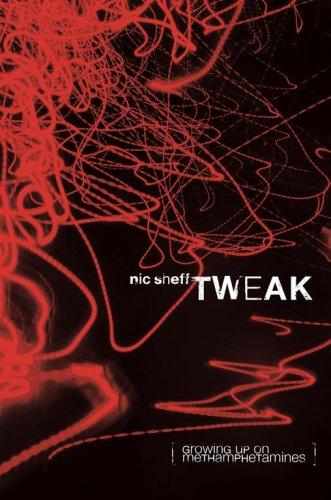
Tweak
by Nic Sheff
★ Top 25 book of 2007 · #21 on Best Books of 2007
Nic Sheff began drinking at eleven and went on to cocaine, Ecstasy, crystal meth and heroin, always believing he could quit. This raw memoir recounts a violent relapse in California and his difficult path toward recovery.
Best for: Readers who want an unflinching, honest, yet hopeful true story about addiction
Tweak is #21 on BookWard's Best Books of 2007, out of 53 2007 books that cleared our data bar.
What Tweak is about
Nic Sheff was first drunk at eleven. In the years that followed he smoked pot regularly, used cocaine and Ecstasy, and slid into addiction to crystal meth and heroin. All the while he told himself he could quit and put his life back together whenever he chose. A violent relapse one summer in California showed him otherwise.
This true account is told in a raw, confessional voice that holds nothing back about the descent or the struggle to recover. Nic is at odds with his past, his family, his substances and himself, and the book follows that fight without softening it. It is a hard read, but an honest one, and it may speak to teenagers and adults facing addiction, or to family members trying to understand what a loved one is going through.
Tweak on the Best Books of 2007
Tweak came out in 2007. Of the 53 books first published in 2007 that met BookWard's data bar, it ranks #21 on our Best Books of 2007 list.
Why it made the list: 281 readers have shelved it on Open Library. The list ranks each year’s books on how many readers have picked them up, how highly readers rate them, and how many are reading them right now.
Nearby on the 2007 list
- The Shock Doctrine Naomi Klein, #19
- Double Take Catherine Coulter, #20
- The Mysterious Benedict Society (the Mysterious Benedict Society #1) Trenton Lee Stewart, #22
- An Abundance of Katherines John Green, #23
See all Best Books of 2007 Best books by year
More years: Best Books of 2006 Best Books of 2008.
The numbers behind it
- Readers: 254 want to read it, 9 are reading it now and 18 have read it, according to Open Library.
| Signal | This book (0 to 100) | Weight |
|---|---|---|
| Reach | 57 | 55% |
| Reader love | 58 | 25% |
| Being read right now | 40 | 20% |
Questions about Tweak
When was Tweak published?
Tweak by Nic Sheff was first published in 2007.
Was Tweak one of the best books of 2007?
Tweak is #21 on BookWard's Best Books of 2007, out of 53 2007 books that cleared our data bar. 281 readers have shelved it on Open Library.
Why is Tweak on the Best Books of 2007 list?
281 readers have shelved it on Open Library.
More of the best books of 2007
- Dog Days Jeff Kinney, #1
- A Thousand Splendid Suns Khaled Hosseini, #2
- Harry Potter and the Deathly Hallows J. K. Rowling, #3
- The Titan's Curse Rick Riordan, #4
- The Name of the Wind Patrick Rothfuss, #5
- Rodrick Rules Jeff Kinney, #6
See the full Best Books of 2007, the Top 100, or new books on Rising.
How we know
This page uses public data: Open Library reader counts and ratings, and Wikipedia page views for recent years. The description is paraphrased from real source text. Rankings reflect reading interest, not quality or sales, and can be affected by data gaps. Lists update monthly.
Best suited to older teens and adults.
Depends on the edition you pick.
A raw, first-person account of meth addiction and relapse. 64% taste match
 BookWard’s take
A raw, first-person account of meth addiction and relapse
Tweak is Nic Sheff's memoir of addiction, beginning with his first drink at eleven and moving through pot, cocaine, Ecstasy, crystal meth and heroin. It centers on a violent relapse in California and the long road back. The voice is the draw: confessional, unvarnished, and willing to show the physical and mental wreckage. The narration is distinctive and unsparing, and it pulls you in fast, since the stakes of addiction are on the page from the start. The tone stays restrained, letting events carry the weight rather than inviting pity. Its darkness feels earned, because every bleak scene is tied to a real consequence. It is harrowing, but not without hope, and that balance keeps it from feeling like a lecture.
A memoir built around one relapse and recovery, short and propulsive enough to read quickly, which suits BookWard's taste for tight books.
The relapse drives the story forward fast, close to BookWard's preference for momentum.
The subject is well-trodden, but the first-person rawness gives it a fresh edge; a little under BookWard's high bar.
The writing is plain and direct, favoring immediacy over ornament, a little plainer than BookWard's mid-range.
The book is driven by the narrator's inner struggle with himself rather than by external plot.
Harrowing for most of its length, but the recovery thread leaves room for hope, a touch below BookWard's lean.
A straightforward first-person account with no formal experiments, close to BookWard's conventional-leaning middle.
This is a serious book about addiction, with little room for humor.
Drug use, self-destruction and despair are at the center of the book.
The raw first-person telling makes for an emotionally intense read.
See all 50 dialsEvery position, side by side with this book
Where it lines up
- PaceBookWard 8 · book 8
- Character depthBookWard 8 · book 8
- Authorial voiceBookWard 9 · book 9
Where it pulls apart
- Familiar tropesBookWard 10 · book 5
- Rigor (nonfiction)BookWard 9 · book 3
- LengthBookWard 1 · book 4
A memoir built around one relapse and recovery, short and propulsive enough to read quickly, which suits BookWard's taste for tight books.
The narration plunges into the damage of addiction almost immediately, matching BookWard's wish for an opening that hooks at once.
Addiction memoirs share a familiar arc, though Sheff's specific voice keeps it from feeling stock; slightly below BookWard's standard.
The account follows a clear chain of cause and consequence from drug use to relapse to recovery, which BookWard values.
The relapse drives the story forward fast, close to BookWard's preference for momentum.
The subject is well-trodden, but the first-person rawness gives it a fresh edge; a little under BookWard's high bar.
Sheff exposes his own motives, self-deceptions and contradictions in detail, which BookWard rates highly.
The road to recovery gives the book a direction and some closure, though recovery is never presented as final.
Events are told plainly rather than milked for pity, though emotion still runs hot; close to BookWard's restraint.
The darkness is tied to real consequence rather than staged for effect, which sits well with BookWard.
This is personal testimony rather than research, so rigor is low; it is not what the book sets out to do.
The voice is confessional, urgent and unmistakably Sheff's, squarely what BookWard prizes.
It is firmly story-led, following one man's lived experience rather than building an argument.
The experience is shown in scene and sensation more than explained, in line with BookWard's preference.
The relapse keeps pressure on throughout, though repetitive cycles of use can slow some stretches.
The writing is plain and direct, favoring immediacy over ornament, a little plainer than BookWard's mid-range.
The book is driven by the narrator's inner struggle with himself rather than by external plot.
Harrowing for most of its length, but the recovery thread leaves room for hope, a touch below BookWard's lean.
A straightforward first-person account with no formal experiments, close to BookWard's conventional-leaning middle.
This is a serious book about addiction, with little room for humor.
Easy to read in style, though the subject matter is heavy and emotionally taxing.
Told entirely from Sheff's own perspective as narrator.
Centered on a relapse and recovery with some looking back at earlier years, mostly linear.
A true story set in the real world with no fantastical elements.
The story stays tight around Sheff, his family and a handful of people in his orbit.
An intimate, personal story rather than a sweeping one.
Dominated by what Sheff feels and rationalizes, even when the events themselves are physical.
Scenes with family, friends and dealers carry a fair amount of spoken exchange.
Relationships appear but the central relationship is between Sheff and his addiction.
The drug world and recovery circles are unfamiliar territory for most readers, a draw for BookWard.
Set in the early years of the 2000s, recent enough to feel close to the present day.
Addiction and recovery are enduring subjects, so the book holds beyond its moment.
Sheff is honest about his own self-deception, but an addict's account of himself invites some doubt.
The book does not hand down tidy verdicts, and Sheff's choices are left messy and human.
Physical and mental effects of drug use are rendered vividly, though the style stays lean.
It is told as a story with scenes and a through line, not analysis.
Entirely personal, written from inside the experience.
A standalone memoir, though the author has written related work.
The surprises come from relapse and consequence rather than plot reversals.
The material is emotionally difficult and offers no easy comfort.
Drug use, self-destruction and despair are at the center of the book.
The raw first-person telling makes for an emotionally intense read.
Any humor is dry and rare, used briefly against a bleak backdrop.
A violent relapse and the physical toll of drugs appear, though violence is not the focus.
Sexual content appears as part of the drug-fueled lifestyle but is not the focus.
The book is personal rather than political, with little commentary on policy.
The language is plain and conversational, with some drug slang but nothing dense.
Sheff's voice is strongly judgmental, especially toward himself.
The book is concerned with the past and the present struggle, with recovery pointing gently forward.
Neither cynical nor naive, it ends on a hard-earned, cautious belief in change.
Review written by BookWard, dial version 1, November 2026.
Who is Tweak right for?
Best suited to older teens and adults. It contains frank, detailed depictions of drug use, self-harm risk and emotional distress, so it may be difficult for some readers.
Easy to read in style, though the subject matter is heavy and emotionally taxing.
Drug use, self-destruction and despair are at the center of the book.
The raw first-person telling makes for an emotionally intense read.
A violent relapse and the physical toll of drugs appear, though violence is not the focus.
Book CompanionTweak: ideas, characters, themes
Tweak is a memoir of how addiction takes hold, how relapse can happen even to someone convinced he is in control, and how recovery begins.
- Early start. Nic Sheff was drunk for the first time at age eleven, and the book traces how use escalated from there.
- A widening range of drugs. He moves from pot and cocaine to Ecstasy, crystal meth and heroin.
- The illusion of control. He believed he could quit whenever he needed to, an assumption the story steadily dismantles.
- A violent relapse. A relapse one summer in California convinces him he cannot manage his addiction alone.
- The road to recovery. The book follows his descent and then his path back, set against his strained relationships with his past and family.
Characters
Nic Sheff
Narrator and author
The memoirist whose addiction, relapse and recovery form the whole story.
Themes
How substances take over a person's choices, body and relationships.
The stories an addict tells himself about being able to quit.
The strain between Nic and the people who love him and are hurt by his use.
Recovery as a process that can fail before it holds.
Telling the truth about shame and damage as a step toward healing.
Discussion questions
- Why does Nic believe he can quit whenever he wants, and when does that belief break?
- How does the raw, unfiltered voice change the way you feel about his choices?
- What role does his family play in his addiction and in his recovery?
- Does the book glamorize drug use, or does it work against that? Where do you see it?
- What makes hope believable here, given how bleak much of the story is?
Personalize your Book Companion
This is the general edition. In BookWard, the Companion is written for you: your reading profile, your notes, and spoiler-safe to the page you are on.
Buy, listen or borrow Tweak
Each link opens a search for this book on that store, in a new tab.
Read on a device
Borrow
Reviews and community
If you liked Tweak
A sharp, sad school mystery narrated by a cynic who won't admit she cares
The House of My MotherShari FrankeA daughter's memoir of the family behind 8 Passengers
This Is MeHayden PanettiereA former child star reclaims her story, on her terms
All the Way to the RiverElizabeth GilbertA memoir of love and addiction told from inside the wreckage
Find your own best books
Add what you have read, rate it, and BookWard will recommend what to read next.
Free to start. No credit card needed.