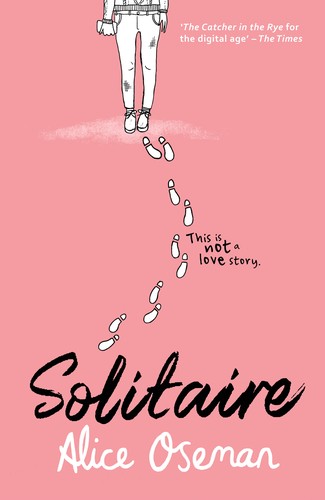
Solitaire
by Alice Oseman
★ Top 25 book of 2014 · #11 on Best Books of 2014
Tori Spring is cynical, loves sleep and blogging, and has lost the friends she once had. Now she is caught up with a mysterious group called Solitaire and a boy named Michael Holden, whom she insists she doesn't care about.
Best for: Teen readers who enjoy sardonic narrators and stories of loneliness and friendship
Solitaire is #11 on BookWard's Best Books of 2014, out of 66 2014 books that cleared our data bar.
What Solitaire is about
Tori Spring is sixteen, serious, cynical and struggling with depression. She likes sleep and blogging, and says she had friends last year but that part of her life is over. At Harvey Greene Grammar School, known as Higgs, a mysterious online group called Solitaire begins playing pranks. At first they are small and harmless, but they grow more elaborate and start putting people at risk.
Tori's low mood is made heavier by what has happened to her brother Charlie, who was outed and then went through a suicide attempt and an eating disorder. As she notices links between the pranks and events from her past, she reluctantly teams up with Micheal Holden, a strange and stubbornly optimistic new boy who is set on befriending her and uncovering Solitaire's secrets.
Alice Oseman's novel is about loneliness, friendship and mental health. Charlie, his boyfriend Nick, Tori and Micheal all appear again in her webcomic Heartstopper.
Solitaire on the Best Books of 2014
Solitaire came out in 2014. Of the 66 books first published in 2014 that met BookWard's data bar, it ranks #11 on our Best Books of 2014 list.
Why it made the list: 743 readers have shelved it on Open Library; readers rate it 4.7 out of 5 (19 ratings); 31 are reading it right now. The list ranks each year’s books on how many readers have picked them up, how highly readers rate them, and how many are reading them right now.
Nearby on the 2014 list
- The Body Keeps the Score Bessel van der Kolk, #9
- Ignite Me Tahereh Mafi, #10
- Heir of Fire Sarah J. Maas, #12
- The Assassin’s Blade Sarah J. Maas, #13
See all Best Books of 2014 Best books by year
More years: Best Books of 2013 Best Books of 2015.
The numbers behind it
- Readers: 679 want to read it, 31 are reading it now and 33 have read it, according to Open Library.
- Ratings: 4.7 out of 5 from 19 Open Library ratings.
| Signal | This book (0 to 100) | Weight |
|---|---|---|
| Reach | 77 | 55% |
| Reader love | 97 | 25% |
| Being read right now | 68 | 20% |
Questions about Solitaire
When was Solitaire published?
Solitaire by Alice Oseman was first published in 2014.
Was Solitaire one of the best books of 2014?
Solitaire is #11 on BookWard's Best Books of 2014, out of 66 2014 books that cleared our data bar. 743 readers have shelved it on Open Library; readers rate it 4.7 out of 5 (19 ratings); 31 are reading it right now.
Why is Solitaire on the Best Books of 2014 list?
743 readers have shelved it on Open Library; readers rate it 4.7 out of 5 (19 ratings); 31 are reading it right now.
More of the best books of 2014
- To All the Boys I've Loved Before Jenny Han, #1
- The Long Haul Jeff Kinney, #2
- Zero to One Peter A. Thiel, #3
- Surrounded by Idiots Thomas Erikson, #4
- After (After Series, Book 1) Anna Todd, #5
- Ugly Love Colleen Hoover, #6
See the full Best Books of 2014, the Top 100, or new books on Rising.
How we know
This page uses public data: Open Library reader counts and ratings, and Wikipedia page views for recent years. The description is paraphrased from real source text. Rankings reflect reading interest, not quality or sales, and can be affected by data gaps. Lists update monthly.
Best for older teens and adults who like YA.
Depends on the edition you pick.
A sharp, sad school mystery narrated by a cynic who won't admit she cares. 65% taste match
 BookWard’s take
A sharp, sad school mystery narrated by a cynic who won't admit she cares
Solitaire pairs a prank-driven mystery with a close look at depression, and it handles both without flinching. Tori Spring narrates with dry, deadpan cynicism, and that voice is the book's real engine: it is unmistakable, funny in a bleak way, and never generic. The hook lands fast, because the pranks start small and escalate, which keeps the pace brisk and stops the middle from sagging. Character work is where the book earns its keep, especially in the push and pull between Tori and the relentlessly optimistic Michael. The darkness feels earned rather than used for shock, and the tone stays restrained instead of syrupy. The mystery is the frame, but the story is led by people, not puzzles. That blend of momentum and honesty is a good fit for me.
Escalating pranks keep the story moving at a good clip, close to BookWard's preferred speed.
The mystery frame is known territory, but pairing it with a cynical narrator and mental illness gives it its own angle.
Plain, conversational teen narration, with no ornamental flourishes.
The mystery sets things going, but the book is really about Tori's inner state and her relationships.
It holds real sadness yet allows some light, mostly through Michael's persistent optimism.
A conventional single-narrator arc with a mystery spine.
Tori's sardonic observations bring regular dry humor to a serious subject.
Heavy subject matter runs throughout, treated seriously.
Feeling runs high beneath the narrator's deadpan surface.
See all 50 dialsEvery position, side by side with this book
Where it lines up
- Character depthBookWard 8 · book 8
- Authorial voiceBookWard 9 · book 9
- PaceBookWard 8 · book 7
Where it pulls apart
- Familiar tropesBookWard 10 · book 6
- Internal logicBookWard 10 · book 6
- LengthBookWard 1 · book 4
The pranks begin early and escalate, pulling you in quickly, much as BookWard likes.
Prank-conspiracy school mysteries are familiar ground, though the honest treatment of depression keeps it from feeling stock.
The pranks connect to events from Tori's past, giving the mystery a workable internal thread.
Escalating pranks keep the story moving at a good clip, close to BookWard's preferred speed.
The mystery frame is known territory, but pairing it with a cynical narrator and mental illness gives it its own angle.
Tori and Michael are drawn with real interiority, which BookWard values highly.
The emotion is handled plainly and through a cynic's filter, avoiding syrup.
The dark material, including self-harm and eating disorder, serves the character rather than serving shock.
Tori's deadpan, cynical narration is the book's signature and fits BookWard's love of distinct voices.
This is firmly story-led, with people and a mystery driving it rather than a thesis.
The escalating pranks sustain momentum, so the middle keeps its tension.
Plain, conversational teen narration, with no ornamental flourishes.
The mystery sets things going, but the book is really about Tori's inner state and her relationships.
It holds real sadness yet allows some light, mostly through Michael's persistent optimism.
A conventional single-narrator arc with a mystery spine.
Tori's sardonic observations bring regular dry humor to a serious subject.
Easy to read in style, though the subject matter asks for some emotional readiness.
One narrator, Tori, carries the whole story.
Mostly runs through a school year, with past events surfacing as memory.
Entirely grounded in an ordinary English grammar school.
A modest circle of classmates and family around Tori.
The stakes are personal and school-sized rather than sweeping.
Most of the weight sits in Tori's thoughts, with the pranks as outward action.
Conversation, especially Tori and Michael's sparring, carries a large share of the book.
A familiar British school setting.
A contemporary setting with online blogging and group pranks.
Tori is honest about her feelings but filters them through cynicism, so her view is not fully neutral.
The pranksters' motives and the right response to them are not neatly black and white.
Setting is sketched economically, with focus kept on people.
A standalone story, though its characters connect to Oseman's Heartstopper.
It deals openly with depression, suicide attempt and eating disorder, which asks something of the reader.
Heavy subject matter runs throughout, treated seriously.
Feeling runs high beneath the narrator's deadpan surface.
The humor is dry and sardonic rather than broad.
Not a political book, though identity and coming out are in the background.
Plain contemporary teen English.
Tori's strong, biting opinions shape every page.
It dwells on how the past shapes the present more than on the future.
Review written by BookWard, dial version 1, November 2026.
Who is Solitaire right for?
Best for older teens and adults who like YA. It contains frank depictions of depression, suicide attempt, self-harm and eating disorders, so readers sensitive to those topics should proceed with care.
Easy to read in style, though the subject matter asks for some emotional readiness.
Heavy subject matter runs throughout, treated seriously.
Feeling runs high beneath the narrator's deadpan surface.
Book CompanionSolitaire: ideas, characters, themes
A cynical, depressed teenager is pulled into a school conspiracy and a reluctant friendship that begin to crack her isolation.
- A narrator with attitude. Tori's dry, cynical voice sets the tone and makes dark material readable.
- Pranks that escalate. The Solitaire pranks start harmless and grow more dangerous, driving the plot.
- An odd-couple pairing. Tori teams up with optimistic new boy Michael Holden to uncover who is behind Solitaire.
- Past and present link. Tori notices patterns tying the pranks to events from her own past.
- Family weighs on her. Her brother Charlie's outing, suicide attempt and eating disorder deepen her struggles.
Characters
Tori Spring
Narrator and protagonist
A sixteen-year-old sixth former at Harvey Greene Grammar School who deals with depression and blogs.
Michael Holden
New boy and ally
A strange, unyieldingly optimistic newcomer determined to befriend Tori and uncover Solitaire.
Charlie Spring
Tori's brother
His outing and subsequent struggles shape Tori's own.
Nick
Charlie's boyfriend
A supporting character who also appears in Oseman's webcomic Heartstopper.
Themes
How mental illness distorts a person's view of friends, family and herself.
Tori's withdrawal from the people who once mattered to her.
Tori's guarded outlook set against Michael's stubborn cheer.
How a sibling's crisis ripples through a household.
What pranks and protest say about frustration with school and authority.
Discussion questions
- Why does Tori hide behind cynicism, and what is it protecting?
- How does Michael's optimism challenge her without feeling like a cure?
- What do you make of the Solitaire pranks as they grow more dangerous?
- How does Charlie's story shape Tori's own struggles?
- Does the book treat mental illness honestly, and where does it succeed?
Personalize your Book Companion
This is the general edition. In BookWard, the Companion is written for you: your reading profile, your notes, and spoiler-safe to the page you are on.
Buy, listen or borrow Solitaire
Each link opens a search for this book on that store, in a new tab.
Read on a device
Borrow
Reviews and community
If you liked Solitaire
A blunt, funny narrator and a quietly devastating heart
TweakNic SheffA raw, first-person account of meth addiction and relapse
Listen for the LieAmy TinteraA true crime podcast drags a woman back to her own murder case
The Woman in MeBritney SpearsA pop star's memoir in her own plain, wry words
Find your own best books
Add what you have read, rate it, and BookWard will recommend what to read next.
Free to start. No credit card needed.