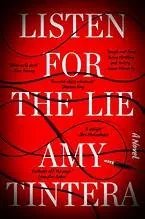
Listen for the Lie
by Amy Tintera · 2024
Best suited to adult readers and older teens comfortable with crime fiction.
360 pages, about 5.5 to 8.5 hours.
A true crime podcast drags a woman back to her own murder case. 67% taste match
The story
Listen for the Lie is a 2024 novel by Amy Tintera, filed under literary and general fiction and American literature. It runs to roughly 360 pages and is built around a murder in a small Texas town, where two women were once the most admired pair in their circle.
Lucy was found on the streets one night with her best friend Savvy's blood on her, and she has no memory of what happened. Most people concluded she was the killer. Savvy had been the town's beloved social butterfly, the subject of plenty of gossip, while Lucy had married a man with a large new house and a flashy ring. Years afterward, Lucy has relocated and built a different life far from home.
That distance is disrupted when a hugely popular true crime podcast, also named Listen for the Lie, picks Savvy's killing as the focus of its second season. Its host, Ben Owens, is looking into the case, and Lucy has to go back to the town she swore she would never visit again. The story follows her return and the question of what really took place that night, including whether she herself was responsible.
- Want to read 61
- Read 12
Most people shelving it are saving it for later.
Of 73 readers who put it on a shelf, 84% want to read it, 0% are reading it now, 16% have finished it and 0% stopped before the end.
By the numbers
- The median edition runs 360 pages. Counting about 275 words a page and an adult reading pace of 250 words a minute, that is about 6.6 hours of reading.
- Open Library tracks 5 editions from 3 publishers.
- On reader demand it ranks in the top 3% of the recent releases books in our catalog (1,627 of them).
- Libraries shelve it under Library of Congress class PS-3620.00000000.I557L5 2024.
 BookWard’s take
A true crime podcast drags a woman back to her own murder case
Listen for the Lie sets a hooky premise in motion fast: a woman with no memory of the night her best friend died, and a podcast pulling her home to face it. The opening grabs you at once, and the pace stays quick across 360 pages. It's a tight read rather than a sprawl, which suits the story. The central question, whether Lucy could be the killer, gives it real surprises and an unreliable edge. Expect the characters to matter more than the prose, and the tone to run darkly funny rather than grim. The podcast frame is familiar territory, so how much it leans on well-worn crime conventions is the thing to watch.
At 360 pages it is a brisk, contained read, which matches BookWard's preference for tight books.
The investigation structure keeps momentum high, close to BookWard's quick-moving taste.
The podcast-as-engine angle adds a modern twist, but the murder-mystery frame is familiar, short of BookWard's appetite for the original.
The writing is clean and conversational rather than ornate, a touch plainer than BookWard's middle position.
The plot's puzzle leads, but it is anchored in one woman's psyche, so it balances slightly toward plot.
A return to a painful past carries some dread, but the tone is not despairing, so it lands in the middle.
Weaving podcast framing with present-day return and recollection adds some formal play beyond a straight line.
The narrator's dark, wry humor runs through an otherwise grim case, fitting BookWard's lean toward funny.
A murder, a blood-covered survivor and small-town cruelty make it dark, though the wit lightens it.
Grief, suspicion and shame give it real feeling, tempered by the dry narration.
See all 50 dialsEvery position, side by side with this book
Where it lines up
- PaceBookWard 8 · book 8
- EndingBookWard 8 · book 8
- OpeningBookWard 10 · book 9
Where it pulls apart
- Familiar tropesBookWard 10 · book 5
- Internal logicBookWard 10 · book 7
- LengthBookWard 1 · book 3
At 360 pages it is a brisk, contained read, which matches BookWard's preference for tight books.
A woman covered in her best friend's blood opens the story with a question that grabs immediately, just what BookWard wants.
The true crime podcast and small-town secrets are well-worn ground, so it sits mid-scale, below BookWard's high bar for avoiding tropes.
A mystery built on a memory gap needs its clues to add up, and the setup promises a fair puzzle.
The investigation structure keeps momentum high, close to BookWard's quick-moving taste.
The podcast-as-engine angle adds a modern twist, but the murder-mystery frame is familiar, short of BookWard's appetite for the original.
Lucy's guilt, memory loss and complicated friendship with Savvy invite real interiority, though it stops short of BookWard's deeper drawing.
Mysteries of this kind promise an answer to what happened that night, which BookWard rewards.
Grief and friendship are present, but the tone leans sharp rather than sappy, a little softer than BookWard's restraint.
The darkness serves the central mystery rather than existing for effect, though it cannot match BookWard's strictest standard.
A sardonic, distinctive narrator voice is central to the book's appeal, close to BookWard's taste.
This is firmly story-led, driven by who did it, which is more story than BookWard's already story-leaning position.
Information arrives through scenes, interviews and memory fragments rather than lectures, in line with BookWard.
A mystery with a ticking question tends to stay propulsive, supporting BookWard's sustained-middle preference.
The writing is clean and conversational rather than ornate, a touch plainer than BookWard's middle position.
The plot's puzzle leads, but it is anchored in one woman's psyche, so it balances slightly toward plot.
A return to a painful past carries some dread, but the tone is not despairing, so it lands in the middle.
Weaving podcast framing with present-day return and recollection adds some formal play beyond a straight line.
The narrator's dark, wry humor runs through an otherwise grim case, fitting BookWard's lean toward funny.
It reads easily and quickly, a little lighter than BookWard's slightly demanding middle.
It centers on Lucy while the podcast adds outside perspectives, so it sits mid-range, below BookWard's many-voiced leaning.
The night of the murder is revisited against the present-day investigation, so time shifts without becoming tangled.
This is a grounded, realistic crime story with nothing supernatural.
A small town of friends, spouses and suspects gives a moderate cast, not a crowd.
The story stays intimate, focused on one friendship and one town.
Lucy's fractured memory pulls the story inward even as the investigation pushes outward, leaving it balanced.
Interviews, podcast exchanges and town confrontations make for talk-heavy scenes, matching BookWard's taste.
A small Texas town and a Los Angeles life are both easy to picture, so the setting feels familiar.
The podcast culture places it squarely in the present day, as BookWard likes.
Its true crime podcast moment is distinctly of now, so it may age less well than BookWard prefers.
Lucy cannot remember the crucial night and may even be guilty, making her a strongly unreliable guide, which BookWard enjoys.
Friendship, guilt and gossip blur who deserves blame, giving it the ambiguity BookWard favors.
Description serves mood and place without lingering, a little sparer than BookWard's middle.
Told close to Lucy's own experience, so the perspective is personal rather than detached.
It is a standalone novel.
A whodunit with an unreliable narrator is built on reveals, in line with BookWard's taste for surprise.
It entertains more than it unsettles, so it leans comforting compared with BookWard's challenge-seeking.
A murder, a blood-covered survivor and small-town cruelty make it dark, though the wit lightens it.
Grief, suspicion and shame give it real feeling, tempered by the dry narration.
The humor is wry and sardonic rather than slapstick, nearer dry than broad.
A murder anchors the story, but it is mostly handled through aftermath and investigation.
Rumors of affairs and a romantic thread appear, but explicit content is not the focus.
Gossip, class and small-town dynamics matter more than politics, which stay in the background.
The language is plain and conversational, easy to follow.
Lucy's strong, biting voice colors everything, making the narration pointedly opinionated.
Pulled back to a past event, the book is oriented toward what already happened.
A cynical view of gossip, friendship and small-town reputations runs through the premise.
Review written by BookWard, dial version 1, November 2026.
Who is Listen for the Lie right for?
Best suited to adult readers and older teens comfortable with crime fiction. It involves a murder, grief, rumors of infidelity and some strong language.
It reads easily and quickly, a little lighter than BookWard's slightly demanding middle.
A murder, a blood-covered survivor and small-town cruelty make it dark, though the wit lightens it.
Grief, suspicion and shame give it real feeling, tempered by the dry narration.
A murder anchors the story, but it is mostly handled through aftermath and investigation.
Book CompanionListen for the Lie: ideas, characters, themes
A woman who cannot remember the night her best friend died is forced home when a hit true crime podcast reopens the case.
- The memory gap. Lucy was found covered in Savvy's blood with no recollection of what happened, and that blank drives the story.
- The podcast frame. A hugely popular true crime show, also called Listen for the Lie, makes Savvy's death the subject of its second season.
- The return home. Lucy has built a new life in LA and must go back to the Texas town she swore she would avoid.
- Two golden girls. Lucy and Savvy were admired in their small town, one married well and the other widely loved and gossiped about.
- Is she guilty?. The story keeps open whether Lucy herself might be the killer, which keeps her narration unsettling.
Characters
Lucy
Protagonist and narrator
Found with her friend's blood on her and no memory of that night, she has since moved to Los Angeles.
Savvy
Lucy's murdered best friend
The social butterfly of their small Texas town, loved by many and the subject of rumors.
Ben Owens
Podcast host
The good-looking host of Listen for the Lie, who takes on Savvy's murder for the show's second season.
Themes
How reliable we are about our own past, especially after trauma.
The closeness, envy and secrets within a long female friendship.
How a small town decides who someone is and what they did.
What happens when real tragedy becomes public entertainment.
Whether Lucy can trust her own innocence.
Discussion questions
- Did you trust Lucy as a narrator, and when did that change?
- How does the podcast format shape what we learn and when?
- What does the book say about small-town gossip and reputation?
- Is it fair to turn a real friend's death into a public story?
- Did the ending match the way the mystery was set up?
Personalize your Book Companion
This is the general edition. In BookWard, the Companion is written for you: your reading profile, your notes, and spoiler-safe to the page you are on.
Buy, listen or borrow Listen for the Lie
Each link opens a search for this book on that store, in a new tab.
Read on a device
Borrow
Reviews and community
If you liked Listen for the Lie
A nanny, a lie, and a perfect family hiding more
The Girl on the TrainPaula HawkinsA pacy commuter thriller built on an unreliable narrator
First Lie WinsAshley ElstonA con artist in a picket-fence life, one lie from collapse
SolitaireAlice OsemanA sharp, sad school mystery narrated by a cynic who won't admit she cares
Sources: Open Library.
Track Listen for the Lie and find your next favorite
Add it to your shelf, rate what you have read, and BookWard will recommend what fits you.
Free to start. No credit card needed.