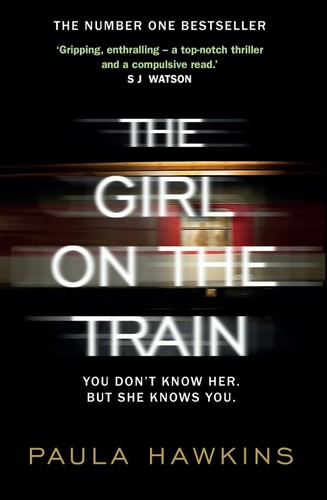
The Girl on the Train
by Paula Hawkins
★ Top 25 book of 2014 · #22 on Best Books of 2014
On her daily commute, Rachel watches a seemingly perfect couple from the train window, until she witnesses something shocking. She shares it with the police and becomes tangled in the lives of everyone involved in this debut psychological thriller.
Best for: Thriller fans who enjoy psychological suspense and Hitchcock-style tension
The Girl on the Train is #22 on BookWard's Best Books of 2014, out of 66 2014 books that cleared our data bar.
What The Girl on the Train is about
Every morning, Rachel rides the same commuter train, and every morning it halts at a signal beside a row of comfortable suburban houses. From her seat she watches one couple eating breakfast on their deck. She has named them Jess and Jason, and she feels she knows them. To her their life looks perfect, a lot like the one she recently lost. Then, in the single minute the train stands still, she sees something shocking. She goes to the police with what she knows and finds herself tangled in events and in the lives of everyone involved. Paula Hawkins's 2014 debut is a tense, dark psychological thriller that asks whether Rachel has helped or harmed.
The Girl on the Train on the Best Books of 2014
The Girl on the Train came out in 2014. Of the 66 books first published in 2014 that met BookWard's data bar, it ranks #22 on our Best Books of 2014 list.
Why it made the list: 832 readers have shelved it on Open Library; readers rate it 3.6 out of 5 (97 ratings); 60 are reading it right now. The list ranks each year’s books on how many readers have picked them up, how highly readers rate them, and how many are reading them right now.
Nearby on the 2014 list
- The Obstacle Is the Way Ryan Holiday, #20
- Everblaze Shannon Messenger, #21
- We Should All Be Feminists Chimamanda Ngozi Adichie, #23
- Maybe Someday Colleen Hoover, #24
See all Best Books of 2014 Best books by year
More years: Best Books of 2013 Best Books of 2015.
The numbers behind it
- Readers: 635 want to read it, 60 are reading it now and 137 have read it, according to Open Library.
- Ratings: 3.6 out of 5 from 97 Open Library ratings.
| Signal | This book (0 to 100) | Weight |
|---|---|---|
| Reach | 80 | 55% |
| Reader love | 6 | 25% |
| Being read right now | 85 | 20% |
Questions about The Girl on the Train
When was The Girl on the Train published?
The Girl on the Train by Paula Hawkins was first published in 2014.
Was The Girl on the Train one of the best books of 2014?
The Girl on the Train is #22 on BookWard's Best Books of 2014, out of 66 2014 books that cleared our data bar. 832 readers have shelved it on Open Library; readers rate it 3.6 out of 5 (97 ratings); 60 are reading it right now.
Why is The Girl on the Train on the Best Books of 2014 list?
832 readers have shelved it on Open Library; readers rate it 3.6 out of 5 (97 ratings); 60 are reading it right now.
More of the best books of 2014
- To All the Boys I've Loved Before Jenny Han, #1
- The Long Haul Jeff Kinney, #2
- Zero to One Peter A. Thiel, #3
- Surrounded by Idiots Thomas Erikson, #4
- After (After Series, Book 1) Anna Todd, #5
- Ugly Love Colleen Hoover, #6
See the full Best Books of 2014, the Top 100, or new books on Rising.
How we know
This page uses public data: Open Library reader counts and ratings, and Wikipedia page views for recent years. The description is paraphrased from real source text. Rankings reflect reading interest, not quality or sales, and can be affected by data gaps. Lists update monthly.
Suits adult readers and older teens comfortable with a tense psychological thriller.
Depends on the edition you pick.
A pacy commuter thriller built on an unreliable narrator. 58% taste match
 BookWard’s take
A pacy commuter thriller built on an unreliable narrator
Paula Hawkins opens with a woman watching a stranger's life from a train window, and the hook lands at once. The pace stays brisk and the short chapters keep it moving, so the middle holds. The narration is where it gets interesting: Rachel is an unreliable narrator, and the shifting viewpoints and timeline make the reader work for the picture. The ending resolves cleanly, which is satisfying after all that tangling. The prose is plain and unshowy, and the characters are drawn through their flaws more than their likability. Where it falters is originality: the domestic-thriller machinery is recognisable, and some turns will feel familiar to anyone who reads in the genre. Still, it grips and it delivers.
A brisk, compact thriller that never sprawls, which matches BookWard's preference for tight books.
Short chapters and steady revelations keep the story moving quickly, close to BookWard's own taste.
The premise of an observer pulled into a crime is fresh enough, but the genre machinery is well worn.
The writing is plain and functional, serving the plot, a little plainer than BookWard's middle ground.
It balances a puzzle plot with a character study of Rachel, leaning slightly toward character.
The tone is mostly bleak, built on addiction, loss and betrayal, with only a faint lift near the end.
Alternating narrators and dated sections add some structural play, a bit more than conventional.
There is almost no humour, as the book stays serious and tense throughout.
Deals with alcoholism, abuse and a death, making it moderately dark.
Rachel's grief and shame give it real emotional charge without tipping into excess.
See all 50 dialsEvery position, side by side with this book
Where it lines up
- PaceBookWard 8 · book 8
- EndingBookWard 8 · book 8
- OpeningBookWard 10 · book 9
Where it pulls apart
- Familiar tropesBookWard 10 · book 4
- Internal logicBookWard 10 · book 6
- OriginalityBookWard 9 · book 5
A brisk, compact thriller that never sprawls, which matches BookWard's preference for tight books.
A woman watches a couple from a train window and sees something shocking within the opening pages, hooking you at once.
The domestic-thriller setup is recognisable, with familiar beats, so it avoids tropes less than BookWard would like.
The mystery mostly fits together, though some reveals rely on convenient coincidence, short of the airtight standard BookWard wants.
Short chapters and steady revelations keep the story moving quickly, close to BookWard's own taste.
The premise of an observer pulled into a crime is fresh enough, but the genre machinery is well worn.
Rachel is drawn with real flaws and history, though others lean toward types, a little under BookWard's depth.
The central mystery is resolved decisively, which fits BookWard's liking for a fully answered ending.
It stays fairly unsentimental about its damaged characters, though it leans on emotional wounds more than BookWard prefers.
The darkness serves the plot rather than decorating it, though a few turns reach for effect.
This is fiction, so the nonfiction rigor dial does not apply.
Distinct enough through Rachel's compromised perspective, but the prose style is not strongly signature.
This is firmly story-led, driven by what happened and who did it rather than by ideas.
Information mostly arrives through scene and memory fragments, in line with BookWard's preference for showing.
The momentum holds across the middle because new questions keep surfacing, matching BookWard's wish for sustained drive.
The writing is plain and functional, serving the plot, a little plainer than BookWard's middle ground.
It balances a puzzle plot with a character study of Rachel, leaning slightly toward character.
The tone is mostly bleak, built on addiction, loss and betrayal, with only a faint lift near the end.
Alternating narrators and dated sections add some structural play, a bit more than conventional.
There is almost no humour, as the book stays serious and tense throughout.
Easy to read in sittings, though tracking whose account to trust takes some attention.
Several women narrate in turn, giving a handful of viewpoints rather than a single one.
The chapters jump between dates and layer memory over present events, so the timeline shifts often.
Entirely grounded in ordinary suburban and commuter life.
A small circle of connected people drives the whole story.
Intimate and domestic, focused on a few households and one stretch of track.
Much of the book lives in Rachel's head and memory, more than in outward action.
Conversations carry a fair share of the story but are not the main engine.
Failed marriages and affairs sit at the root of the plot, giving relationships a substantial role.
A familiar contemporary English commuter setting.
Set in the present day of its time, with contemporary commuter life.
Tied to its 2010s thriller moment, though the human core still reads clearly.
Rachel's memory gaps and self-deception make her highly unreliable, which is central to the book.
Few characters are plainly good or bad, and sympathies shift as secrets emerge.
Description is selective, focused on a few vivid images such as the train window and the houses.
This is fiction, so the nonfiction style dial does not apply.
Told in a close, personal first-person voice rather than from a detached distance.
A standalone novel.
Reveals and reversals drive much of the reading experience.
A gripping read that is more entertaining than demanding, with some unease about its characters.
Deals with alcoholism, abuse and a death, making it moderately dark.
Rachel's grief and shame give it real emotional charge without tipping into excess.
Humour is minimal and, where it appears, dry.
Violence is present and pivotal but not dwelt on at length.
Affairs and relationships feature, with little explicit content on the page.
Largely absent, as the focus stays on private lives.
Plain, accessible modern English.
The narration reflects its speakers' biases but the book itself stays fairly neutral.
It looks back at what went wrong far more than it looks forward.
A fairly cynical view of marriage, memory and the lives people present to others.
Review written by BookWard, dial version 1, November 2026.
Who is The Girl on the Train right for?
Suits adult readers and older teens comfortable with a tense psychological thriller. It deals with alcoholism, infidelity and a death, so sensitive readers may want to know that before starting.
Easy to read in sittings, though tracking whose account to trust takes some attention.
Deals with alcoholism, abuse and a death, making it moderately dark.
Rachel's grief and shame give it real emotional charge without tipping into excess.
Violence is present and pivotal but not dwelt on at length.
Book CompanionThe Girl on the Train: ideas, characters, themes
A lonely commuter who watches strangers' lives from a train window becomes entangled in a crime she thinks she witnessed.
- The window on other lives. Rachel daily watches a couple from the train and invents a perfect life for them, an image that drives the whole story.
- An unreliable narrator. Rachel's memory and self-trust are compromised, so the reader must weigh her account against others.
- Multiple women's voices. The story is told by several women in turn, building a picture from partial and conflicting views.
- Domestic secrets. Behind ordinary suburban homes sit hidden affairs, grief and lies that surface as the mystery unfolds.
- A thriller of resolution. The book builds steadily toward answers, giving the central questions a clear payoff.
Characters
Rachel
Central narrator
A commuter who takes the same train each day and watches a couple she calls Jess and Jason, grieving the life she lost.
Themes
How far a person can trust their own account of events.
Watching other lives from a distance and the stories we invent about them.
Grief for a life that has gone and the envy it breeds.
What is hidden behind apparently perfect homes and marriages.
The ways people shield themselves from painful truths.
Discussion questions
- How does knowing Rachel is unreliable change the way you weigh what she tells you?
- Why do we invent stories about strangers we only glimpse, and what does Rachel gain from it?
- Which narrator did you trust most, and did that change as the book went on?
- How does the commuter setting add to the tension and the sense of isolation?
- Does the ending feel earned, and how does it reframe what came before?
Personalize your Book Companion
This is the general edition. In BookWard, the Companion is written for you: your reading profile, your notes, and spoiler-safe to the page you are on.
Buy, listen or borrow The Girl on the Train
Each link opens a search for this book on that store, in a new tab.
Read on a device
Borrow
Reviews and community
If you liked The Girl on the Train
A stalker thriller where the watched may once have been the watcher
The GhostwriterJulie ClarkA ghostwriter is hired to write her father's confession
Home Is Where the Bodies AreJeneva RoseA family thriller where old home videos unearth a buried crime
Forget Me NotStacy WillinghamA sister's cold case reopens inside a vineyard diary
Find your own best books
Add what you have read, rate it, and BookWard will recommend what to read next.
Free to start. No credit card needed.