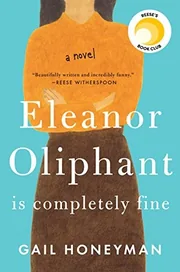
Eleanor Oliphant is Completely Fine
by Gail Honeyman · 2017
Suits adult and older teen readers who enjoy warm, character-led contemporary fiction.
352 pages, about 5.5 to 8 hours.
A blunt, funny narrator and a quietly devastating heart. 60% taste match
The story
Eleanor Oliphant Is Completely Fine is a contemporary novel by Gail Honeyman, first published in 2017 as her debut. It is shelved as women's fiction and contemporary romance, and it won the 2017 Costa Debut Novel Award. The story is set in Glasgow, Scotland, and follows Eleanor Oliphant, a woman who works in an office and keeps to a strict routine. She tends to speak her mind plainly, spends her weekends alone, and talks by phone with her mother.
Her routine is disrupted when she meets Raymond Gibbons, a colleague from the IT department. Together they come to the aid of Sammy Thom, an older man who has fallen in the street, and the three form a friendship. Eleanor also develops a crush on a singer, Johnnie Lomond. Alongside these events, the book looks at loneliness and isolation, Eleanor's difficult past, and her gradual progress toward understanding herself. Themes of mental health, counselling, social work and foster care run through the story.
Characters
Eleanor OliphantJohnnie LomondRaymond GibbonsSammy Thom
Setting
ScotlandGlasgow
Themes
Contemporary Romancemooningdry icebinge drinkingsuicidegeneral practitionersmental health counsellorsfoster care
- Want to read 291
- Reading now 5
- Read 44
Most people shelving it are saving it for later.
Of 340 readers who put it on a shelf, 86% want to read it, 1% are reading it now, 13% have finished it and 0% stopped before the end.
By the numbers
- The median edition runs 352 pages. Counting about 275 words a page and an adult reading pace of 250 words a minute, that is about 6.5 hours of reading.
- Open Library tracks 15 editions from 9 publishers, the earliest dated 2017 and the latest 2020, across 2 languages.
- On reader demand it ranks in the top 1% of the recent books in our catalog (6,647 of them).
- Libraries shelve it under Dewey 823.92 and Library of Congress class PR-6108.00000000.O55E43 2017.
 BookWard’s take
A blunt, funny narrator and a quietly devastating heart
Eleanor Oliphant is a debut built on one unforgettable voice: a Glasgow office worker whose plain speaking and rigid routine are both the joke and the wound. The voice is unmistakable, and the humor and the emotion make the book more interesting than its premise suggests, because the comedy is dry while the feeling is held back rather than poured on. It is driven by character more than plot, and it reads easily, so the pages move quickly even as the outlook stays hopeful but earned. Where it is less comfortable is in its familiar shape: the lonely-woman-finds-friendship story is well worn, even if the execution is fresh. The pace is steady rather than fast, and the opening hooks through tone more than incident.
At 352 pages it is mid-length and unhurried, a little longer than BookWard's taste for tight, short books.
It moves at a steady, readable clip built on short scenes, slightly slower than BookWard's preference for brisk.
The premise is known territory, but the narrator's way of seeing the world feels new, a partial fit with BookWard.
The language is plain and clear, with wit coming from phrasing rather than ornament, close to BookWard's taste.
The drive comes from who Eleanor is and how she changes, so it is strongly character-led, beyond BookWard's own lean.
Despite grim backstory, the book moves toward connection and recovery, which sits comfortably with BookWard's hopeful lean.
The telling is linear and conventional, with the occasional hint at a withheld past, close to BookWard's mild preference.
Eleanor's blunt literalism produces frequent laughs even amid sad material, a good match for BookWard's appetite for humour.
Suicide, trauma and neglect sit under the humour, giving it real darkness, close to BookWard's middle position.
The feeling builds and lands hard, even through Eleanor's reserve, a touch more intense than BookWard's lean.
See all 50 dialsEvery position, side by side with this book
Where it lines up
- EndingBookWard 8 · book 8
- Story or ideasBookWard 3 · book 3
- Character depthBookWard 8 · book 9
Where it pulls apart
- Familiar tropesBookWard 10 · book 4
- LengthBookWard 1 · book 5
- OpeningBookWard 10 · book 7
At 352 pages it is mid-length and unhurried, a little longer than BookWard's taste for tight, short books.
Eleanor's deadpan voice pulls you in quickly, though the draw is tone rather than a sharp event, a near match for BookWard.
The isolated misfit who is drawn out by an unlikely friend is a familiar shape, so it falls short of BookWard's tropes-averse taste.
The story hangs together and the character's behaviour makes sense once her past comes into view, in line with BookWard.
It moves at a steady, readable clip built on short scenes, slightly slower than BookWard's preference for brisk.
The premise is known territory, but the narrator's way of seeing the world feels new, a partial fit with BookWard.
Eleanor is drawn with real specificity, from her routines to her buried history, which is exactly what BookWard rewards.
The book resolves its central emotional question with care, which suits BookWard's liking for closure.
Warmth is present but tempered by dry humour and reticence, though it leans a touch more tender than BookWard's restraint.
The darker material is tied to Eleanor's past and the story's purpose, which BookWard values over shock for effect.
Eleanor's literal, formal, unintentionally funny voice is the book's greatest strength and matches BookWard's love of distinct voices.
This is firmly story-led, following one woman's days and relationships, in line with BookWard's story preference.
Much of Eleanor's inner life is told straight to the reader in her own words, which runs against BookWard's show-don't-tell lean.
The middle holds well through the friendship and the singer crush, with only slight softening, close to BookWard's standard.
The language is plain and clear, with wit coming from phrasing rather than ornament, close to BookWard's taste.
The drive comes from who Eleanor is and how she changes, so it is strongly character-led, beyond BookWard's own lean.
Despite grim backstory, the book moves toward connection and recovery, which sits comfortably with BookWard's hopeful lean.
The telling is linear and conventional, with the occasional hint at a withheld past, close to BookWard's mild preference.
Eleanor's blunt literalism produces frequent laughs even amid sad material, a good match for BookWard's appetite for humour.
The prose and plotting are easy to read, a little easier than BookWard's usual middle ground.
The story stays inside Eleanor's head throughout, which is narrower than BookWard's taste for multiple viewpoints.
Events move mostly forward in time with the past surfacing gradually, close to BookWard's mild lean.
This is a grounded, realistic story set in everyday Glasgow, more realistic than BookWard's middle position.
The focus stays on Eleanor, Raymond, Sammy and a few others, a small cast in line with BookWard.
The stakes are personal and domestic, so it is more intimate than BookWard's middle position.
Most of the action happens in Eleanor's perceptions and reflections, more inward than BookWard's balanced lean.
Conversations carry much of the humour and the friendship, but the narration still does plenty, so it sits mid-range.
A crush and a hoped-for romance run through it, but friendship is the real emotional core, so romance is secondary.
The setting is contemporary Glasgow and an office, which is familiar and not far from BookWard's leaning.
The story is set in a recognisably present-day world, matching BookWard's taste for the contemporary.
The themes of loneliness and connection last, though some details place it in the 2010s, a bit under BookWard's bar.
Eleanor's account is sincere but she misreads herself and others, which gives an unreliability BookWard enjoys.
The book is mostly sympathetic and clear about what matters, with less ambiguity than BookWard likes.
Description is functional and filtered through Eleanor's habits, which is near BookWard's middle ground.
It is a standalone novel, matching BookWard's slight preference for single books.
A revelation about Eleanor's past reshapes the story, though the plot is not built on constant surprises, near BookWard's lean.
It faces loneliness and trauma but delivers a warm payoff, so it is gently challenging, a little under BookWard's lean.
Suicide, trauma and neglect sit under the humour, giving it real darkness, close to BookWard's middle position.
The feeling builds and lands hard, even through Eleanor's reserve, a touch more intense than BookWard's lean.
The humour is dry, deadpan and observational, drier than BookWard's middle position.
There is little violence on the page and its dark past is handled with restraint, below BookWard's middle position.
The book has very little sexual content, below BookWard's middle position.
Social issues like care and isolation surface, but the book is not political, below BookWard's middle position.
The language is clear, with some Scottish touches and Eleanor's formal diction, a little easier than BookWard's middle.
Eleanor's narration is full of firm, unfiltered judgments, more opinionated than BookWard's lean.
The story moves toward a better future for its heroine, in line with BookWard's forward lean.
It believes small kindnesses can repair a life, which fits BookWard's slightly idealistic side.
Review written by BookWard, dial version 1, November 2026.
Who is Eleanor Oliphant is Completely Fine right for?
Suits adult and older teen readers who enjoy warm, character-led contemporary fiction. It touches on suicide, trauma, neglect and heavy drinking, so readers sensitive to those topics should take care.
The prose and plotting are easy to read, a little easier than BookWard's usual middle ground.
Suicide, trauma and neglect sit under the humour, giving it real darkness, close to BookWard's middle position.
The feeling builds and lands hard, even through Eleanor's reserve, a touch more intense than BookWard's lean.
There is little violence on the page and its dark past is handled with restraint, below BookWard's middle position.
Book CompanionEleanor Oliphant is Completely Fine: ideas, characters, themes
A socially isolated woman with a buried past slowly opens up through unexpected friendship and honest self-reckoning.
- A life run by routine. Eleanor's timetable of work, frozen pizza and vodka weekends keeps the world at a safe distance.
- Plain speech as comedy. Her habit of saying exactly what she thinks makes her funny and also shows how little she has been understood.
- An unlikely friendship. Meeting Raymond from IT and helping Sammy after his fall pulls her into connections she did not seek.
- The crush on a singer. Her fixation on Johnnie Lomond shows how she imagines a different life while missing what is in front of her.
- A past that explains the present. The story gradually reveals the damage behind her habits, including mental health and care experiences.
Characters
Eleanor Oliphant
Narrator and protagonist
A Glasgow office worker with strict routines, a literal way of speaking and a painful history.
Raymond Gibbons
IT colleague and friend
A bumbling, kind colleague whose warmth draws Eleanor out of isolation.
Sammy Thom
Elderly man Eleanor and Raymond help
The man who falls in the street and becomes part of their growing circle.
Johnnie Lomond
Singer Eleanor admires
The object of her crush, who stands for the future she imagines.
Themes
The ache of living without real connection, and how routine can hide it.
How a damaged past shapes behaviour and how healing can begin.
Small, steady kindnesses that rebuild a person's trust in others.
Counselling, support and the courage of asking for help.
Seeing yourself and your history clearly enough to change.
Discussion questions
- Is Eleanor's way of speaking funny, sad or both, and did that change as you read?
- How do her routines protect her, and what do they cost her?
- What does Raymond offer that Eleanor's earlier life never did?
- Why does the crush on Johnnie Lomond matter to her story?
- Did the reveal about her past change how you read earlier scenes?
Personalize your Book Companion
This is the general edition. In BookWard, the Companion is written for you: your reading profile, your notes, and spoiler-safe to the page you are on.
Buy, listen or borrow Eleanor Oliphant is Completely Fine
Each link opens a search for this book on that store, in a new tab.
Read on a device
Borrow
Reviews and community
If you liked Eleanor Oliphant is Completely Fine
A sharp, sad school mystery narrated by a cynic who won't admit she cares
Everything I Know About LoveDolly AldertonA funny, warm memoir of friendship, bad dates and growing up
The Woman in MeBritney SpearsA pop star's memoir in her own plain, wry words
Paper TownsJohn GreenA midnight caper that turns into a search for a person
Sources: Open Library.
Track Eleanor Oliphant is Completely Fine and find your next favorite
Add it to your shelf, rate what you have read, and BookWard will recommend what fits you.
Free to start. No credit card needed.