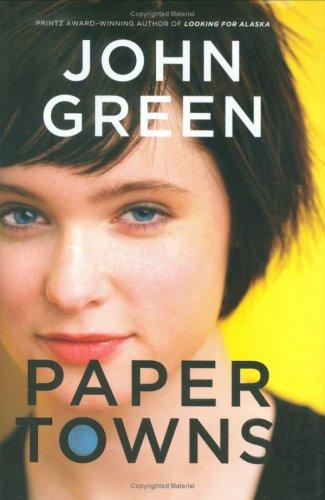
Paper Towns
by John Green
★ Top 10 book of 2008 · #9 on Best Books of 2008
Quentin Jacobsen is content with his dull routine a month before graduation, until his neighbor Margo Roth Spiegelman pulls him into a midnight adventure. Soon afterward she vanishes, leaving him with a mystery.
Best for: Teen readers who enjoy high school stories mixing adventure, romance, and a missing-girl mystery
Paper Towns is #9 on BookWard's Best Books of 2008, out of 46 2008 books that cleared our data bar.
What Paper Towns is about
Quentin Jacobsen has spent years quietly fascinated by his neighbor, Margo Roth Spiegelman. As kids, they once found something frightening together in their neighborhood park, and the memory still ties them. Now Quentin is a senior at Winter Park High School, living in a suburban Orlando subdivision, with his friends Ben and Radar beside him.
One night, a month before graduation, Margo climbs through his window and recruits him as her driver for an elaborate plan of payback against people who wronged her. Then she vanishes, and Quentin starts following the clues she seems to have left behind, among them a highlighted book of poetry and a mention of "paper towns."
Part mystery, part coming-of-age story, it is wry and a little bittersweet. John Green asks how well we ever know another person, and how easily we replace someone real with the image we have of them.
Paper Towns on the Best Books of 2008
Paper Towns came out in 2008. Of the 46 books first published in 2008 that met BookWard's data bar, it ranks #9 on our Best Books of 2008 list.
Why it made the list: 769 readers have shelved it on Open Library; readers rate it 3.8 out of 5 (77 ratings); 34 are reading it right now. The list ranks each year’s books on how many readers have picked them up, how highly readers rate them, and how many are reading them right now.
Nearby on the 2008 list
- The Graveyard Book Neil Gaiman, #7
- The Hero of Ages Brandon Sanderson, #8
- Thinking in Systems Donella H. Meadows, #10
- Just After Sunset Stephen King, #11
See all Best Books of 2008 Best books by year
More years: Best Books of 2007 Best Books of 2009.
The numbers behind it
- Readers: 599 want to read it, 34 are reading it now and 136 have read it, according to Open Library.
- Ratings: 3.8 out of 5 from 77 Open Library ratings.
| Signal | This book (0 to 100) | Weight |
|---|---|---|
| Reach | 91 | 55% |
| Reader love | 22 | 25% |
| Being read right now | 87 | 20% |
Questions about Paper Towns
When was Paper Towns published?
Paper Towns by John Green was first published in 2008.
Was Paper Towns one of the best books of 2008?
Paper Towns is #9 on BookWard's Best Books of 2008, out of 46 2008 books that cleared our data bar. 769 readers have shelved it on Open Library; readers rate it 3.8 out of 5 (77 ratings); 34 are reading it right now.
Why is Paper Towns on the Best Books of 2008 list?
769 readers have shelved it on Open Library; readers rate it 3.8 out of 5 (77 ratings); 34 are reading it right now.
More of the best books of 2008
- The Hunger Games Suzanne Collins, #1
- End of Days Sylvia Browne, #2
- The Last Straw Jeff Kinney, #3
- Amulet Kazu Kibuishi, #4
- Outliers Malcolm Gladwell, #5
- Michelle Obama in Her Own Words Michelle Obama, #6
See the full Best Books of 2008, the Top 100, or new books on Rising.
How we know
This page uses public data: Open Library reader counts and ratings, and Wikipedia page views for recent years. The description is paraphrased from real source text. Rankings reflect reading interest, not quality or sales, and can be affected by data gaps. Lists update monthly.
Suits older teens and adults who enjoy contemporary YA.
Depends on the edition you pick.
A midnight caper that turns into a search for a person. 61% taste match
 BookWard’s take
A midnight caper that turns into a search for a person
Paper Towns opens with a bang: Margo climbs through Quentin's window with an eleven-part plan, and the book never really lets go of that energy. The hook is immediate and the pace is quick, though the story is driven by character, since the real subject is how Quentin imagines Margo versus who she is. Familiar tropes are present (the mysterious dream girl, the road trip), but the book knowingly pokes at them, which gives it more freshness than you might expect. It is funny in a bright, banter-heavy way, with dialogue doing much of the work, and it ends on a restrained note rather than a syrupy one. If you like YA with some brain behind the charm, start here.
A mid-length standalone novel that keeps its story compact, which suits BookWard's preference for tight books.
The midnight escapade and the clue chase keep things moving, close to the speed BookWard likes.
The paper towns idea gives it a fresh hook, even if the genre scaffolding is well worn.
The prose is conversational and clear, with occasional lyrical flights, a bit plainer than ornate.
The mystery drives events, but the real question is about how Quentin sees Margo, so character comes first.
It carries real melancholy but moves toward growth and connection, a mildly hopeful outlook that fits BookWard.
The structure is a conventional three-part arc of night, search and journey, with little formal play.
Banter and teenage comic chemistry keep the tone light, in line with BookWard's taste for humor.
An early suicide discovery and Margo's pain give it shadow, but it stays largely light.
Feelings run warm and sometimes poignant, but not overwhelming.
See all 50 dialsEvery position, side by side with this book
Where it lines up
- Authorial voiceBookWard 9 · book 9
- OpeningBookWard 10 · book 9
- PaceBookWard 8 · book 7
Where it pulls apart
- Familiar tropesBookWard 10 · book 5
- Internal logicBookWard 10 · book 6
- LengthBookWard 1 · book 4
A mid-length standalone novel that keeps its story compact, which suits BookWard's preference for tight books.
Margo appears at Quentin's window in the opening chapters with a plan, so the book grabs hard, matching BookWard's love of immediate hooks.
The manic dream girl and road-trip structure are familiar, though the book questions them, which only partly satisfies BookWard's wish to avoid tropes.
The trail of clues holds together well enough, though the coincidences are looser than BookWard's airtight standard.
The midnight escapade and the clue chase keep things moving, close to the speed BookWard likes.
The paper towns idea gives it a fresh hook, even if the genre scaffolding is well worn.
Quentin and his friends feel drawn from life, while Margo is deliberately seen through his projections, which is the point.
It resolves the central question about Margo, though it leaves some feelings open, a little less closed than BookWard prefers.
There is warmth and some wistfulness, but it holds back from tidy sentiment, which BookWard can accept.
The darker moments grow out of the story and its characters rather than being used for effect, which BookWard values.
Green's narration is quick, self-aware and recognizable, which BookWard rewards.
It leans toward story, but the ideas about how we imagine other people drive the whole plot.
Ideas are mostly acted out and talked through in scenes, with some explaining toward the end, which BookWard likes.
The middle road stretch can feel loose, so it holds momentum less evenly than BookWard wants.
The prose is conversational and clear, with occasional lyrical flights, a bit plainer than ornate.
The mystery drives events, but the real question is about how Quentin sees Margo, so character comes first.
It carries real melancholy but moves toward growth and connection, a mildly hopeful outlook that fits BookWard.
The structure is a conventional three-part arc of night, search and journey, with little formal play.
Banter and teenage comic chemistry keep the tone light, in line with BookWard's taste for humor.
Easy to read and fast to follow, though some of the poetry references add a layer for those who want it.
Told entirely through Quentin, a single viewpoint.
The story moves forward in a straightforward order.
Entirely grounded in suburban Florida, with nothing fantastical.
A small circle of friends and classmates carries the story.
A suburban, high-school-sized story, deeply intimate in scope.
Quentin's thoughts about Margo matter as much as the capers, though events are central.
Quick, witty conversation carries a big share of the book, which BookWard enjoys.
A crush and its idealization sit at the core, but this is not a standard love story.
Suburban Florida and a high school are very familiar territory.
Set in a contemporary-feeling, late-2000s American teen world.
The theme of seeing people as they are lasts, though the setting is clearly of its decade.
Quentin is sincere but sees Margo through his own projections, so he is a mostly reliable narrator.
Right and wrong are fairly clear, though the book explores how we misjudge each other.
Settings are sketched rather than lingered over, with a moderate amount of detail.
A standalone novel.
There are some turns in the search, but it is more about revelation than shock.
It asks gentle questions about idealizing others without being heavy-handed.
An early suicide discovery and Margo's pain give it shadow, but it stays largely light.
Feelings run warm and sometimes poignant, but not overwhelming.
The humor is witty and friendly, somewhere between dry and broad.
There is almost no violence on the page.
Teen romance is mostly implied rather than explicit.
Politics is largely absent.
Language is plain and accessible throughout.
Quentin's voice shares plenty of opinions and observations.
It looks toward what comes after high school, with some nostalgia mixed in.
It critiques idealizing people while still holding to a hopeful belief in connection.
Review written by BookWard, dial version 1, November 2026.
Who is Paper Towns right for?
Suits older teens and adults who enjoy contemporary YA. It touches on an early suicide discovery, teenage drinking and romantic tension, so younger readers may want some context.
Easy to read and fast to follow, though some of the poetry references add a layer for those who want it.
An early suicide discovery and Margo's pain give it shadow, but it stays largely light.
Feelings run warm and sometimes poignant, but not overwhelming.
There is almost no violence on the page.
Book CompanionPaper Towns: ideas, characters, themes
Quentin searches for Margo and slowly learns that the person he imagined is not the person she is.
- The midnight plan. Margo arrives at Quentin's window with an eleven-part plan of payback and needs a car and an accomplice.
- The disappearance. After the night out, Margo goes missing, and her family reports her gone after a few days.
- The clues. Quentin finds items she left behind, including a highlighted copy of Whitman's Song of Myself and an address.
- Friends join in. Ben and Radar help follow the trail, with Lacey drawn in as the search continues.
- Paper towns. The title idea, drawn from the author's own road journey, frames the book's themes about things that look real but are not.
Characters
Quentin "Q" Jacobsen
Narrator and protagonist
A quiet senior who has long been fascinated by his neighbor Margo.
Margo Roth Spiegelman
The missing neighbor
A popular, adventurous classmate whom Quentin has idealized since childhood.
Ben Starling
Quentin's friend
One of Quentin's close friends who joins the search.
Marcus "Radar" Lincoln
Quentin's friend
Another close friend who helps follow the clues.
Lacey Pemberton
Margo's classmate
A peer who becomes part of the search.
Themes
Seeing a person as a story you have written about them rather than as they are.
Who we are to others versus who we are to ourselves.
The loyalty and humor of the group that helps Quentin on his search.
The shift from predictable routine toward risk and uncertainty at the end of high school.
How we fill gaps in what we know about other people with our own wishes.
Discussion questions
- Why does Quentin see Margo the way he does, and what does he miss?
- How does the idea of a paper town shape the book's meaning?
- What role do the poetry and the clues play in the search?
- How do Ben, Radar and Lacey change the story?
- Is the ending satisfying, and what do you think it says about Margo and Quentin?
Personalize your Book Companion
This is the general edition. In BookWard, the Companion is written for you: your reading profile, your notes, and spoiler-safe to the page you are on.
Buy, listen or borrow Paper Towns
Each link opens a search for this book on that store, in a new tab.
Read on a device
Borrow
Reviews and community
If you liked Paper Towns
A bully's own story, told with humor and real heart
The Fault in Our StarsJohn GreenA funny, tender teen love story that refuses easy comfort
SolitaireAlice OsemanA sharp, sad school mystery narrated by a cynic who won't admit she cares
Looking for AlaskaJohn GreenA boarding-school coming-of-age novel split by a single event
Find your own best books
Add what you have read, rate it, and BookWard will recommend what to read next.
Free to start. No credit card needed.